Is 1,400 Calories a Day Enough to Lose Weight?
This article is for educational purposes only and is not medical advice. Talk with a qualified healthcare professional before making major nutrition, weight loss, or medication-related changes.
Maybe, but 1,400 calories alone cannot answer the question. If your actual daily energy use is higher than your actual intake, there is an arithmetic energy gap. That does not tell you whether 1,400 calories is appropriate for you, whether the foods provide enough nutrients, or how quickly your weight might change.
The current Dietary Guidelines for Americans, 2025–2030 says calorie needs depend on age, sex, height, weight, and physical activity. The CDC also notes that health conditions, medications, and other circumstances can affect weight management. A fixed number cannot be a universal recommendation for women, men, or adults in general.
What the evidence supports
- Eating 1,400 calories is not the same as having a 1,400-calorie deficit.
- Whether 1,400 is below estimated energy needs depends on individual inputs and uncertain assumptions.
- A federal guide includes a 1,400-calorie food-group pattern, but it is not a recommendation for every adult.
- A calorie total by itself does not establish nutrient adequacy or predict a specific rate of weight change.
- Static “calorie gap to pounds per week” tables oversimplify a dynamic process.
Eating 1,400 Calories vs. a 1,400-Calorie Deficit
These phrases describe different things:
- A food record showing 1,400 calories a day describes estimated recorded intake.
- A 1,400-calorie deficit would mean eating 1,400 fewer calories than the energy used over the same period. That is a much larger claim.
- Burning 1,400 calories can refer to total daily energy use or to an activity estimate. It does not say what someone ate.
Search queries often mix these ideas together. This article is about an intake of 1,400 calories per day, not a 1,400-calorie daily deficit and not an exercise-calorie target.
Compare 1,400 With Estimated Daily Energy Use
The only direct calculation is subtraction. The examples below are arithmetic illustrations, not safety labels or weight-loss forecasts.
| Illustrative estimated total daily energy expenditure (TDEE) | Recorded intake | Arithmetic difference |
|---|---|---|
| 1,600 calories | 1,400 calories | 200 calories |
| 1,900 calories | 1,400 calories | 500 calories |
| 2,200 calories | 1,400 calories | 800 calories |
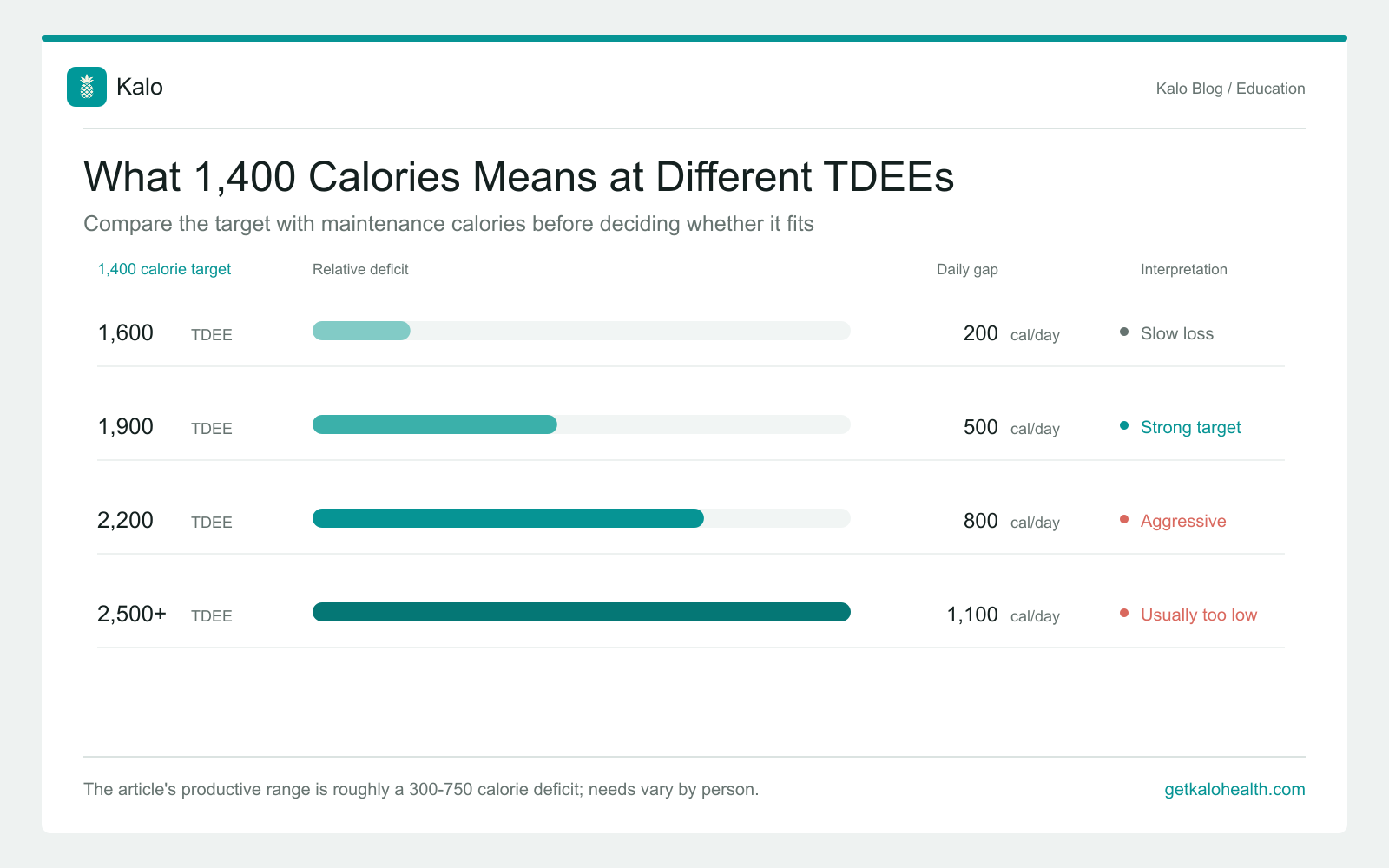
Each TDEE number is still an estimate. Kalo's TDEE calculator uses a population equation and an activity multiplier. Activity selection is subjective, and the calculation cannot account for every difference in body composition, health, medication, or metabolism. The complete assumptions are documented in the calculator methodology.
Why This Table Does Not Predict Weekly Weight Loss
Multiplying a daily calorie difference by seven and converting it directly into pounds treats weight change as linear. NIDDK explains that methods which do not account for metabolic slowing can overestimate weight loss. Its Body Weight Planner uses a dynamic adult model instead. NIDDK also describes the limitation of the static 3,500-calorie rule and the research behind its dynamic model.
Even a dynamic model is a planning estimate. It cannot promise what one person will lose, and a recorded food total may differ from actual intake because portions, recipes, labels, and database matches are imperfect.
What Does a 1,400-Calorie Food Pattern Look Like?
There is no single 1,400-calorie menu. The federal Daily Servings by Calorie Level guide provides one food-group pattern at that calorie level:
| Food group | Federal 1,400-calorie pattern | One serving example from the guide |
|---|---|---|
| Protein foods | 2 to 2½ servings | 3 oz cooked meat, poultry, or seafood; 1 egg; or ½ cup beans, peas, or lentils |
| Dairy | 2½ servings | 1 cup milk, ¾ cup yogurt, or 1 oz cheese |
| Vegetables | 1¾ servings | 1 cup raw or cooked vegetables, or 2 cups leafy greens |
| Fruit | 1½ servings | 1 cup raw fruit or ½ cup dried fruit |
| Whole grains | 1¾ to 3¼ servings | ½ cup cooked oats, brown rice, barley, quinoa, or buckwheat; or 1 slice of bread |
| Healthy Fats | 2½ teaspoons | 1 teaspoon olive oil or butter per serving |
This table shows how the federal guide distributes food groups at 1,400 calories. It does not establish that 1,400 calories is right for you or that every menu assembled from those groups will meet your individual needs. The guide itself notes that foods within a group vary in calories and nutrients.
Is 1,400 Enough for a Woman or a Man?
Sex can be one input in an energy-requirement equation, but it does not create a universal calorie target. The USDA DRI Calculator for Healthcare Professionals also asks for age, height, weight, and activity. It warns that individual requirements may be higher or lower than its recommendations.
That is why this page does not use a women's “floor,” a men's “floor,” or body-type cards to decide who should eat 1,400 calories. Those shortcuts turn population estimates into individual prescriptions.
When This Page Is Not an Appropriate Planning Tool
NIDDK limits its Body Weight Planner to adults 18 and older and says it should not be used by people who are pregnant or breastfeeding. This article follows the same scope. If you are under 18, pregnant, or breastfeeding, do not use this page to set a calorie target.
The CDC notes that medicines, medical conditions, stress, genes, hormones, environment, and age can affect weight management. If your question depends on a health condition, medication, or other individual medical context, discuss the target with a qualified healthcare professional. This page does not evaluate those factors. See the CDC's current Steps for Losing Weight page.
A Better Way to Evaluate the Number
- Start with an individualized estimate. Use a tool that asks for more than sex alone, and read its scope and limitations.
- Keep arithmetic separate from prediction. Estimated TDEE minus 1,400 is a calculated difference, not a promised rate of loss.
- Evaluate food and nutrient coverage. A calorie total does not show whether the selected foods meet individual nutrient needs.
- Account for uncertainty. Energy-use estimates and food records both contain assumptions that can change the apparent gap.
- Use qualified support when the decision is clinical. A professional who knows your history can evaluate factors this article and its calculators do not collect.
Frequently Asked Questions
Does everyone lose weight at 1,400 calories?
No. An arithmetic gap exists only when actual energy use is higher than actual intake. Neither number is known perfectly, and weight response changes over time.
How much weight will I lose on 1,400 calories?
This page cannot predict an individual result. Static calorie-to-pound calculations can overestimate longer-term change, which is why NIDDK uses a dynamic model.
Is 1,400 calories too little?
The number alone cannot establish that. Energy and nutrient needs vary, and a calorie total does not describe the foods selected or a person's health context.
Is 1,200 or 1,400 calories better?
They differ by 200 calories, but that arithmetic does not determine which is appropriate. Compare any target with an individualized estimate and nutrient needs instead of assuming lower is better.
Why might my result differ from a calculator?
Activity assumptions, individual energy use, food portions, recipes, database matches, and changing expenditure can all create differences. A calculator is an estimate, not a diagnosis.
What Kalo Can and Cannot Do
Kalo accepts typed meal descriptions and returns nutrition estimates that users can review and edit. Kalo cannot determine whether 1,400 calories is appropriate for you, measure your actual daily energy use, or guarantee a weight outcome. This page does not present a Kalo-specific accuracy percentage.
How This Page Was Prepared
AI-assisted tools materially contributed to claim screening, source research, drafting, and a separate adversarial review. Kalo is responsible for the final wording and publication. Sources were checked again on September 14, 2026. This article has not been medically reviewed and does not provide a personal calorie prescription.
Primary Sources
- Dietary Guidelines for Americans, 2025–2030 (U.S. Departments of Agriculture and Health and Human Services)
- Daily Servings by Calorie Level (Dietary Guidelines for Americans, 2025–2030)
- DRI Calculator for Healthcare Professionals (USDA National Agricultural Library)
- Body Weight Planner (National Institute of Diabetes and Digestive and Kidney Diseases)
- Body Weight Simulator (NIDDK)
- Research Behind the Body Weight Planner (NIDDK)
- Steps for Losing Weight (Centers for Disease Control and Prevention)
Related Articles

Do You Count Cooking Oil Calories? How to Log Oil and Spray
Yes. A tablespoon of olive oil has about 119 calories, and a spray labeled 0 calories is not zero. See how to measure an...
Can ChatGPT Count Calories? What the Research Shows
ChatGPT put calories within 10% of a nutritionist reference for under half of 222 foods. See when a chat estimate works...
Why Don't Calories Match the Macros on a Food Label?
Rounding, fiber, and sugar alcohols can make calories differ from a 4-4-9 macro calculation. See two worked examples and...
Know what to eat next.
Kalo sets your daily calorie and macro targets and suggests meals that fit your goals, your diet, and what you have left today.