Is 1200 Calories a Day Enough, or Is It Too Little?
This article is for educational purposes only and is not medical advice. Talk with a qualified healthcare professional before making major nutrition, weight loss, or medication-related changes.
1,200 calories a day can be enough for some smaller, less-active adults, but it is too little for many people. It may support weight loss when it creates a manageable calorie deficit and the diet still meets nutrition needs; for larger, more active adults, it can create an unnecessarily aggressive deficit.
The useful question is not whether 1,200 is a universal minimum. It is how far 1,200 sits below your total daily energy expenditure (TDEE), whether you can build balanced meals within it, and how your hunger, energy, health, and weight trend respond. Start with the free calorie deficit calculator instead of choosing the lowest target an app will allow.
Key Takeaways
- 1,200 calories is not automatically safe, unsafe, or effective. The size of the deficit and the person's needs determine the answer.
- Some clinical weight-loss plans use 1,200-1,500 calories for women, but guidelines say to adjust the target for body weight, activity, preferences, and health status.
- 1,200 is usually too low when it creates a very large deficit or causes persistent fatigue, dizziness, excessive hunger, poor recovery, or rapid loss.
- BMR is not a universal calorie floor. Compare the target with full daily needs and the quality of the diet rather than using one equation as a safety test.
- Use 2-4 weeks of trend data to calibrate the estimate, unless symptoms or medical concerns mean you should seek professional guidance sooner.
Is 1200 Calories Enough? The Quick Answer
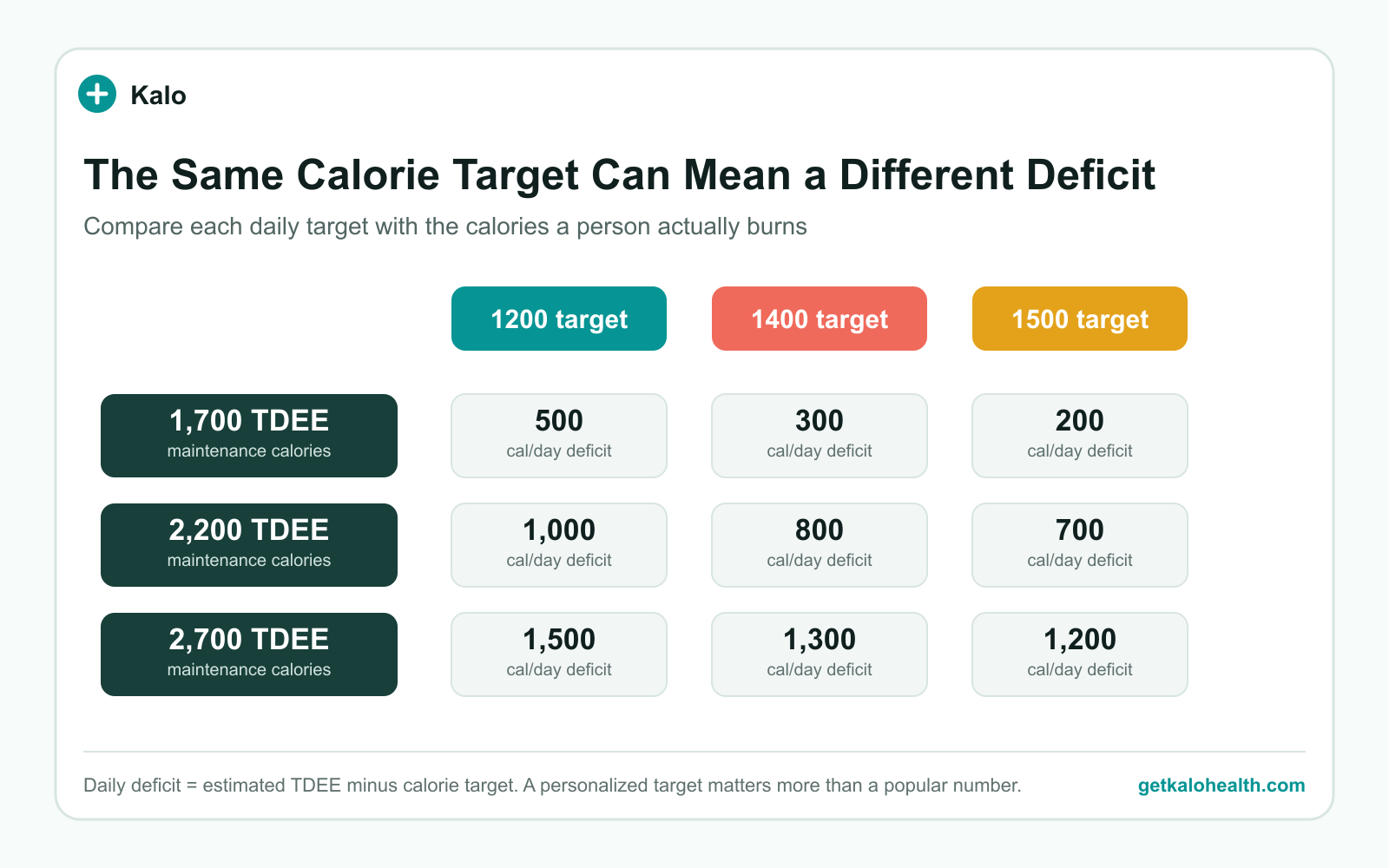
1,200 calories is enough only when it creates a reasonable deficit and leaves room for adequate nutrition. The same intake can be modest for one person and extreme for another. This table shows why maintenance calories matter more than the target by itself.
| Estimated maintenance | Deficit at 1,200 | How to read it |
|---|---|---|
| 1,500 calories | 300/day | A modest mathematical gap, but nutrition and individual context still matter |
| 1,700 calories | 500/day | A common planning deficit; monitor hunger, energy, and trend weight |
| 2,000 calories | 800/day | More aggressive and often harder to fuel well |
| 2,400 calories | 1,200/day | A very large gap that should not be self-selected casually |
These are planning examples, not prescriptions. Maintenance estimates and food logs are imperfect, and weight change is not perfectly linear. Use observed trends or the NIH Body Weight Planner for a more individualized forecast.
What Is a 1200-Calorie Diet?
A 1,200-calorie diet is an eating pattern in which meals, snacks, and caloric drinks total about 1,200 calories per day. It is a low-calorie target, not a specific menu or food philosophy. A very-low-calorie diet is generally defined much lower—typically below 800 calories per day—and is a medically supervised intervention, not a do-it-yourself plan.
Adult obesity-treatment guidelines have used ranges of 1,200-1,500 calories for women and 1,500-1,800 for men, while emphasizing adjustment for body weight, activity, preferences, and health status. Those ranges describe possible clinical starting points for adults who would benefit from weight loss; they do not make 1,200 the right target for every woman or anyone outside that context.
Is 1200 Calories a Day Too Little?
For many adults, yes. A target is more likely to be too low when the gap from maintenance is large, there is little room for a varied diet, or it repeatedly causes persistent hunger, fatigue, dizziness, irritability, poor concentration, or declining exercise performance.
Do not use BMR as a rigid "never eat below this number" rule. BMR estimates energy used at rest, while TDEE includes normal movement and exercise. A better decision uses the full deficit, diet quality, medical context, symptoms, and actual rate of change. If 1,200 feels too restrictive, compare the tradeoffs in the guide to 1,500 calories and review the calculator limitations.
Is 1200 Calories Good for Weight Loss?
It can produce weight loss when it is below maintenance, but a lower target is not automatically a better one. A plan that is unnecessarily aggressive can make it harder to get enough protein, fiber, fats, and micronutrients or to maintain normal activity. A somewhat higher target may still create progress while being easier to repeat.
Start by understanding how a calorie deficit works. Then treat the first 2-4 weeks as calibration: compare weekly average weight, intake consistency, hunger, energy, and training rather than assuming the calculator's first estimate is exact.
Is 1200 Calories Enough for a Woman or a Man?
Sex affects calorie estimates, but it cannot answer the question by itself. A smaller, older, less-active woman may get a modest deficit from 1,200 calories, while a taller or active woman may get a much larger one. Because adult men often have higher energy needs, 1,200 is below the common clinical range used for men and will be too restrictive for most.
Height, weight, age, activity, health conditions, medications, pregnancy or breastfeeding, and a history of disordered eating can all change the decision. Children and teenagers should not use an adult calorie target, and pregnant or breastfeeding people should seek individualized guidance rather than dieting from a generic number.
How Much Weight Can You Lose Eating 1200 Calories a Day?
The answer comes from the deficit, not from 1,200 alone. If maintenance is near 1,700 calories, the initial gap is about 500 per day. If maintenance is near 2,000, the gap is about 800. Simple calorie math can provide a starting estimate, but the NIH Body Weight Planner accounts for changing energy needs over time and is more useful than multiplying one week forever.
Daily weight can also move because of water, sodium, glycogen, digestion, and menstrual-cycle changes. Judge progress from weekly averages over several weeks. If you are losing rapidly, feel unwell, or cannot meet basic nutrition and recovery needs, increase the target and speak with a qualified clinician or registered dietitian.
What Can a Balanced 1200-Calorie Day Look Like?
A 1,200-calorie budget is tight, so each meal needs to do more nutritional work. This example is a layout—not a prescription—and portions vary by brand and preparation:
Example Meal Structure
- Breakfast (about 300 calories): Greek yogurt or a fortified alternative, berries, and oats
- Lunch (about 350 calories): Chicken, tofu, or beans with vegetables, a grain, and measured dressing
- Snack (about 150 calories): Fruit with a small portion of nuts, cheese, or yogurt
- Dinner (about 400 calories): Fish, poultry, tofu, or legumes with vegetables, potatoes or rice, and measured oil
The example shows the constraint: drinks, restaurant meals, oils, sauces, and larger portions can use the budget quickly. If balanced meals leave you persistently hungry or under-fueled, that is evidence to revisit the target rather than force the menu smaller.
What Should You Do Before Choosing 1200 Calories?
- Estimate maintenance calories. Use age, height, weight, and activity as a starting estimate rather than accepting a default app floor.
- Calculate the actual deficit. A 300-calorie gap and a 1,000-calorie gap should not be treated as the same diet.
- Check the meal pattern. Make sure there is room for protein-rich foods, fruit and vegetables, fiber-rich carbohydrates, and dietary fats.
- Track the easy-to-miss items. Cooking oil, dressings, drinks, sauces, and unrecorded snacks can materially change the total.
- Review 2-4 weeks of trends. Use average weight, hunger, energy, and performance. Adjust sooner if symptoms or medical concerns appear.
Frequently Asked Questions
Is 1200 calories a day too little?
It is too little for many adults, especially when it creates a large deficit or cannot support a varied diet and normal activity. It may be workable for some smaller, less-active adults, but the target should be individualized.
Is 1200 calories enough to lose weight?
It can cause weight loss when it is below maintenance calories. The better question is whether the resulting deficit is manageable and the diet remains nutritionally adequate.
Is 1200 calories good for weight loss?
It may be appropriate for some adults, but it is not a universal best target. A higher calorie level can still produce weight loss and may leave more room for balanced meals, activity, and adherence.
Why am I not losing weight on 1200 calories?
First confirm the trend over several weeks and review portions, drinks, cooking fats, activity, medications, and normal water-weight changes. If your record is reliable and the trend remains flat, use a clinician or registered dietitian to review the estimate instead of cutting lower automatically.
Should I eat below my BMR to lose weight?
BMR is an estimate of resting energy use, not a universal intake floor. Use total daily needs, the size of the deficit, diet quality, symptoms, and professional guidance when needed to choose a target.
How Kalo Helps You Evaluate a Calorie Target
A calorie target becomes useful only when you can compare it with a food record. Kalo lets you photograph a meal and returns an estimated calorie and macro breakdown that you can review and edit. Correcting portions and adding easy-to-miss oils, sauces, and drinks makes the estimate more useful.
Photo logging is not a laboratory measurement and should not decide whether a restrictive diet is medically appropriate. Its practical value is making it easier to collect a consistent, editable record before you change the target again.
Calculate a realistic starting target, then use Kalo to build a food record you can review instead of relying on memory.
Sources
Related Articles

Do You Count Cooking Oil Calories? How to Log Oil and Spray
Yes. A tablespoon of olive oil has about 119 calories, and a spray labeled 0 calories is not zero. See how to measure an...
Can ChatGPT Count Calories? What the Research Shows
ChatGPT put calories within 10% of a nutritionist reference for under half of 222 foods. See when a chat estimate works...
Why Don't Calories Match the Macros on a Food Label?
Rounding, fiber, and sugar alcohols can make calories differ from a 4-4-9 macro calculation. See two worked examples and...
Know what to eat next.
Kalo sets your daily calorie and macro targets and suggests meals that fit your goals, your diet, and what you have left today.