This article is for educational purposes only and is not medical advice. Talk with a qualified healthcare professional before making major nutrition, weight loss, or medication-related changes.
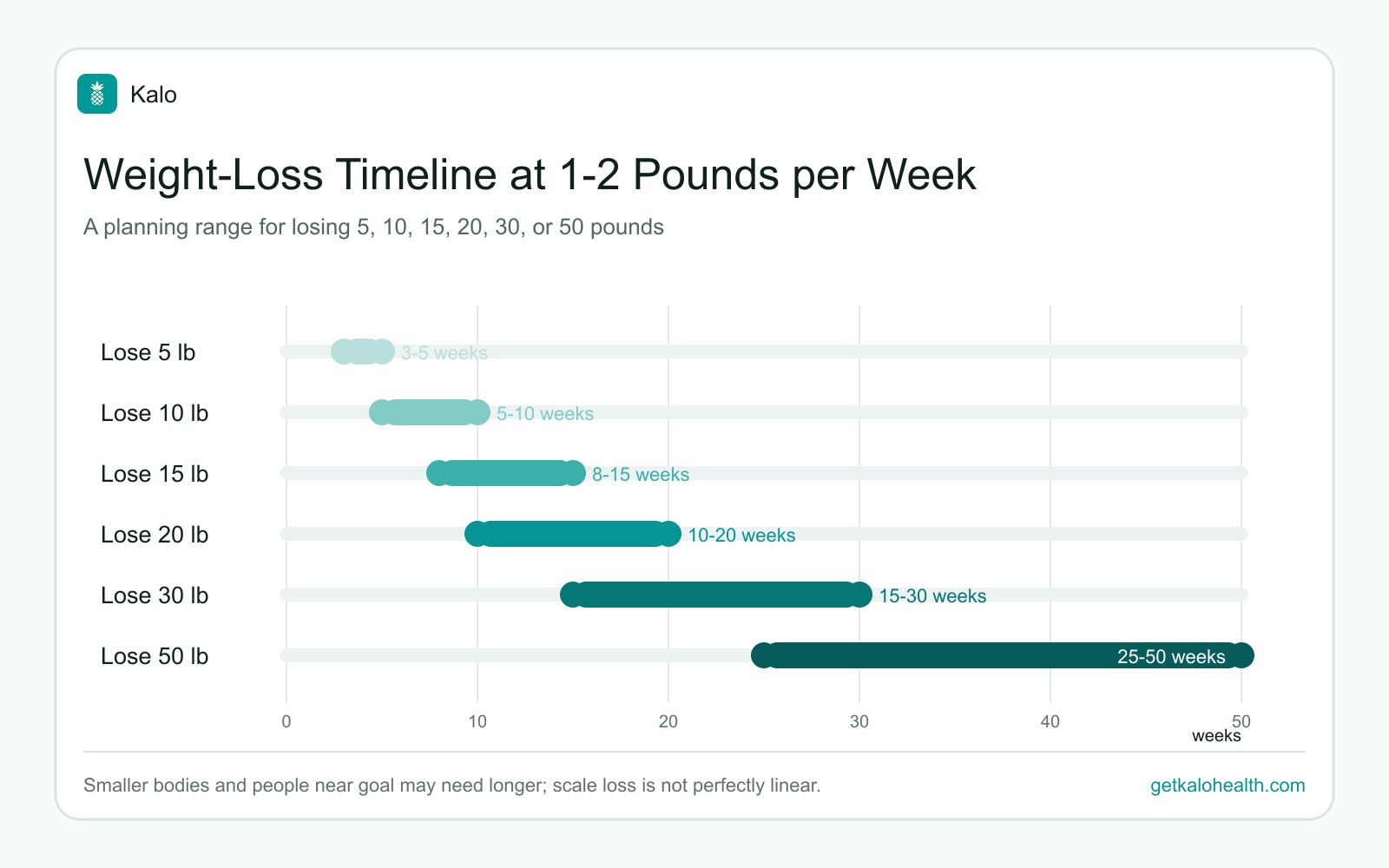
Losing 15 pounds usually takes about 8 to 15 weeks at a gradual rate of 1 to 2 pounds per week. If you are smaller, already near your goal weight, or using a modest deficit, 15 to 30 weeks may be more realistic.
The scale may drop faster during the first week because lower food intake, carbohydrates, and sodium can reduce water and glycogen. That early change is real scale loss, but it is not the same as losing 15 pounds of body fat, so the most useful plan is built around months rather than a crash-diet deadline.
Key Takeaways
- Most adults need 8 to 15 weeks to lose 15 pounds at 1 to 2 pounds per week.
- A 500-calorie daily deficit points to roughly 15 weeks, while a 750-calorie deficit points to about 10 weeks as a planning estimate.
- Fifteen pounds in one month is too aggressive for most people because it requires a deficit near 1,750 calories per day.
- Fifteen pounds in two months can be possible, but it requires nearly 2 pounds per week and fits larger bodies better than smaller ones.
- The 3,500-calorie rule is only a starting estimate; calorie needs fall as body weight drops, so real progress rarely stays perfectly linear.
- Tracking trend weight and calorie-dense extras is more useful than reacting to one weigh-in or cutting food harder after a slow week.
What Is a Realistic 15-Pound Weight-Loss Timeline?
A realistic 15-pound weight-loss timeline is the amount of time needed to lose mostly body fat while keeping the calorie deficit manageable. The CDC describes about 1 to 2 pounds per week as a gradual pace that is more likely to stay off, which puts 15 pounds at roughly 8 to 15 weeks.
That range is a guide, not a promise. Someone starting at 250 pounds may be able to sustain a larger deficit than someone starting at 145 pounds, while medications, sleep, stress, activity, and medical conditions can all change the pace. For many adults, 10 to 15 weeks is the most useful expectation because it allows for slower weeks, normal water fluctuations, and the occasional maintenance day.
How Long Does It Take to Lose 15 Pounds at Different Calorie Deficits?
The table below uses the practical estimate that 3,500 calories is roughly equivalent to 1 pound of fat. It is useful for setting a starting timeline, but it is not exact: your body burns fewer calories as it gets lighter, and some early weight change comes from water and lean tissue rather than fat.
| Daily deficit | Estimated weekly loss | Time to lose 15 pounds | Typical fit |
|---|---|---|---|
| 250 calories | ~0.5 lb/week | ~30 weeks | Smaller bodies or people near goal |
| 500 calories | ~1 lb/week | ~15 weeks | A practical starting point for many adults |
| 750 calories | ~1.5 lb/week | ~10 weeks | Larger or more active adults |
| 1,000 calories | ~2 lb/week | ~8 weeks | Aggressive and unsuitable for many adults |
Use the calorie deficit calculator to estimate a target from your own maintenance calories rather than choosing the fastest row. A 750-calorie deficit may be comfortable for someone who burns 2,800 calories per day and far too restrictive for someone who burns 1,750.
Can You Lose 15 Pounds in One Month?
Losing 15 pounds of body fat in one month is not realistic for most adults. The rough math requires a total deficit near 52,500 calories, or about 1,750 calories every day for 30 days. That is larger than many people can create while still eating enough food to support normal health, training, and daily life.
A 15-pound scale change can happen in a month for someone with a high starting weight, especially when the first several pounds are water and glycogen. It can also happen during medically supervised treatment. For most people dieting independently, however, 4 to 8 pounds in the first month is a more useful expectation, with the rest of the 15-pound goal taking another month or two.
Can You Lose 15 Pounds in Two Months?
Losing 15 pounds in two months means averaging about 1.9 pounds per week. That sits near the aggressive end of the commonly recommended range, so it may be achievable for a larger adult with enough maintenance calories to create the deficit. It is less realistic for someone smaller, leaner, or already close to goal weight.
Two-Month Target
- About 1.9 pounds per week
- Roughly a 900-calorie daily deficit
- Little room for tracking error or maintenance days
- Too aggressive for many smaller adults
Three-Month Target
- About 1.25 pounds per week
- Roughly a 600-calorie daily deficit
- More room for normal fluctuations and social meals
- More repeatable for many adults
If you are deciding between a short sprint and a steadier plan, start with our guide on planning a 10-pound goal. A larger goal usually needs a longer observation window, but an individual timeline should not be promised from arithmetic alone.
Is Losing 15 Pounds Noticeable?
Fifteen pounds is noticeable for many people, but the visual change depends on starting weight, height, fat distribution, and whether muscle is preserved. It equals 10% of body weight for a 150-pound person, 7.5% for a 200-pound person, and 6% for a 250-pound person.
You may notice changes in your waist, face, and clothing before the mirror looks dramatically different. Photos, waist measurements, and the fit of the same pair of pants can show progress that daily scale checks miss. Our guide to when weight-loss results become visible explains why your own perception and other people's reactions often arrive at different times.
What Is the Best Plan to Lose 15 Pounds?
The best plan is one that keeps the deficit measurable for at least 10 to 15 weeks. A dramatic first week matters less than whether the same food and movement pattern still feels workable in week eight.
- Estimate maintenance calories and subtract 300 to 750. Start near the smaller end if you are shorter, lighter, less active, or close to goal. Avoid choosing a calorie target simply because it promises the shortest timeline.
- Give every meal a protein anchor. Eggs, Greek yogurt, chicken, fish, tofu, beans, cottage cheese, and lean meat make a deficit easier to tolerate and help preserve lean mass.
- Track the calorie-dense parts of the plate. Oils, dressings, cheese, sauces, nut butter, alcohol, and restaurant portions create more timeline drift than vegetables or lean protein. When you photograph a burrito bowl in Kalo, review rice, meat, cheese, guacamole, and sauce separately instead of accepting one vague bowl estimate.
- Build a repeatable activity floor. The CDC recommends at least 150 minutes of moderate activity each week plus two days of muscle-strengthening work. Walking is a useful way to increase the deficit without making every workout intense.
- Weigh consistently and use a 7-day average. Compare weekly averages under similar conditions. Sodium, carbohydrates, digestion, menstrual-cycle changes, and soreness can hide fat loss for several days.
- Wait two to three weeks before adjusting. If the average is not moving after accurate tracking, reduce intake by about 100 to 200 calories or add a manageable amount of movement. Do not react to one flat week.
- Practice maintenance before declaring victory. Once the 15 pounds are off, keep logging and gradually return toward maintenance calories. The skill that keeps weight off is noticing when portions and routines begin drifting again.
Why Does Weight Loss Slow Before You Reach 15 Pounds?
Weight loss slows because the body is dynamic. A lighter body needs less energy to move and maintain, so the same food intake creates a smaller deficit after several pounds are gone. Hunger, reduced spontaneous movement, and imperfect adherence can narrow the gap further.
This is why multiplying a fixed 500-calorie deficit by a calendar can overpromise the exact finish date. Use the first four weeks as a calibration period: compare your planned loss with your real trend, then update the timeline. A plan that produces 0.8 pounds per week is working even if an online estimate promised 1 pound.
When Is a 15-Pound Goal Too Aggressive?
Slow down and consider professional guidance if the plan causes persistent dizziness, fainting, exhaustion, worsening workouts, obsessive food rules, binge-restrict cycles, or rapid loss that continues beyond the first few weeks. A lower number on the scale is not worth losing normal function or a healthy relationship with food.
Talk with a qualified clinician or registered dietitian before intentional weight loss if you are pregnant or breastfeeding, under 18, underweight, recovering from an eating disorder, managing diabetes or kidney disease, or taking medication that affects appetite, blood sugar, or body weight. A clinician can also help determine whether losing 15 pounds is appropriate for your height and health history.
Frequently Asked Questions
How long does it take to lose 15 pounds with a 500-calorie deficit?
The simple estimate is about 15 weeks because a 500-calorie daily deficit is roughly 1 pound per week. Real progress may take slightly longer as energy needs decrease and adherence varies.
How long does it take to lose 15 pounds with a 750-calorie deficit?
A 750-calorie daily deficit points to about 1.5 pounds per week, or roughly 10 weeks for 15 pounds. That deficit is reasonable for some larger or active adults but too aggressive for many smaller people.
Can you lose 15 pounds in two months?
It is possible, but it requires an average near 1.9 pounds per week and a daily deficit around 900 calories. A three- or four-month timeline gives most people more room to eat adequately and handle normal slow weeks.
Can walking help you lose 15 pounds?
Yes, walking can increase daily energy use and support the calorie deficit, but food intake still matters. A consistent walking habit works best as one part of a plan rather than an attempt to erase meals through exercise.
Will losing 15 pounds change your clothing size?
It often changes how clothes fit, especially around the waist, but there is no universal pounds-per-size conversion. Height, starting weight, body shape, muscle, and clothing brands all affect when a full size change happens.
Sources
- Steps for Losing Weight - Centers for Disease Control and Prevention
- Body Weight Planner - National Institute of Diabetes and Digestive and Kidney Diseases
- Adult Activity Guidelines - Centers for Disease Control and Prevention
- Energy Content of Weight Loss During Caloric Restriction - CALERIE and Kiel studies
How Kalo Helps You Lose 15 Pounds Without Guessing
A 10- to 15-week plan does not require perfect eating, but it does require enough visibility to catch repeated calorie gaps. Restaurant oils, dressings, drinks, sauces, and larger-than-expected portions can quietly turn a planned 500-calorie deficit into maintenance.
Kalo makes meal logging faster with AI-powered photo tracking. Snap a meal, review the calorie and macro estimate, and correct the components that matter most. That gives you a practical record of the week without manually searching a database for every ingredient.
Ready to turn a 15-pound goal into a measurable plan? Download Kalo to log meals in seconds, review your intake, and keep the deficit honest.
Related Articles

Can ChatGPT Count Calories? What the Research Shows
ChatGPT put calories within 10% of a nutritionist reference for under half of 222 foods. See when a chat estimate works...
Why Don't Calories Match the Macros on a Food Label?
Rounding, fiber, and sugar alcohols can make calories differ from a 4-4-9 macro calculation. See two worked examples and...

What to Eat for Dinner Based on Your Remaining Calories and Protein
Compare three dinner combinations, check cooked portions, and use your remaining calories and protein as planning estima...
Know what to eat next.
Kalo sets your daily calorie and macro targets and suggests meals that fit your goals, your diet, and what you have left today.