
The Kalo Blog
Tips, insights, and guides to help you reach your health goals
From calorie-deficit basics to meal-prep strategies, Kalo publishes educational guides. Articles found to have unresolved source or claim issues are removed from this listing while they are corrected. Inclusion here does not mean an article was clinically reviewed; check each page's sources, limitations, and review disclosure.
The information provided is for educational purposes only and should not replace professional medical advice. Consult a healthcare provider before making significant dietary or lifestyle changes, especially if you have health conditions, take medications, are pregnant or breastfeeding, or have a history of eating disorders.

Active Calories vs Total Calories: Which Should You Use?
Active calories leave out resting energy and total calories include it. See which number to add to a calorie target, with worked examples.
Do You Count Cooking Oil Calories? How to Log Oil and Spray
Yes. A tablespoon of olive oil has about 119 calories, and a spray labeled 0 calories is not zero. See how to measure and log cooking fats.
Can ChatGPT Count Calories? What the Research Shows
ChatGPT put calories within 10% of a nutritionist reference for under half of 222 foods. See when a chat estimate works and when to use a food log.
Why Don't Calories Match the Macros on a Food Label?
Rounding, fiber, and sugar alcohols can make calories differ from a 4-4-9 macro calculation. See two worked examples and what to check before changing your log.

What to Eat for Dinner Based on Your Remaining Calories and Protein
Compare three dinner combinations, check cooked portions, and use your remaining calories and protein as planning estimates, not rigid rules.

How Many Calories Does Walking 3,000 Steps Burn?
3,000 steps burn about 85-230 total calories depending on weight and cadence. See estimates, active calories, distance, and walking time.

How Many Calories Does a 15-Minute Walk Burn?
A 15-minute walk burns about 40-140 total calories depending on your weight and pace. See estimates by weight, speed, steps, and active calories.
How Many Steps Does It Take to Burn 100 Calories?
A 2,000-3,000-step walk burns about 100 calories for many adults, but weight, pace, and incline change the result. See estimates from 50 to 500.

How Many Calories Does a 2-Hour Walk Burn?
A 2-hour walk burns about 340-1,100 total calories at common weights and paces. See estimates by weight, speed, distance, and active calories.

How Many Calories Does a 40-Minute Walk Burn?
A 40-minute walk burns about 115-365 calories at common paces, depending on body weight. See the chart, distance, steps, and weight-loss math.
Is Cal AI Accurate? What the Evidence Actually Shows
52 AI food-image studies found calorie errors from 0.1% to 38.3%. See what that evidence can—and cannot—tell you about Cal AI accuracy.
How Many Calories Does a 1-Hour Walk Burn?
A 1-hour walk burns about 160-470 calories at common paces, depending on body weight. See estimates by weight, speed, incline, and active calories.
Is 1900 Calories a Day Enough to Lose Weight?
1,900 calories can produce about 1 pound of loss per week at 2,400 maintenance. See who it fits, meal math, and how to test it.
What to Eat on GLP-1: High-Protein Foods and a Simple Plan
20-30g of protein per meal can help make smaller GLP-1 meals count. See easy foods, meal ideas, hydration tips, and what to limit.
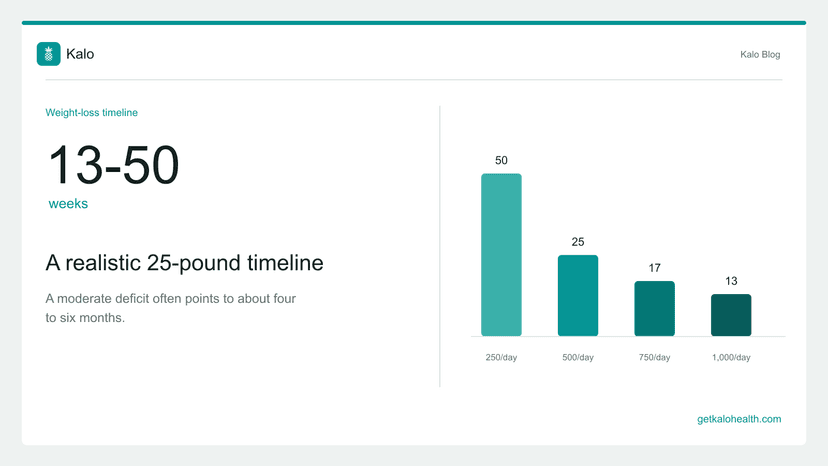
How Long Does It Take to Lose 25 Pounds?
25 pounds takes about 13-50 weeks to lose at 0.5-2 pounds per week. See realistic timelines, calorie math, and when to adjust.
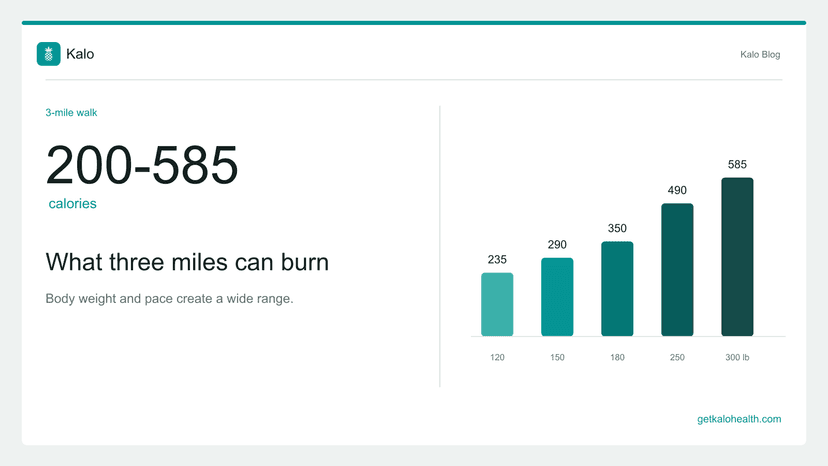
How Many Calories Does Walking 3 Miles Burn?
3 miles of walking burns about 200-585 calories depending on body weight and pace. See the chart, time, steps, and weight-loss math.
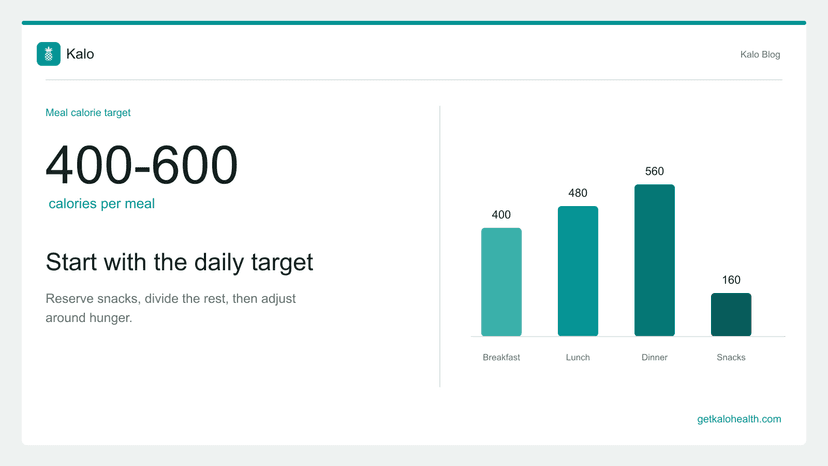
How Many Calories Should I Eat per Meal to Lose Weight?
400-600 calories per meal fits many weight-loss plans, but your daily target and snack budget decide the right split. See exact examples.
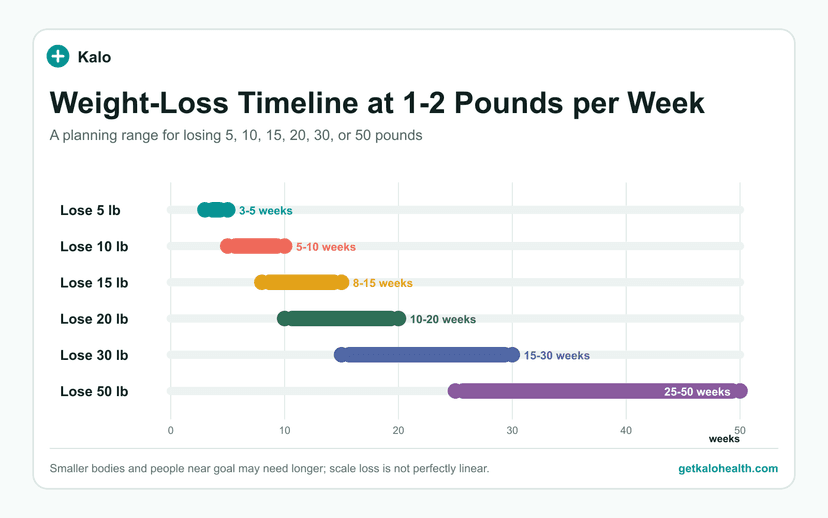
How Long Does It Take to Lose 15 Pounds?
15 pounds takes about 8-30 weeks to lose safely, depending on body size and deficit. See realistic timelines and a practical plan.
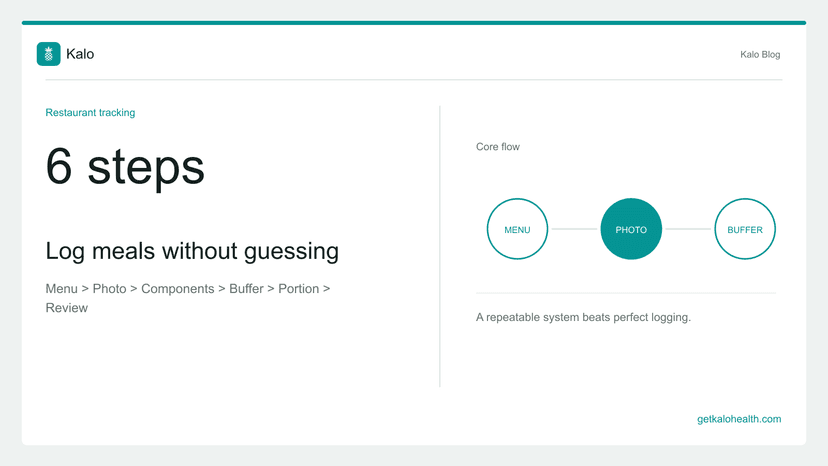
How to Track Calories When Eating Out: 6 Steps
6 restaurant tracking steps help you log calories when eating out without guessing. Use menu labels, photo logs, and hidden-oil buffers.
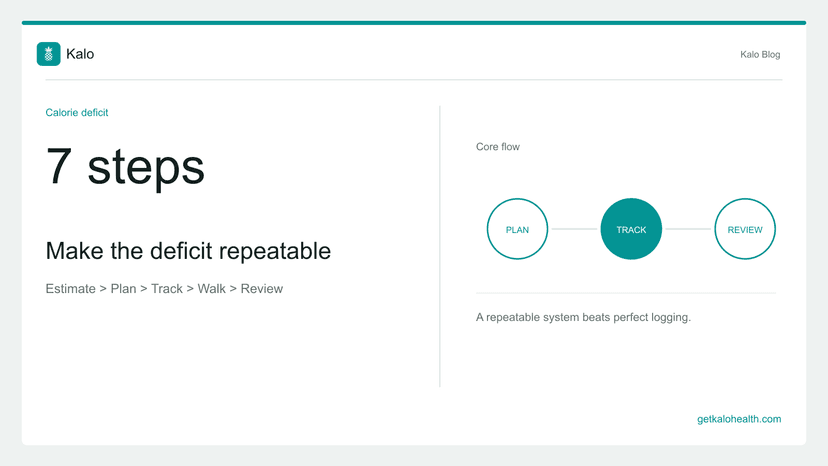
How to Stay in a Calorie Deficit: 7 Steps That Work
7 repeatable habits help you stay in a calorie deficit without crash dieting. Use this checklist to close the tracking gaps that erase progress.
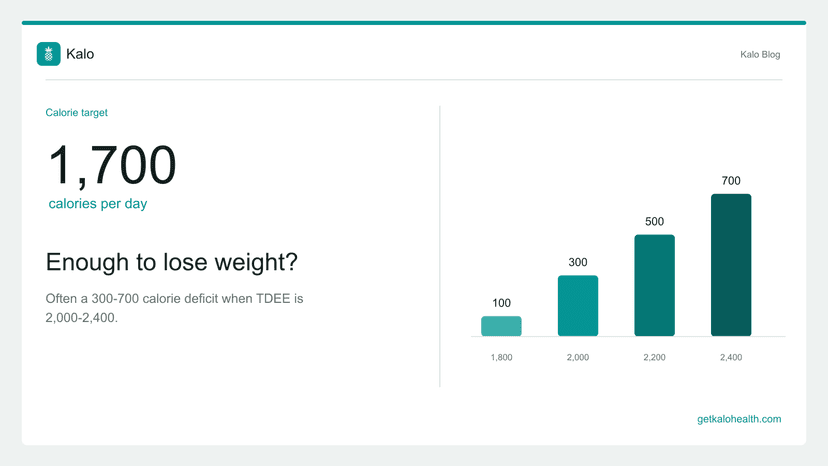
Is 1700 Calories a Day Enough to Lose Weight?
1700 calories is enough for most women and some smaller men to lose weight. Here's who it fits, expected loss, and when to eat more.
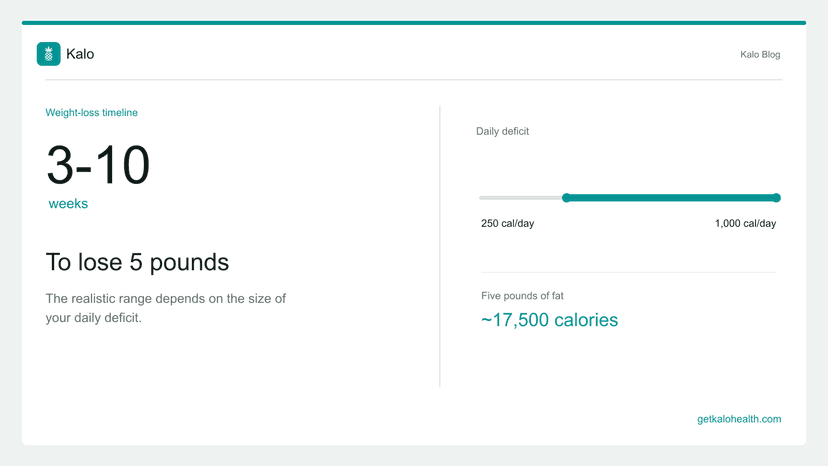
How Long Does It Take to Lose 5 Pounds?
5 pounds of fat takes about 3-10 weeks to lose safely, depending on your calorie deficit. Here's the realistic timeline and plan.
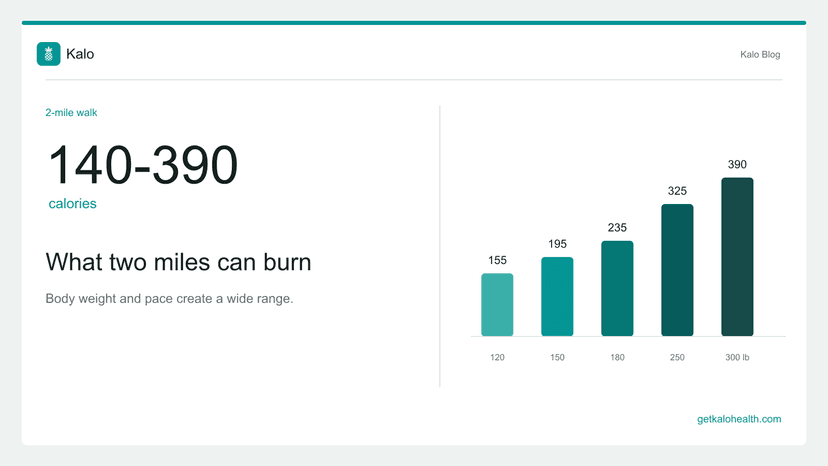
How Many Calories Does Walking 2 Miles Burn?
2 miles of walking burns about 140-390 calories depending on weight and pace. See the chart, formula, and weight-loss math.
Is 1300 Calories a Day Enough to Lose Weight?
1300 calories is enough for some petite women but too low for most men and active adults. Here's who it fits and safer targets.
How Many Calories Does Walking a Mile Burn?
1 mile of walking burns about 60-160 calories depending on body weight and pace. See the chart, formula, and weight-loss math.
Best Calorie Counter App for Weight Loss? 6 Apps Compared (2026)
Kalo, MyFitnessPal, Lose It!, Cronometer, MacroFactor, and Cal AI compared on how you log food, what is free, and who each app fits, from official listings.
How to Calculate Calories in Homemade Food: Recipe & Portion Math
Add ingredient calories, then calculate your portion by cooked weight or equal servings. Worked examples explain raw vs. cooked entries, oil, and leftovers.
How to Track Calories With Photos: 6 Steps That Work
10 seconds is enough to track calories with photos when the app can see each food. Use this 6-step method to improve accuracy and catch hidden calories.
How to Calculate TDEE for Men: Formula and Examples
Most men have a TDEE of 2,200 to 3,000 calories. Here's the male Mifflin-St Jeor formula, activity multipliers, and worked examples to find yours.
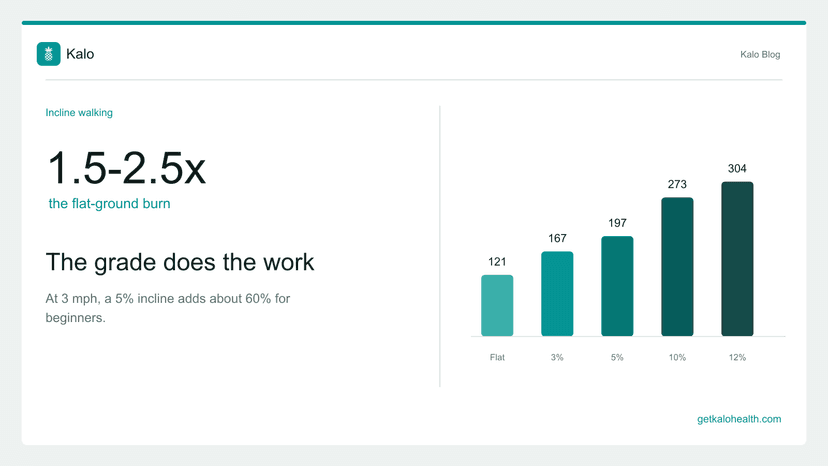
How Many Calories Does Incline Walking Burn? 12-3-30 Included
Incline walking burns 1.5 to 2.5x more than flat walking: about 250 to 425 calories per 30 minutes at a 12% grade. Here are exact charts by weight.
How to Lose 10 Pounds in 2 Weeks: What's Actually Possible
Losing 10 pounds of pure fat in 2 weeks isn't realistic, but you can drop 4 to 8 pounds on the scale. Here's the exact 14-day plan and the math.
How to Calculate TDEE for Women: Formula and Examples
Most women have a TDEE of 1,600 to 2,400 calories. Here's the female Mifflin-St Jeor formula, activity multipliers, and examples to find yours.
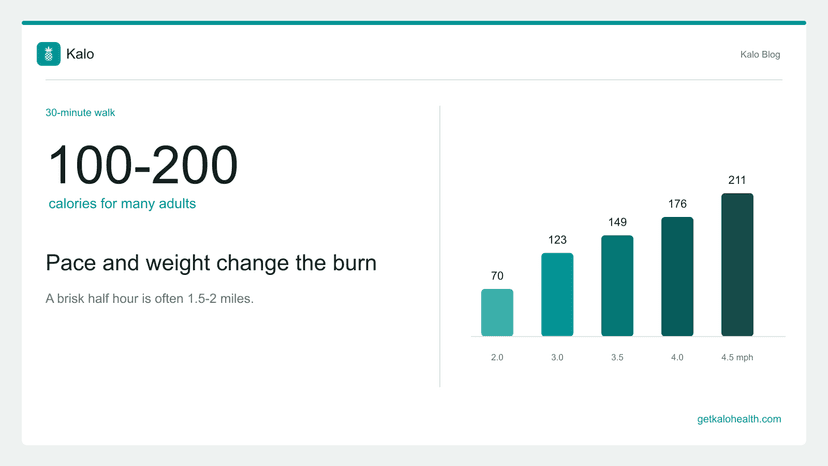
How Many Calories Does a 30-Minute Walk Burn?
A 30-minute walk burns about 120 to 210 calories at a brisk pace, depending on your weight. See exact numbers by weight and speed, plus what it means for weight loss.
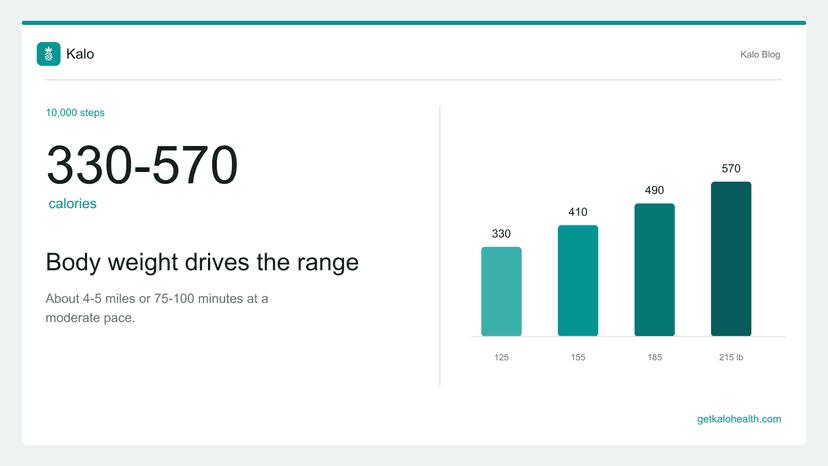
How Many Calories Does Walking 10,000 Steps Burn?
Walking 10,000 steps burns roughly 330 to 570 calories, about 40 per 1,000 steps, depending on your weight. See exact charts by weight and step count.
How Many Calories Does Cycling Burn? Exact Numbers by Speed and Weight
Cycling burns 400 to 1,000 calories per hour, or 7 to 16 per minute, by weight and speed. See exact burn charts for road, spin, and Peloton rides.
Walking vs Running for Weight Loss: Which Burns More Fat?
Running burns ~2x more calories per minute than walking, but walking captures 60-80% per mile with less injury risk. Here's which wins for fat loss.
Is 1,400 Calories a Day Enough to Lose Weight?
A 1,400-calorie intake may be below estimated energy needs for some adults, but the number alone cannot show whether it is appropriate, nutritionally adequate, or likely to produce a specific result.
How Long Does It Take to Lose 50 Pounds? A Realistic Timeline
Losing 50 pounds takes 6-12 months at a safe 500-1,000 calorie daily deficit. Here's the realistic timeline, calorie math, and step-by-step plan.
Is 1600 Calories a Day Enough to Lose Weight?
1600 calories creates a 300-500 calorie deficit for most women (about 1 lb/week) but is too aggressive a cut for most men. Here's who loses at 1600.
How Long Does It Take to Lose 30 Pounds? A Realistic Timeline
At an assumed 1–2 pounds weekly, 30 pounds would take 15–30 weeks. See why that arithmetic is not a forecast and how to review a goal.
How to Lose Weight Without Exercise: 8 Methods That Work
Weight loss is roughly 80% diet. Most adults lose 1-2 lbs per week with a 500-calorie deficit alone, no workouts. Here are 8 proven methods that work.
Is 2500 Calories a Day Enough to Lose Weight?
2500 calories creates a moderate deficit for active or large men (0.4-1.4 lbs/week) but sits at maintenance for most women. Here's who loses at 2500.
How Many Calories Should a Man Eat to Lose Weight?
Most men lose weight at 1,800-2,400 calories per day, a 500-750 deficit below TDEE. Here's the exact number by age, height, and activity level.
How Many Calories Should a Woman Eat to Lose Weight?
Most women lose weight at 1,400-1,600 calories per day, a 500 calorie deficit below their TDEE. Here's the exact number by age, height, and activity.
Is 1000 Calories a Day Enough to Lose Weight?
1000 calories is below BMR for most adults and is medically classified as a Very Low-Calorie Diet. Here's why it backfires and what to eat instead.
How Long Does It Take to See Weight Loss Results? A Realistic Timeline
Most people see scale changes in 1-2 weeks and notice their own progress at 4-6 weeks. Others typically notice after 8-9 pounds of loss.
How Accurate Are AI Calorie Counter Apps? What Tests Show
Four photo calorie apps logged 102 weighed meals about a third too low in a 2026 test by NIH researchers. See the evidence and how to correct an estimate.
How Much Weight Can You Lose in a Month? A Realistic Answer
A safe rate of fat loss is 4-8 pounds per month. The first month often shows 6-12 pounds because of water weight. Here's the real math by starting weight.
Is 2000 Calories a Day Enough to Lose Weight?
2000 calories creates a moderate deficit for most men (0.8-1.6 lbs/week) but sits at maintenance for average women. Here's who loses weight at 2000.
Is 1800 Calories a Day Enough to Lose Weight?
1800 calories creates a 500-800 calorie deficit for most men (1-1.6 lbs/week) but sits near maintenance for smaller women. Here's how to tell if it's right for you.
How Many Steps a Day to Lose Weight? A Science-Backed Answer
Walking 7,000-10,000 steps daily with a calorie deficit burns 0.5-1 pound of fat per week. Here's the exact step count for your weight and goal.
Cal AI Alternatives: 6 Calorie Tracking Apps Compared (2026)
MyFitnessPal owns Cal AI. Compare Kalo, SnapCalorie, MacroFactor, Cronometer, MyFitnessPal, and Lose It! on photo logging, what is free, and who each fits.
How Long Does It Take to Lose 20 Pounds? A Realistic Timeline
At an assumed 1–2 pounds weekly, 20 pounds would take 10–20 weeks. See why that arithmetic is not a forecast and how to review a goal.
How Many Calories Does Running Burn? Exact Numbers by Pace and Weight
Running burns 10-17 calories per minute depending on pace and weight. Here are exact calorie burn charts for every weight and speed.
Should I Eat Back Exercise Calories? Why It Stalls Weight Loss
Fitness trackers overestimate calorie burn by 30-93%, and most calorie targets already include exercise. Here's when to eat back exercise calories and when to skip them.
How to Lose 10 Pounds: How Long It Takes and a 6-Step Plan
Losing 10 pounds usually takes about 5-10 weeks at a gradual pace. See the timeline, calorie math, and a 6-step plan you can adjust.
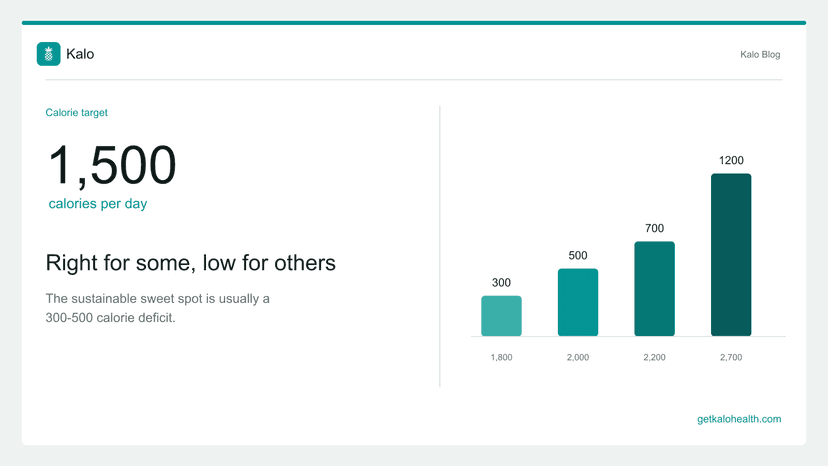
Is 1500 Calories a Day Enough to Lose Weight?
1,500 calories can support weight loss when it creates a moderate deficit. See who it fits, expected weekly loss, and when it is too low.
Best Foods to Eat in a Calorie Deficit and Stay Full
Foods under 1.5 cal/gram let you eat big portions while losing weight. Here are the best proteins, carbs, fats, and snacks for a sustainable calorie deficit.
What Happens If You Eat Too Few Calories? 8 Side Effects of Undereating
Eating under 1,200 calories slows metabolism by up to 25%, triggers muscle loss, and causes rebound weight gain. Here are 8 signs you're undereating.
What Is BMR and How Do You Calculate It? A Guide to Basal Metabolic Rate
Your BMR accounts for 60-75% of your daily calorie burn. Here's how to calculate yours using the Mifflin-St Jeor equation and use it to set the right calorie target for weight loss.
How to Calculate Your Macros for Weight Loss: A Step-by-Step Guide
See how calorie estimates and fixed macro percentages translate into protein, carbohydrate, and fat examples, plus the limits of using a preset split.
How to Lose Belly Fat: What Actually Works According to Science
Visceral belly fat is the first fat your body burns in a calorie deficit. Here are the proven strategies to lose belly fat, from diet and exercise to sleep and stress management.
How to Track Calories Without Weighing Food: A Practical Guide
Track calories without a scale using labels, household measures, and a worked meal example. Learn what to check and when to accept an estimate.
How to Lose Weight Without Counting Calories: 7 Methods That Work
People who eat whole, unprocessed foods naturally eat 500 fewer calories per day. Here are 7 proven methods to lose weight without tracking a single number.
Why Am I Not Losing Weight in a Calorie Deficit? 7 Reasons and How to Fix Them
47% of dieters underestimate their calorie intake. Here are 7 science-backed reasons your deficit isn't working and exactly how to fix each one.
What Should I Eat for Breakfast to Lose Weight?
A high-protein breakfast (25-30g) cuts daily calorie intake by up to 400 calories. Here are the best breakfast foods, 5 quick recipes, and what to avoid.
Why Does My Weight Fluctuate So Much Day to Day?
Daily weight swings of 2-5 pounds are completely normal and caused by water, sodium, and glycogen — not fat. Here's what drives fluctuations and how to track real progress.
Does Stress Make You Gain Weight? How Cortisol Affects Your Diet
Chronic stress raises cortisol by up to 50%, increasing appetite and belly fat storage. Here's how stress drives weight gain and 6 ways to stop it.
How to Calculate Your TDEE: A Simple Guide to Total Daily Energy Expenditure
Most adults burn 1,600-3,000+ calories daily. Learn how to calculate your TDEE using the Mifflin-St Jeor formula and use it to lose weight, build muscle, or maintain.
How Much Fat Should I Eat Per Day? A Guide to Healthy Fat Intake
Most adults need 44-78g of fat daily (20-35% of calories). Here's how to find your ideal fat intake for weight loss, muscle gain, or maintenance.
How Many Carbs Should I Eat Per Day? A Guide Based on Your Goals
Most adults need 150-300g of carbs daily, but 100-150g works best for weight loss. Here's how to find your ideal carb intake based on your body and goals.
How Much Protein Do I Need Per Day? A Simple Guide by Body Weight and Goal
Most adults need 0.7-1g of protein per pound of body weight daily — far more than the RDA minimum. Here's how to calculate your exact target based on your goal.
How to Count Calories: A Step-by-Step Guide for Beginners
Estimate your needs, log everything you eat and drink, get calories from labels or a nutrition database, and review weekly. Includes worked label math.
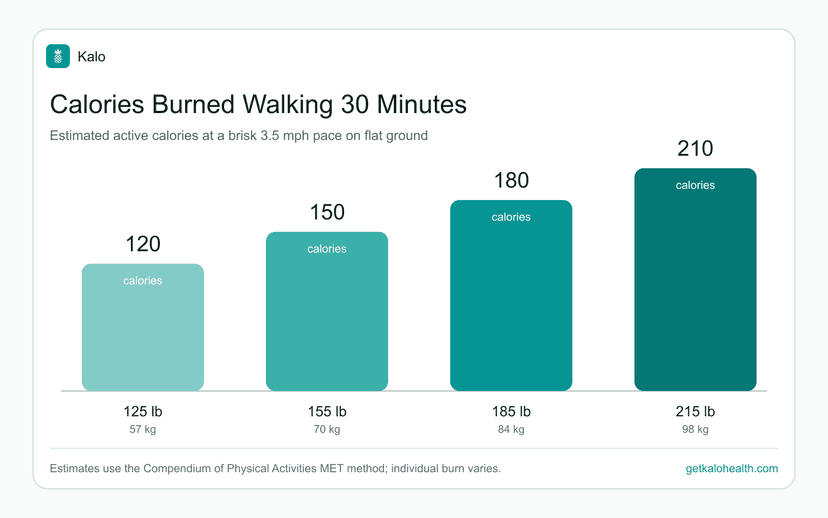
How Many Calories Does Walking Burn? By Weight, Time & Miles
Walking burns about 80-415 calories in 20-60 minutes depending on weight and pace. See estimates by time, speed, steps, and miles.
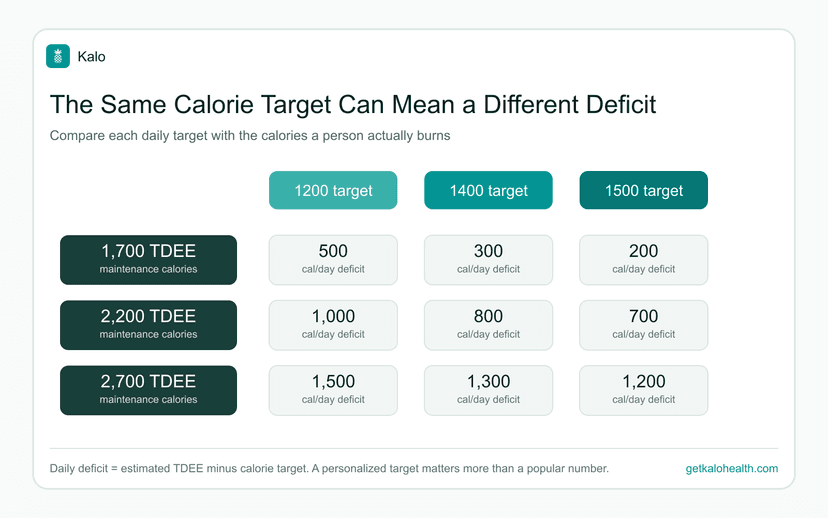
Is 1200 Calories a Day Enough, or Is It Too Little?
1,200 calories is too little for many adults. See when it may support weight loss, who needs more, and how to calculate a safer target.
How to Stop Eating at Night: Why You Snack After Dinner and How to Break the Habit
Nighttime eating accounts for 25-50% of total daily calories for many dieters. Here's the science behind post-dinner cravings and 6 proven strategies to stop.
Why Am I Always Hungry? 7 Reasons You Can't Stop Eating
Constant hunger affects 1 in 4 dieters and often has nothing to do with willpower. Here are 7 science-backed reasons you're always hungry and how to fix each one.
What Is a Calorie Deficit and How Does It Actually Work?
A calorie deficit of 500 calories per day leads to about 1 pound of fat loss per week. Here's exactly how it works and how to find your number.
The Plateau Problem: Why Your Weight Loss Stalls and How to Break Through
Weight loss plateaus hit nearly everyone. Learn why your progress stalls and science-backed strategies to break through and keep losing.
Portion Distortion: Why Your "Normal" Serving Size Is Probably Double What You Think
The average American plate has grown 44% since the 1980s—and so have our portions. Learn how portion distortion silently adds hundreds of calories to your day and simple strategies to recalibrate without measuring cups.
Why You Crave Sugar (And How to Stop the Cycle Without Willpower)
Sugar cravings aren't a character flaw—they're a biological response you can learn to manage. Discover the science behind why your brain demands sweets and practical strategies to break free from the sugar cycle.
Smart Snacking: When Eating Between Meals Helps (and When It Hurts) Your Diet
Learn how timing, portion, protein, fiber, and individual hunger patterns can change whether a snack supports your routine.
Mindful Eating: How Slowing Down Can Help You Eat Less Without Dieting
Research shows eating slowly can reduce calorie intake by 10-15% per meal—without changing what you eat. Learn the science behind mindful eating and practical techniques to implement today.
How to Travel Without Gaining Weight: A Practical Guide for Vacations and Business Trips
Vacations and business trips don't have to mean gaining 5 pounds. Learn evidence-based strategies to enjoy your travels while maintaining your progress—no deprivation required.
Weekend Binge Eating: Why You Overeat on Saturdays and How to Stop
Monday through Friday, you're disciplined. Then Saturday hits and everything falls apart. Learn why the weekend binge cycle happens, what it's costing you, and evidence-based strategies to finally break free.
Metabolism After 30: How Much It Really Slows Down (and How to Fix It)
Your metabolism drops just 1-2% per decade until age 60, not the dramatic crash most people assume. The real culprit is muscle loss. Here's how to reverse it.
How Many Calories Should I Eat to Lose Weight? A Science-Based Guide
The answer depends on your body, your goals, and how fast you want results. Learn how to calculate your personal calorie target for sustainable weight loss—without starving yourself or hitting a plateau.
Grocery Shopping on a Budget: How to Eat Healthy Without Breaking the Bank
Think eating healthy has to be expensive? Think again. Learn proven strategies to fill your cart with nutritious foods while keeping your wallet happy—no couponing obsession required.
How to Read Food Labels: Serving Sizes, Calories and Claims
Turn a Nutrition Facts label into your actual portion. Compare serving sizes, calculate calories and protein, and understand common package claims.
Intermittent Fasting 101: A Complete Beginner's Guide to Time-Restricted Eating
Curious about intermittent fasting but not sure where to start? Learn how IF works, the most popular methods, what the science actually says, and how to decide if it's right for you.
How Drinking More Water Helps You Lose Weight, According to Research
Drinking 500ml of water before meals reduces calorie intake by 13%. Here's exactly how much water you need per day and why dehydration stalls fat loss.
Emotional Eating: How to Break the Cycle Between Feelings and Food
Stress, boredom, sadness—we all reach for food when emotions run high. Learn why it happens, how to recognize your triggers, and practical strategies to build a healthier relationship with eating.
The Complete Beginner's Guide to Meal Prep: Save Time, Money, and Calories
Meal prep isn't just for fitness influencers. Learn how spending 2 hours on Sunday can transform your entire week—making healthy eating automatic and calorie tracking effortless.
Sleep and Weight Loss: The Hidden Connection Your Diet Is Missing
You're eating right and exercising, but the scale won't budge. The missing piece might not be on your plate—it could be on your pillow. Discover how sleep affects your weight loss more than you think.
How to Eat Out Without Ruining Your Diet: A Complete Guide
Restaurant meals don't have to derail your progress. Learn proven strategies for navigating menus, estimating calories, and enjoying dining out while staying on track with your goals.
Your 2026 Weight Loss Resolution: Why This Year Will Be Different
80% of New Year's resolutions fail by February. Here's the science behind why—and a realistic framework to make 2026 the year you finally reach your goals.
The Psychology of Food Logging: Why Consistency Beats Perfection
Tired of tracking burnout? Learn why logging 80% of your meals beats perfect tracking that lasts two weeks, and discover science-backed strategies to build a sustainable habit.
The Science of Satiety: Why Some 500-Calorie Meals Fill You Up and Others Don't
A 500-calorie bowl of oats keeps you full for hours while a 500-calorie muffin leaves you hungry in 30 minutes. Here's the science behind satiety and how to use it.
The Clean Eating Trap: Why 'Healthy' Foods Can Still Stall Progress
Eating clean but not losing weight? Learn why the health halo sabotages progress and how to balance nutrition with calories.
Holiday Eating Survival Guide: Navigating Parties, Family Dinners, and Treats
The holidays don't have to derail your progress. Learn practical strategies to enjoy celebrations without undoing months of hard work—no deprivation required.
Alcohol and Your Diet: The Math Nobody Talks About
You're tracking every meal, hitting your protein goals, and staying in a calorie deficit. But those weekend drinks might be silently erasing all your progress. Here's the uncomfortable math.
What to Eat Before and After a Workout for Better Results
Eat 25-50g carbs with 20g protein 1-2 hours before training, then a 3:1 carb-to-protein ratio within 30 minutes after. Here's the complete pre and post workout meal guide.
Why the Scale Lies: 5 Reasons Your Weight Doesn't Reflect Real Progress
Gained 3 pounds overnight despite eating clean? Water retention, muscle gain, and hormones can shift the scale 2-5 lbs daily. Here's what to track instead of weight.
7 Hidden High-Calorie Foods That Are Sabotaging Your Diet
Olive oil, granola, and smoothie bowls can pack 300-600 hidden calories per serving. Here are 7 common 'healthy' foods quietly adding hundreds of calories to your day.
Why You're Not Hitting Your Protein Goals (And How to Fix It)
Falling short on protein daily? Discover the 5 invisible barriers sabotaging your goals and simple fixes that actually work.
5 Ways AI Makes Calorie Tracking Easier
Describe a meal, review its estimated nutrition, correct portions, reuse saved meals, and explore meal ideas with Kalo.
Understanding Macros: A Simple Guide for Beginners
Learn what macronutrients are, why they matter for your health goals, and how to track them effectively with Kalo.
Photo vs Manual Tracking: Which Method is Right for You?
Explore the pros and cons of different tracking methods and find out which approach fits your lifestyle best.