Is 1500 Calories a Day Enough to Lose Weight?
This article is for educational purposes only and is not medical advice. Talk with a qualified healthcare professional before making major nutrition, weight loss, or medication-related changes.
1,500 calories can be enough for weight loss when it is below your maintenance calories and still supports your nutrition needs. If it creates a 300-500 calorie daily deficit, a reasonable early estimate is about 0.5-1 pound of weight loss per week, although real loss is not perfectly linear.
The number is not automatically healthy, low, or effective on its own. A smaller, less-active adult may get a moderate deficit from 1,500 calories, while a larger or highly active adult may find the same target unnecessarily aggressive. The useful question is how far 1,500 sits below your total daily energy expenditure (TDEE).
Key Takeaways
- 1,500 calories causes weight loss only when it is below your maintenance needs.
- A 300-500 calorie deficit is a practical starting range for many adults who want gradual progress.
- Maintenance needs matter more than sex alone because body size, age, activity, and health context change the result.
- Use the first 2-4 weeks as a calibration period and judge the plan by trend weight, energy, hunger, and training performance.
- Meal quality still matters because protein, produce, fiber-rich carbohydrates, and dietary fats make a limited calorie budget easier to use well.
What Is a 1500-Calorie Diet?
A 1,500-calorie diet is an eating plan in which meals, snacks, and caloric drinks add up to about 1,500 calories per day. It is not a specific food list or branded program. Whether it produces weight loss depends on the difference between that intake and the calories your body uses.
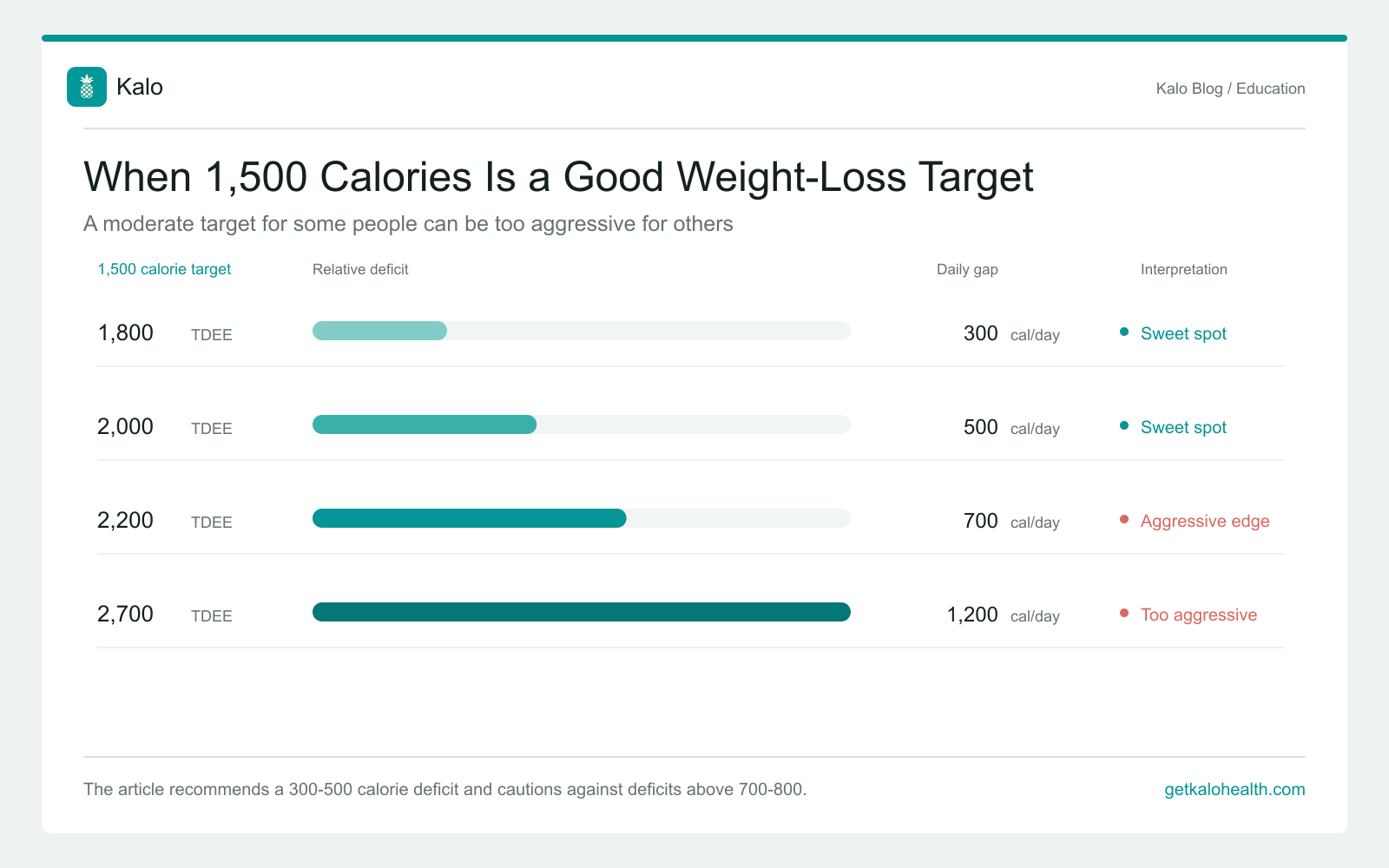
For example, someone who maintains their weight near 2,000 calories would begin with an estimated 500-calorie deficit at 1,500. Someone whose maintenance is closer to 1,700 would have only a 200-calorie deficit, while a person maintaining near 2,500 would face a much larger 1,000-calorie gap.
Is 1500 Calories a Day Good for Weight Loss?
1,500 calories can be good for weight loss when it creates a manageable deficit that you can sustain. Start by estimating maintenance calories, subtract 1,500, and use the difference as a planning number. If the concept is new, read how a calorie deficit works, then use the free calorie deficit calculator for a starting timeline.
| Estimated maintenance | Deficit at 1,500 | Early weekly estimate | How to read it |
|---|---|---|---|
| 1,800 calories | 300/day | About 0.5-0.6 lb | Moderate starting deficit |
| 2,000 calories | 500/day | About 0.5-1 lb | Common planning range |
| 2,200 calories | 700/day | About 1-1.4 lb | More aggressive; monitor recovery |
| 2,500 calories | 1,000/day | Up to about 2 lb initially | Often difficult to sustain without guidance |
These estimates use simple calorie math for initial planning. Weight change slows and fluctuates as body weight, activity, water, and energy needs change, so use the NIH Body Weight Planner or your observed trend for a more individualized forecast.
How Much Weight Can You Lose Eating 1500 Calories a Day?
The answer comes from your deficit, not from 1,500 alone. If your maintenance estimate is 1,800, the initial math suggests roughly half a pound per week. At 2,000 maintenance calories, it suggests roughly 0.5-1 pound per week. Actual results can be slower because energy needs change during weight loss and food and activity estimates are imperfect.
Treat the first 2-4 weeks as a calibration period. Compare weekly average weight rather than individual weigh-ins, because water, sodium, digestion, and menstrual-cycle changes can hide fat loss temporarily. If the trend is flat, review portions and activity before cutting calories further.
Is Eating 1500 Calories a Day Healthy?
A 1,500-calorie pattern can include a balanced mix of foods, but the number does not guarantee nutritional adequacy. The NHLBI publishes a DASH eating pattern for 1,400-1,600 calories that includes vegetables, fruit, grains, dairy or alternatives, protein foods, and fats. The exact portions and food choices still need to fit the individual.
A plan may be too restrictive if it repeatedly causes dizziness, persistent fatigue, excessive hunger, declining exercise performance, or rapid weight loss. Children and teenagers, pregnant or breastfeeding people, and anyone managing a medical condition or a history of disordered eating should seek individualized professional guidance rather than selecting 1,500 as a universal target.
Is 1500 Calories Too Low?
It may be. Compare 1,500 with your full daily energy needs rather than treating BMR as a simple calorie floor. BMR estimates the energy used at rest, while TDEE also includes normal movement and exercise. The larger the gap between TDEE and 1,500, the more important it is to reconsider the target.
If 1,500 produces only a small estimated deficit and your trend is moving gradually, it may be workable. If it produces a very large estimated deficit, consider whether 1,600 calories or a higher target could leave more room for food and recovery. Do not assume that going lower is automatically safer or more effective.
Who Should and Shouldn't Eat 1500 Calories a Day?
A 1,500-calorie starting point may be reasonable for adults who:
- Estimate maintenance calories near 1,800-2,100 per day
- Want a gradual deficit rather than the fastest possible loss
- Can build balanced meals within the target without persistent hunger or fatigue
- Are willing to adjust the estimate using several weeks of real weight and intake data
It deserves more caution when someone:
- Has high maintenance needs because of body size, work, sport, or training volume
- Is pregnant, breastfeeding, younger than 18, or managing a medical condition
- Has a history of disordered eating or finds calorie targets trigger restrictive behavior
- Experiences persistent fatigue, dizziness, poor recovery, or a sharp decline in performance
How to Make 1500 Calories Work for Weight Loss
The goal is not to make every day mathematically perfect. It is to build a repeatable pattern, collect enough information to judge the trend, and adjust only when the evidence supports it.
- Estimate maintenance first. Use your age, sex, height, weight, and activity as a starting point, then calculate the gap between maintenance and 1,500.
- Build meals around protein and produce. Protein-rich foods can support lean-mass retention during weight loss, while fruit, vegetables, and other fiber-rich foods add volume. Your ideal protein amount depends on body size and health context rather than one universal gram target.
- Leave room for carbohydrates and fats. Whole grains, beans, potatoes, fruit, dairy or alternatives, oils, nuts, and seeds can all fit; portions determine how they use the calorie budget.
- Track the easy-to-miss items. Cooking oil, dressings, drinks, sauces, and bites while cooking can meaningfully change the total. An estimate you consistently review is more useful than a detailed log you abandon.
- Reassess after 2-4 weeks. Use average weight, energy, hunger, and training performance. If the target feels unsustainable or produces faster loss than intended, increase it rather than forcing the original number.
What Does a Day of 1500 Calories Look Like?
One balanced example might divide the day into three meals and a snack. Nutrition values vary by brand, recipe, and portion, so use these numbers as a layout rather than a prescription:
Sample 1500-Calorie Day
- Breakfast (about 350 calories): Plain Greek yogurt, berries, oats, and chia seeds
- Lunch (about 425 calories): Chicken or tofu grain bowl with vegetables and a measured dressing
- Snack (about 175 calories): An apple with a portion of peanut butter
- Dinner (about 550 calories): Salmon or beans, roasted potatoes, vegetables, and olive oil
This structure is only one option. Some people prefer larger breakfasts, others save more calories for dinner, and either approach can work when the full day remains balanced and repeatable.
Frequently Asked Questions
Is 1500 calories enough?
It can be enough for some adults, but the answer depends on maintenance calories and whether the plan covers nutrition and recovery needs. Compare 1,500 with your TDEE and monitor the result for several weeks.
Is 1500 calories a day good for weight loss?
Yes, when 1,500 creates a manageable calorie deficit. It may produce little change for someone with low maintenance needs or be too aggressive for someone whose daily energy needs are much higher.
Is eating 1500 calories a day healthy?
A balanced 1,500-calorie pattern is possible, but the calorie total alone does not prove that it meets an individual's needs. Food variety, portions, medical context, hunger, energy, and performance all matter.
How much weight can I lose eating 1500 calories a day?
Subtract 1,500 from your estimated maintenance calories for a starting deficit. A 300-500 calorie daily gap often corresponds to roughly 0.5-1 pound per week initially, but weight loss usually slows and fluctuates over time.
Is 1500 calories enough for a woman or a man?
Sex affects calorie estimates, but it is not enough to choose a target by itself. Height, weight, age, activity, health history, and the resulting deficit provide a more useful answer.
How Kalo Helps You Evaluate a 1500-Calorie Target
A calorie target becomes useful only when you can compare it with what you actually eat. Kalo lets you photograph a meal and returns an estimated calorie and macro breakdown that you can review and edit. For a salmon, potato, and vegetable plate, that means checking each visible component and adding easy-to-miss items such as cooking oil or sauce.
Photo logging is an estimate, not a laboratory measurement. Its practical advantage is reducing the friction of creating a food record, while editable portions give you a way to correct the details that matter.
Check whether 1,500 calories fits your goal, then use Kalo to build a food record you can review instead of relying on memory.
Sources
- Body Weight Planner — NIH/NIDDK
- What's on Your Plate? 1,400-1,600 Calories a Day — NIH/NHLBI
- Eating & Physical Activity to Lose or Maintain Weight — NIH/NIDDK
- Online Weight Management Gets Personal — NIH News in Health
- Dietary Protein and Body Composition After Weight Loss — Systematic Review and Meta-Analysis
Related Articles

Why Don't Calories Match the Macros on a Food Label?
Rounding, fiber, and sugar alcohols can make calories differ from a 4-4-9 macro calculation. See two worked examples and...

What to Eat for Dinner Based on Your Remaining Calories and Protein
Compare three dinner combinations, check cooked portions, and use your remaining calories and protein as planning estima...

How Many Calories Does Walking 3,000 Steps Burn?
3,000 steps burn about 85-230 total calories depending on weight and cadence. See estimates, active calories, distance,...
Know what to eat next.
Kalo sets your daily calorie and macro targets and suggests meals that fit your goals, your diet, and what you have left today.