
What to Eat for Dinner Based on Your Remaining Calories and Protein
This article is for educational purposes only and is not medical advice. Talk with a qualified healthcare professional before making major nutrition, weight loss, or medication-related changes.
To choose dinner from your remaining calories and protein, first check the food you have already logged, then compare a few meals you would actually enjoy. Use the remaining numbers as planning estimates. They do not decide whether you are allowed to eat or establish what your body needs tonight.
This guide is for adults already using a daily food plan. It does not set a calorie or protein target. For the difference between a daily target and a meal allocation, see our calories-per-meal guide. Here, the job is narrower: turning an existing food record into a practical dinner choice.
Start With What the Numbers Actually Mean
Imagine an illustrative plan with 2,000 calories and 100 grams of protein, and a food record showing 1,400 calories and 65 grams. Subtraction leaves 600 calories and 35 grams of protein. These are example inputs, not recommended targets. An omitted snack, an incorrect serving, or a meal you have not logged changes the result.
- Review the record. Check portions, drinks, sauces and anything entered twice.
- Check practical constraints. What is available, how much time do you have, and what sounds good?
- Compare whole meals. Include the grain, vegetables, oil and toppings alongside the main protein food.
- Leave room for judgment. The numbers are estimates. Dinner does not need to make every total land exactly on zero.
For packaged ingredients, read the serving size before copying calories or protein. The FDA explains that label amounts generally refer to one serving; the serving size describes an amount typically consumed, not a recommendation for how much you should eat.
Three Dinner Examples You Can Compare
These simple combinations show the calculation, not a prescribed menu or a claim of complete nutrition. All weights are cooked edible weights. Broccoli is boiled and drained; chicken is roasted without skin; salmon is Atlantic farmed salmon cooked with dry heat. Egg weight excludes shell. The totals include only the listed foods, with no added oil, sauce, dressing or other ingredients.
| Meal and cooked portions | Calories | Protein |
|---|---|---|
Chicken, quinoa and broccoli bowl
| About 431 | 47.4 g |
Salmon, quinoa and broccoli plate
| About 578 | 44.6 g |
Egg and quinoa bowl with broccoli
| About 501 | 30.4 g |
For the example with 600 calories and 35 grams remaining, the chicken combination contributes about 431 calories and 47.4 grams of protein before additions. The salmon combination contributes about 578 calories and 44.6 grams. The egg combination contributes about 501 calories and 30.4 grams. This comparison describes the arithmetic; it does not rank one dinner as universally better.
To assemble a bowl, combine the cooked quinoa with the prepared protein food and broccoli. Choose seasonings and toppings you enjoy, and include their amounts when estimating the finished meal. These are assembly examples using already cooked foods, not instructions for cooking raw chicken or fish.
Adjust the Meal You Want, Then Recalculate
A substitution changes more than the name. In these USDA records, replacing 100 grams of cooked chicken breast with 100 grams of cooked salmon adds 41 calories and changes protein from about 31 to 22 grams. Neither food is a gram-for-gram nutritional replacement for the other.
Adding 50 grams of cooked quinoa contributes 60 calories and 2.2 grams of protein. Adding 50 grams of cooked chicken contributes about 83 calories and 15.5 grams of protein. Those are examples of how to update a meal record, not instructions to keep adding protein until a target is exact.
For a plant-based dinner, you could start with tofu or beans, a grain and vegetables. Use the package or matching database record for the actual product and preparation; do not reuse the chicken numbers. For mixed recipes, total all ingredients and divide by the number of portions actually made. Our homemade-food calculation guide covers that workflow.
What If the App Says There Is Very Little Left?
A low remaining number is not an instruction to skip dinner. Check the record and the assumptions behind the plan. Health Canada encourages noticing hunger and fullness cues. If your plan repeatedly leaves you hungry or uncertain about what to eat, discuss it with a qualified dietitian rather than forcing each evening to fit the display.
This article does not determine an appropriate intake for a medical condition or a specialized diet. It also does not recommend compensating tomorrow for a meal today. Its examples explain food-record arithmetic, not treatment or a weight-loss outcome.
Use Kalo to Explore Dinner Ideas
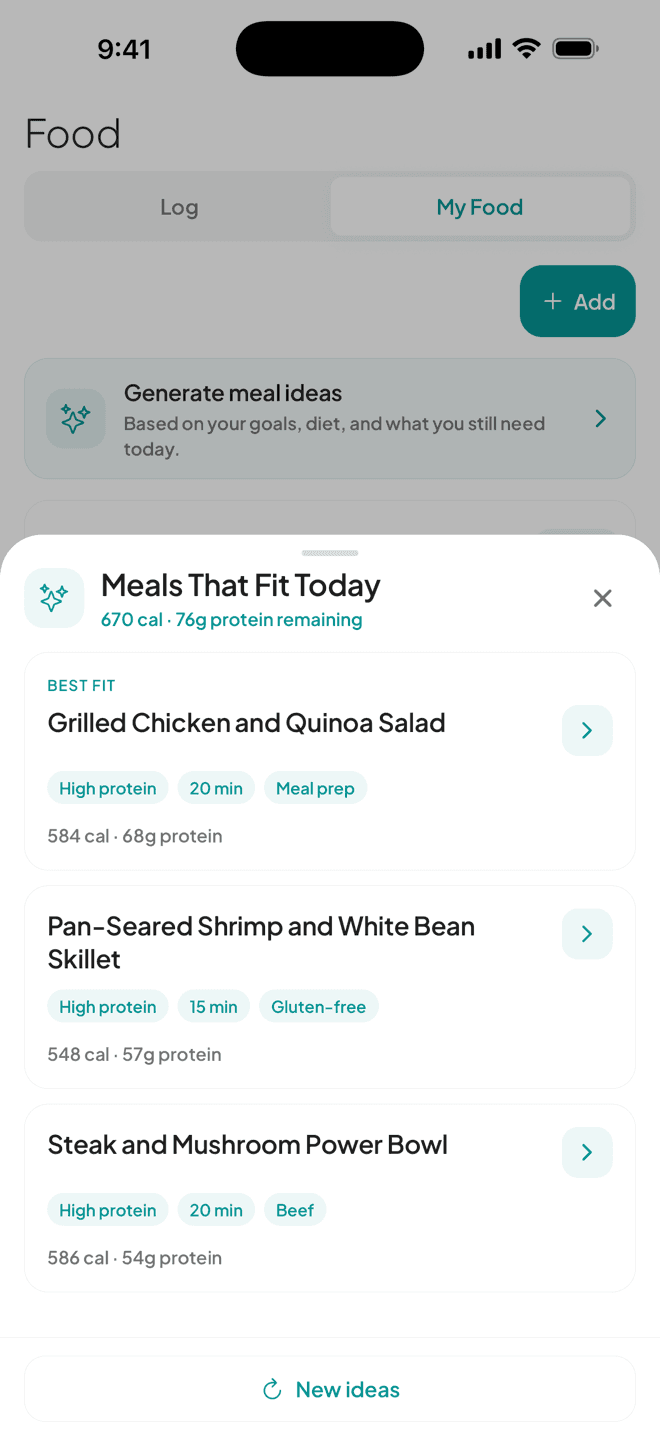
Kalo connects logged meals with remaining daily targets and meal ideas. Describe what you ate, check the foods and portions in the estimate, and review your day before exploring an idea. Choose based on your preferences and what you can prepare; edit ingredients and portions to match the meal you actually eat.


Questions That Come Up at Dinner
Do I have to use every remaining calorie?
The display alone cannot answer that. It reflects a target and a food record, both with assumptions. This guide does not treat a remaining amount as an obligation to eat exactly that much.
Why are the numbers different in my app?
The selected food, brand, preparation, serving weight and rounding may differ. Compare those details before changing the entry. Raw and cooked weights are not interchangeable.
Can I estimate without weighing dinner?
Yes, but the estimate will depend on your portion assumptions. Use a package serving or a familiar measure, review it consistently, and avoid treating it as an exact measurement. See tracking without weighing every food.
Sources and Calculation Notes
USDA FoodData Central SR Legacy records, retrieved September 9, 2026. For each ingredient: cooked grams ÷ 100 × the per-100-gram value. Totals are summed before rounding. Food composition varies; these figures are reference estimates.
- Roasted chicken breast, meat only, FDC 171477: 165 kcal and 31.02 g protein per 100 g.
- Atlantic farmed salmon, cooked with dry heat, FDC 175168: 206 kcal and 22.1 g protein per 100 g.
- Whole hard-boiled egg, FDC 173424: 155 kcal and 12.58 g protein per 100 g.
- Cooked quinoa, FDC 168917: 120 kcal and 4.4 g protein per 100 g.
- Broccoli, boiled and drained, without salt, FDC 169967: 35 kcal and 2.38 g protein per 100 g.
Kalo publishes this guide and makes the app discussed here. AI-assisted research and drafting received an editorial source check; no clinical review is claimed. The cover is AI-generated editorial artwork, not a photograph of the measured meals. Nutrition totals come from the linked records, not the image.
Related Articles

Are Calorie Counts on Food Labels Accurate? The 20% Rule
A U.S. food can hold up to 20% more calories than its label before it is misbranded. Tested snacks ran a median 4.3% ove...
Should You Weigh Food Raw or Cooked? How to Log Either Way
Either works if the entry matches. 150 g of roasted chicken is about 248 calories, but a raw entry logs 180. See USDA va...
Is Eating the Same Meals Every Day Good for Weight Loss?
In a 2026 study, people who mostly logged repeat foods lost 5.9% of body weight vs 4.3%. See the limits and how to build...
Know what to eat next.
Kalo sets your daily calorie and macro targets and suggests meals that fit your goals, your diet, and what you have left today.