How Many Calories Should I Eat per Meal to Lose Weight?
This article is for educational purposes only and is not medical advice. Talk with a qualified healthcare professional before making major nutrition, weight loss, or medication-related changes.
For many adults losing weight, 400 to 600 calories per meal is a useful starting range when eating three meals a day. Your correct number comes from your daily calorie target: subtract any snack calories, then divide the rest across the meals you actually eat.
For example, a 1,500-calorie target with 150 calories reserved for snacks leaves 1,350 calories for meals, or about 450 calories each if split evenly. The meals do not have to match perfectly. A 350-calorie breakfast, 450-calorie lunch, and 550-calorie dinner can work just as well if the full day still fits your target and keeps you satisfied.
Key Takeaways
- About 400 to 600 calories per meal fits many weight-loss plans, but smaller and larger daily targets need different portions.
- Use your daily target first; there is no universal meal number that causes weight loss by itself.
- Reserve 10 to 20 percent for snacks or drinks if those are a regular part of your day.
- Breakfast, lunch, and dinner do not need equal calories; the best split is the one that controls hunger and fits your routine.
- Eating more often does not automatically increase fat loss when total calories stay the same.
- Track calorie-dense extras separately, especially oils, sauces, dressings, drinks, and restaurant portions.
What Is a Per-Meal Calorie Target?
A per-meal calorie target is a planning range that divides your daily calorie budget among breakfast, lunch, dinner, and snacks. It is not a separate weight-loss rule. Your daily calorie deficit determines whether weight loss occurs; the meal split determines how practical that deficit feels.
A target can prevent one meal from quietly using most of the day's calories, but it should leave room for normal variation. Some people prefer a larger dinner with family, while others need a substantial breakfast to avoid afternoon snacking. Both patterns can work when the daily total, nutrition, and hunger are managed.
How Many Calories per Meal Should You Eat to Lose Weight?
The table below uses one flexible example: 25 percent of daily calories at breakfast, 30 percent at lunch, 35 percent at dinner, and 10 percent for snacks. This is a planning template, not a prescription. You can move calories between meals without changing the daily total.
| Daily target | Breakfast (25%) | Lunch (30%) | Dinner (35%) | Snacks (10%) |
|---|---|---|---|---|
| 1,200 calories | 300 | 360 | 420 | 120 |
| 1,400 calories | 350 | 420 | 490 | 140 |
| 1,600 calories | 400 | 480 | 560 | 160 |
| 1,800 calories | 450 | 540 | 630 | 180 |
| 2,000 calories | 500 | 600 | 700 | 200 |
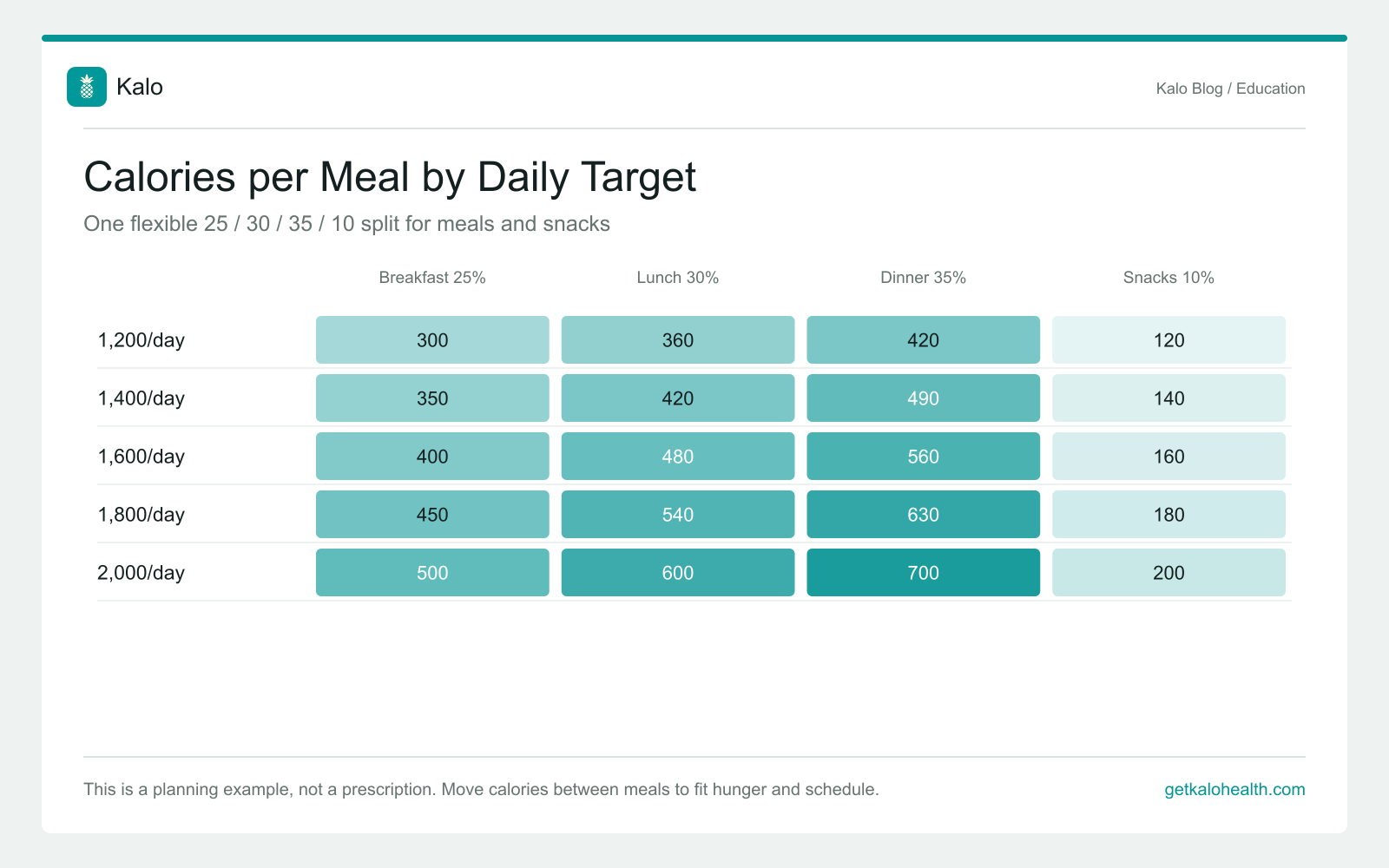
A 1,200-calorie target is too low for many adults, while 2,000 calories may be a deficit for one person and maintenance for another. Start with a personalized daily number using the calorie deficit calculator, then use the table only to distribute that number.
How Do You Calculate Calories per Meal?
The simplest calculation is (daily calorie target minus snack calories) divided by the number of meals. This gives you an equal-split starting point, which you can adjust around appetite, training, work, and family meals.
- Find your daily calorie target. Estimate maintenance calories, then choose a moderate deficit that leaves enough food for protein, fiber, and normal energy.
- Choose how many meals you realistically eat. Use two, three, or four meals based on your routine rather than forcing a schedule you dislike.
- Reserve calories for snacks and drinks. If you usually have a latte, afternoon snack, or dessert, budget for it before dividing the rest.
- Divide the remaining calories. With 1,600 calories, 160 reserved for snacks, and three meals, the equal starting point is 480 calories per meal.
- Shift calories toward your hungriest time. Moving 100 calories from breakfast to dinner changes the schedule, not the daily total.
- Review hunger and weight trends after two weeks. Adjust the split if one part of the day repeatedly leads to overeating.
If you do not yet have a reliable daily target, our guide to how many calories to eat for weight loss explains the maintenance and deficit math before you divide it into meals.
Should Breakfast, Lunch, and Dinner Have the Same Calories?
No. Equal meals are simple, but there is no requirement that breakfast, lunch, and dinner match. A systematic review of randomized trials found little robust evidence that meal frequency itself changes weight outcomes, and a controlled trial found that shifting more calories to the morning reduced hunger without changing energy expenditure or weight loss when total calories were matched.
This means distribution is mainly an adherence tool. If a small breakfast leaves you raiding the pantry at 4 p.m., move more calories earlier. If you naturally prefer a light morning and a substantial family dinner, save more for evening. The best pattern is the one that makes your daily target easier to repeat, not the one that looks most symmetrical in an app.
Is 500 Calories per Meal Good for Weight Loss?
Five hundred calories per meal is a good fit for a 1,500-calorie plan with no snacks, or roughly a 1,700- to 1,800-calorie plan with room for snacks and drinks. It is not automatically a deficit. A person whose maintenance intake is 1,600 calories would lose slowly or maintain at three 500-calorie meals plus extras, while someone maintaining near 2,400 could lose steadily.
Meal composition also changes how 500 calories feels. A plate with chicken, rice, vegetables, and fruit can be much more filling than 500 calories of pastries or sweetened drinks. Protein, fiber, water-rich foods, and a portion of fat usually make the same calorie budget easier to tolerate.
How Can You Build a Filling Meal Within Your Calorie Target?
Start with the parts of the meal that affect fullness and nutrition, then spend the remaining calories on flavor and preference. The goal is not to create the lowest-calorie plate possible; it is to make a meal that carries you to the next planned eating time.
- Choose a primary protein. Chicken, fish, eggs, Greek yogurt, tofu, beans, lentils, or lean meat gives the meal structure.
- Add high-volume produce. Vegetables, fruit, broth-based soups, and salads add fiber and volume for relatively few calories.
- Include a measured starch. Rice, potatoes, pasta, oats, bread, or tortillas can fit; the portion matters more than labeling the food good or bad.
- Count concentrated fats and sauces. Oil, butter, cheese, avocado, nuts, mayo, dressing, and creamy sauces can add hundreds of calories without much visible volume.
- Leave a small flexibility margin. Planning a 450-calorie meal inside a 500-calorie range gives room for imperfect portions and condiments.
For more meal ideas, see what to eat for breakfast when losing weight. The same protein-and-fiber structure works at lunch and dinner even when the foods change.
Why Can a Meal Exceed Its Calorie Budget So Easily?
Visible food is only part of the estimate. A chicken-and-rice bowl may look like a 500-calorie meal, but a large rice portion, cooking oil, avocado, cheese, and sauce can push it toward 700 or 800 calories. The solution is not to avoid bowls; it is to review the calorie-dense components instead of treating the entire plate as one vague entry.
This is where photo logging is especially useful. When you photograph the bowl in Kalo, review chicken, rice, vegetables, avocado, and sauce as separate components. Correcting one oversized rice serving or hidden sauce estimate matters more than trying to identify every herb or garnish perfectly.
What Should You Do If One Meal Goes Over Target?
Do not skip the next meal or turn the day into a punishment workout. Log the meal honestly, return to your normal structure, and look at the weekly pattern. A single 750-calorie dinner inside an otherwise consistent week has far less impact than repeatedly leaving restaurant meals, drinks, or weekend portions untracked.
The same principle applies to the broader deficit. Our guide to staying in a calorie deficit explains how to use weekly averages and repeatable habits instead of demanding perfect days.
Frequently Asked Questions
How many calories should each meal be on a 1,500-calorie diet?
An equal split is 500 calories for each of three meals. If you want 150 calories for snacks, aim closer to 450 calories per meal, then adjust the distribution around your hunger and schedule.
Can I eat a 700-calorie dinner and still lose weight?
Yes, if the full day remains below your maintenance calories. A larger dinner can fit by using smaller earlier meals, but it should still leave enough calories for adequate protein, produce, and normal energy throughout the day.
Is it better to eat three meals or six small meals for weight loss?
Neither schedule has a dependable fat-loss advantage when calories are equal. Choose the frequency that controls hunger, limits unplanned snacking, and is easiest to follow consistently.
Should breakfast be the biggest meal of the day?
It does not have to be, although some people feel less hungry when they eat more earlier. Controlled research suggests morning-loaded calories may reduce hunger, but total daily intake remains the main weight-loss lever.
Do snacks count toward calories per meal?
Snacks count toward the daily total, so reserve a specific portion of your calorie budget for them. If snacks are unplanned, even modest 150-calorie choices can erase the deficit after two or three servings.
Sources
- Calories and Weight Loss - NHS
- Eating and Physical Activity to Lose or Maintain Weight - NIDDK
- Is Eating Three Meals a Day the Only Way to Be Healthy? - American Heart Association
- Impact of Meal Frequency on Anthropometric Outcomes - Systematic Review of Randomized Trials
- Timing of Daily Calorie Loading, Appetite, and Energy Metabolism - Randomized Crossover Trial
How Kalo Helps You Keep Meals Within Your Target
A per-meal target is only useful when logging is quick enough to use on normal days. Kalo lets you photograph a meal, review the estimated foods and portions, and correct the few ingredients that materially change the total.
Instead of manually searching for every part of lunch, you can see whether the plate lands near your planned range and keep moving. Over a full week, that consistent visibility matters more than making every meal estimate exact to the calorie.
Ready to turn a daily calorie goal into meals you can actually repeat? Download Kalo to log plates with a photo, review portions, and keep your meal budget visible.
Related Articles

Do You Count Cooking Oil Calories? How to Log Oil and Spray
Yes. A tablespoon of olive oil has about 119 calories, and a spray labeled 0 calories is not zero. See how to measure an...
Can ChatGPT Count Calories? What the Research Shows
ChatGPT put calories within 10% of a nutritionist reference for under half of 222 foods. See when a chat estimate works...
Why Don't Calories Match the Macros on a Food Label?
Rounding, fiber, and sugar alcohols can make calories differ from a 4-4-9 macro calculation. See two worked examples and...
Know what to eat next.
Kalo sets your daily calorie and macro targets and suggests meals that fit your goals, your diet, and what you have left today.