Is 1000 Calories a Day Enough to Lose Weight?
This article is for educational purposes only and is not medical advice. Talk with a qualified healthcare professional before making major nutrition, weight loss, or medication-related changes.
For nearly everyone, 1000 calories a day is too few to lose weight safely. It sits below the basal metabolic rate of almost every adult, which means it is classified as a Very Low-Calorie Diet (VLCD) and is only recommended in research and clinical settings under medical supervision. Most people who try eating 1000 calories on their own lose 3-5 pounds in the first week from water and glycogen, then stall, regain quickly, and end up heavier than they started.
That sounds counterintuitive. If a calorie deficit drives weight loss, then bigger deficit, faster results, right? In practice, the body fights aggressive cuts hard. Hormones shift, metabolism adapts, muscle gets burned for fuel, and hunger spikes to the point where most dieters cannot sustain the target for more than 7-14 days. Here is what 1000 calories really does to your body and what to eat instead if you want fat loss that actually holds.
Key Takeaways
- 1000 calories is below BMR for most adults — average BMR is 1,400-1,800, so 1000 forces the body into starvation-response mode
- Medically classified as a VLCD — Very Low-Calorie Diets (under 800-1,000 cal) require physician supervision and are only used for severe obesity
- Up to 25% of weight lost is muscle — without medical oversight and high protein, aggressive cuts strip lean tissue, lowering long-term metabolism
- Metabolic adaptation slows burn by 200-500 calories — your body protects against rapid loss by reducing energy expenditure
- Side effects start within 1-2 weeks — fatigue, hair loss, gallstones, irregular periods, and muscle loss all become likely
- 1,200-1,500 (women) or 1,500-1,800 (men) is the safe floor — moderate deficits produce 80-90% of the same fat loss without the rebound
What Is a 1000-Calorie Diet?
A 1000-calorie diet means eating only about 1000 calories total per day across all meals, snacks, and drinks. To put that in physical terms, 1000 calories is roughly the calorie content of a single Chipotle burrito bowl, two and a half slices of cheese pizza, or a Big Mac with a small fries. For an entire day. That is the volume most people eat at a single meal.
In nutrition research, any diet under 800 calories per day is called a Very Low-Calorie Diet (VLCD), and diets in the 800-1,200 range are sometimes called Low-Calorie Diets (LCDs). The NIH recommends VLCDs only for adults with a BMI over 30 who need rapid pre-surgical weight loss, and only with physician supervision, monitoring, and protein-rich meal replacements designed to preserve lean mass. The 1,000-calorie target lives on the edge of that VLCD threshold and is not intended for at-home dieting.
Will You Lose Weight Eating 1000 Calories a Day?
Yes, you will lose weight initially — but most of week-one loss is water, not fat, and the rate slows dramatically after that. A 1000-calorie target creates a 600-1,500 calorie daily deficit for most adults, which on paper would predict 1.2-3 pounds of weekly fat loss. In reality, three things derail that math.
First, glycogen depletion. Each gram of stored carbohydrate holds 3 grams of water. When you slash calories, glycogen stores empty within 3-5 days and you lose 4-8 pounds of water weight. That is what shows on the scale, not body fat. Second, metabolic adaptation kicks in within 7-14 days, lowering your daily energy expenditure by 200-500 calories to protect against perceived starvation. Third, muscle loss accelerates. Without the protein and resistance training a clinical VLCD program prescribes, up to 25% of the weight you lose at 1000 calories is muscle, not fat.
The result: scale weight drops fast in week one, slows to a crawl by week three, stalls by week six, and rebounds the moment normal eating resumes. The same fat-loss outcome at 1500 calories takes longer week-to-week but holds.
How Many Calories Should You Actually Eat to Lose Weight?
The safe floor for self-directed dieting is 1,200 calories for women and 1,500 calories for men, and even those targets are appropriate only for smaller, sedentary bodies. A practical starting point is 500-750 calories below your maintenance, which produces 1 to 1.5 pounds of fat loss per week without triggering metabolic adaptation. The exact number depends on your body, which you can pin down with our guide on how to calculate your TDEE.
Here is how a sensible target compares to 1000 calories across common body types. Notice that the moderate option produces nearly the same monthly fat loss without the side effects:
1000 cal for a 5'5" 165 lb Woman
- • TDEE: ~1,950 calories/day
- • Deficit: ~950 calories
- • Predicted loss: 1.9 lbs/week
- • Actual loss after 3 weeks: ~0.7 lbs/week
- Hunger, fatigue, muscle loss
1500 cal for the Same Woman
- • TDEE: ~1,950 calories/day
- • Deficit: ~450 calories
- • Predicted loss: 0.9 lbs/week
- • Actual loss after 3 weeks: ~0.85 lbs/week
- Sustainable, no rebound
Over a 12-week cut, the 1000-calorie plan averages about 8-10 pounds of fat loss before quitting. The 1500-calorie plan averages 10-12 pounds without the misery. The math everyone misses is that adherence trumps deficit size.
What Are the Side Effects of Eating 1000 Calories a Day?
Eating 1000 calories without medical supervision triggers a predictable cascade of side effects, most of which start within 1-2 weeks. The eight most common are:
- Persistent fatigue — your brain alone burns 400-500 calories a day, so eating only 1000 leaves little for daily activity. Most VLCD dieters report exhaustion within the first week.
- Muscle loss — without 1g of protein per pound of body weight (which is hard to fit in 1000 calories), the body breaks down muscle for amino acids. Up to 25% of weight lost can be lean tissue.
- Metabolic adaptation — research published in Obesity Reviews shows TDEE drops 200-500 calories below predicted on prolonged severe restriction, locking in lower long-term metabolism.
- Hair loss (telogen effluvium) — typically appears 2-3 months after a severe cut and continues for months after refeeding. Caused by the body diverting protein and micronutrients away from non-essential tissues.
- Gallstones — rapid weight loss raises gallstone risk by 4-6x. The American Gastroenterological Association cites VLCDs as a leading non-genetic cause of cholesterol gallstones.
- Irregular or absent menstrual cycles — chronic energy deficit suppresses reproductive hormones. Female Athlete Triad/RED-S applies to dieters too, not just athletes.
- Mood and cognitive issues — irritability, brain fog, and depressive symptoms are well-documented. The 1944 Minnesota Starvation Experiment found 24-week semi-starvation produced personality changes that lasted months after refeeding.
- Rebound weight gain — a 2016 follow-up of The Biggest Loser contestants found that aggressive caloric restriction permanently lowered metabolism and led most participants to regain more weight than they originally lost within 6 years.
Are You Actually Eating 1000 Calories?
Here is the contrarian take that most diet content misses: most people who think they are eating 1000 calories are actually eating 1,400-1,800. A 1992 New England Journal of Medicine study put participants who self-reported eating 1,028 calories a day in a metabolic ward and measured actual intake. The real average was 2,081 calories — a 100% underestimate. More recent research using doubly labeled water has confirmed underestimation of 20-50% across the general population.
The implication is uncomfortable but useful. If your weight is not budging at "1000 calories," the problem usually is not metabolism, hormones, or thyroid. It is that your real intake is closer to 1,500-1,800 because of unmeasured oils, dressings, drink calories, "just a bite" tasting, and underestimated restaurant portions. This is why people in self-reported calorie deficits often do not lose weight — the deficit on paper is not real on the plate.
What Should You Eat Instead of 1000 Calories?
If your goal is sustainable fat loss, build a moderate deficit anchored on protein and high-volume foods. These five steps replace the 1000-calorie plan with something that actually works for 12+ weeks:
- Calculate your real maintenance — use the Mifflin-St Jeor equation for BMR and multiply by your activity factor. Our walkthrough on what BMR is and how to calculate it takes about three minutes.
- Subtract 500-750 calories from maintenance — this produces 1 to 1.5 pounds of weekly fat loss without triggering adaptation. For a 1,950-calorie maintenance, that means a 1,200-1,450 target — not 1,000.
- Hit 0.8-1g of protein per pound of body weight — at 1,400 calories, this means 25-30g of protein per meal. Protein preserves muscle, increases satiety, and burns 20-30% of its calories during digestion.
- Fill the plate with low-calorie-density foods — vegetables, fruit, lean protein, and watery foods (soup, Greek yogurt) all deliver under 1.5 cal/gram. See our guide on the best foods to eat in a calorie deficit for a full list.
- Track honestly for 2-3 weeks — given that self-reported intake is off by 20-50%, the only way to know your real number is to measure or photo-log every meal. After three accurate weeks, the pattern becomes visible and you can adjust by 100-150 calories at a time.
When Is a 1000-Calorie Diet Appropriate?
Medically supervised VLCDs in the 800-1,000 calorie range are sometimes prescribed for adults with a BMI over 30 who need rapid pre-bariatric-surgery weight loss, or for severely obese patients in clinical research programs. These are tightly controlled. Patients receive protein-fortified meal replacements, daily monitoring, micronutrient supplementation, and weekly clinical visits to track liver function, electrolytes, and gallbladder health. Programs typically last 8-16 weeks and are followed by a structured refeeding phase to limit rebound.
That is not what a typical at-home 1000-calorie diet looks like. Without supervision, the risk-reward equation flips: the same caloric restriction without protein, monitoring, or refeeding produces worse outcomes than a moderate deficit. If you are considering an aggressive cut for medical reasons, talk to your doctor about a structured program — not a DIY VLCD pulled from a TikTok.
Frequently Asked Questions
How much weight will I lose eating 1000 calories a day?
Expect 4-8 pounds in the first 1-2 weeks, mostly water and glycogen. Real fat loss settles to 0.5-1 pound per week by week 3 as metabolic adaptation kicks in, and typically stalls completely by week 6. Most dieters quit and regain more than they lost within a year.
Is 1000 calories a day starvation mode?
Eating 1000 calories triggers what researchers call adaptive thermogenesis — your body lowers daily calorie burn by 200-500 calories to protect against perceived starvation. It is not the mythical "starvation mode" that stops fat loss entirely, but it is a real metabolic adaptation that explains why aggressive cuts plateau early.
Can I survive on 1000 calories a day long-term?
No. 1000 calories is below the basal metabolic rate of nearly every adult, meaning your body cannot meet basic resting energy needs from food alone. Long-term consequences include muscle wasting, gallstones, hair loss, hormonal disruption, and nutrient deficiencies. The NIH and CDC do not recommend any unsupervised diet under 1,200 calories.
Why am I not losing weight on 1000 calories a day?
The most common reason is that your real intake is higher than 1000. Research shows people underestimate calories by 20-50% on average, often missing oils, sauces, drinks, and bites between meals. The second most common reason is metabolic adaptation lowering daily burn by 200-500 calories after sustained restriction.
Is 1200 calories better than 1000?
Yes. 1,200 calories is the lower bound of safe self-directed dieting for most women and produces about 80-90% of the fat loss of a 1000-calorie plan with far fewer side effects and better long-term adherence. For most men, 1,500-1,800 is the equivalent floor.
Keep a Food Record You Can Review
In Kalo, describe what you ate, including amounts, cooking oils, sauces, and drinks. Review the estimated calories and macros, correct the ingredients or portions, and save the meal to your food log.
Your log can help you compare meals with your daily targets and explore meal ideas based on what remains. These numbers are estimates, not a measurement of your intake or a promise of weight loss.
Kalo is free to download, with optional in-app purchases. Describe your next meal and review the estimate before saving it. Current purchase terms are shown before you confirm.
Sources
- Very Low-Calorie Diets — NIH/NIDDK (2023)
- Discrepancy Between Self-Reported and Actual Caloric Intake in Obese Subjects — New England Journal of Medicine (1992)
- Persistent Metabolic Adaptation 6 Years After "The Biggest Loser" Competition — Obesity (2016)
- Metabolic Adaptation to Caloric Restriction — Obesity Reviews (2015)
- Dietary Guidelines for Americans 2020-2025 — U.S. Department of Health and Human Services
Related Articles
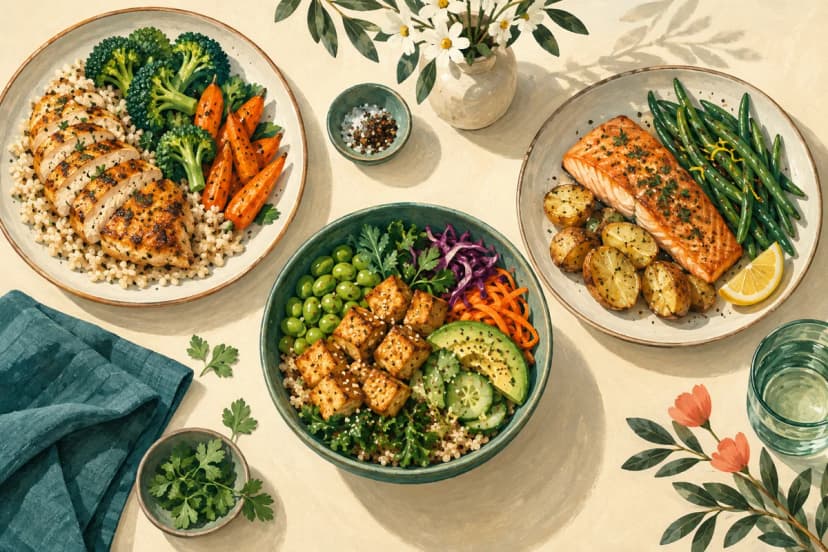
What to Eat for Dinner Based on Your Remaining Calories and Protein
Compare three dinner combinations, check cooked portions, and use your remaining calories and protein as planning estima...

How Many Calories Does Walking 3,000 Steps Burn?
3,000 steps burn about 85-230 total calories depending on weight and cadence. See estimates, active calories, distance,...

How Many Calories Does a 15-Minute Walk Burn?
A 15-minute walk burns about 40-140 total calories depending on your weight and pace. See estimates by weight, speed, st...
Ready to Start Your Health Journey?
Download Kalo to review meal estimates as you track.