Best Foods to Eat in a Calorie Deficit and Stay Full
This article is for educational purposes only and is not medical advice. Talk with a qualified healthcare professional before making major nutrition, weight loss, or medication-related changes.
The best foods to eat in a calorie deficit are high-volume, protein-rich, and fiber-dense foods with low calorie density (under 1.5 calories per gram). These include lean proteins like chicken breast, Greek yogurt, and eggs; non-starchy vegetables like broccoli, spinach, and zucchini; fruits like berries and watermelon; and whole grains like oats and quinoa. Prioritizing these foods lets you eat larger portions while staying within your calorie target.
If you have ever been two weeks into a calorie deficit and felt like you were starving by 3 PM, the problem probably was not your willpower. It was your food choices. The difference between a deficit that feels miserable and one that feels sustainable comes down to what fills your plate. Here is how to build meals that keep you full on fewer calories.
Key Takeaways
- Calorie density is your best tool - foods under 1.5 cal/gram let you eat large portions while staying in a deficit
- Protein is non-negotiable - aim for 25-30g per meal to stay full and preserve muscle during weight loss
- Volume matters more than restriction - a plate packed with vegetables, lean protein, and whole grains can hit 500 calories while feeling like a feast
- Not all "healthy" foods are deficit-friendly - nuts, avocado, and olive oil are nutritious but calorie-dense, so portion control matters
- Building meals around 3 components (protein + fiber + volume) is the simplest framework for staying satisfied in a deficit
What Is Calorie Density and Why Does It Matter?
Calorie density measures how many calories a food contains per gram of weight. Foods with low calorie density give you more food for fewer calories, which is exactly what you want when eating in a deficit. For example, 100 grams of chicken breast has about 165 calories (1.65 cal/g), while 100 grams of almonds has 579 calories (5.79 cal/g). You could eat more than three times as much chicken for the same caloric cost.
In a year-long Penn State trial of dietary energy density, women told to add water-rich foods like fruits and vegetables while cutting fat ate a greater weight of food, reported less hunger, and lost more weight (7.9 vs. 6.4 kg) than women who only cut fat. This is because your stomach responds to the volume and weight of food, not just its calorie content. Stretch receptors in your stomach wall trigger satiety signals based on how physically full your stomach is.
Here is a quick reference for calorie density categories:
Low Calorie Density (eat freely)
- • Most vegetables: 0.1-0.5 cal/g
- • Most fruits: 0.3-0.7 cal/g
- • Broth-based soups: 0.3-0.5 cal/g
- • Non-fat dairy: 0.3-0.6 cal/g
- Fill half your plate with these
High Calorie Density (portion-control)
- • Nuts and seeds: 5-6 cal/g
- • Oils and butter: 7-9 cal/g
- • Cheese: 3-4 cal/g
- • Chocolate and candy: 4-5 cal/g
- Measure these carefully
What Are the Best Proteins for a Calorie Deficit?
Protein is the single most important macronutrient when you are in a calorie deficit. It has the highest thermic effect of food (your body burns 20-30% of protein calories just digesting it), it preserves lean muscle mass during weight loss, and it is the most satiating macronutrient. A 2015 meta-analysis in the American Journal of Clinical Nutrition found that eating 25-30g of protein per meal significantly reduced appetite and late-night snacking.
Here are the best protein sources ranked by calorie efficiency:
- Chicken breast (165 cal/100g, 31g protein) - The gold standard. Versatile, affordable, and extremely lean. Bake a batch on Sunday for the week.
- Greek yogurt, non-fat (59 cal/100g, 10g protein) - One of the lowest calorie-density protein sources. A 200g serving gives you 20g protein for just 118 calories.
- Egg whites (52 cal/100g, 11g protein) - Almost pure protein. Mix with one whole egg for flavor and nutrients while keeping calories low.
- White fish like cod or tilapia (82-96 cal/100g, 18-20g protein) - Very low in fat and extremely filling. Cod is one of the best calorie-to-protein ratios available.
- Shrimp (85 cal/100g, 20g protein) - Often overlooked, shrimp is one of the most protein-dense foods per calorie.
- Cottage cheese, low-fat (72 cal/100g, 12g protein) - Slow-digesting casein protein keeps you full for hours. Great as a bedtime snack.
- Turkey breast (104 cal/100g, 24g protein) - Slightly leaner than chicken breast with similar versatility.
If you are struggling with protein targets, check out our guide on why you are not hitting your protein goals for practical fixes.
What Vegetables Are Best for Staying Full on Fewer Calories?
Vegetables are the ultimate calorie deficit food because most of them have a calorie density below 0.5 cal/g. That means you could eat a full pound of broccoli for about 155 calories, or an entire cucumber for roughly 45 calories. The combination of water content, fiber, and physical bulk makes vegetables the foundation of any sustainable deficit.
The best vegetables for a calorie deficit, ranked by volume-to-calorie ratio:
- Cucumbers (16 cal/cup) - 95% water, perfect for adding bulk to salads and snack plates
- Spinach (7 cal/cup raw, 41 cal/cup cooked) - One of the most nutrient-dense foods on the planet at almost zero caloric cost
- Zucchini (20 cal/cup) - Spiralized as noodle replacements, zucchini cuts pasta dish calories by 75%+
- Bell peppers (30 cal/cup) - Sweet, crunchy, and loaded with vitamin C. Great raw with protein-rich dips
- Broccoli (55 cal/cup) - Higher in protein than most vegetables (3.7g per cup) with fiber that slows digestion
- Cauliflower (27 cal/cup) - Extremely versatile as rice, mash, or pizza crust substitutes
- Mushrooms (15 cal/cup) - Add meaty texture and umami flavor to meals for almost no calories
A practical strategy: build every meal around a base of vegetables first, then add protein, then add your starch or fat. When you snap a photo of your plate with Kalo, the AI breaks down each component separately, so you can see exactly how much of your calorie budget goes to each ingredient and adjust portions over time.
Can You Eat Carbs in a Calorie Deficit?
Yes, and you should. Carbs are not the enemy of weight loss. The problem is that many popular carb sources (white bread, pasta, pastries) are calorie-dense and not very filling. But choosing the right carbs can actually help your deficit feel easier by providing sustained energy and keeping blood sugar stable.
The best carb sources for a calorie deficit are high in fiber and have a lower calorie density:
- Oats (68 cal/100g cooked) - A bowl of oatmeal with berries can keep you full for 4-5 hours thanks to beta-glucan fiber
- Potatoes (77 cal/100g boiled) - Despite their reputation, potatoes score highest on the Satiety Index of all foods tested. Boiled and cooled potatoes form resistant starch, which your body cannot fully absorb
- Sweet potatoes (86 cal/100g) - Slightly more calories than white potatoes but higher in fiber and beta-carotene
- Legumes: lentils, chickpeas, black beans (100-120 cal/100g cooked) - High in both protein and fiber, making them exceptionally satiating for a plant food
- Berries (32-57 cal/100g) - Strawberries, blueberries, and raspberries give you sweetness and volume for minimal calories
- Watermelon (30 cal/100g) - Over 90% water. You can eat 300g (a large wedge) for under 100 calories
For a deeper look at how to set your carb targets, see our guide on how many carbs you should eat per day.
What About Fats? How Do You Include Them Without Overeating?
Fats are essential for hormone production, vitamin absorption, and brain function. You should not cut them out. But at 9 calories per gram (more than double protein or carbs), fats are the most calorie-dense macronutrient, which means small portions add up fast. A single tablespoon of olive oil is 120 calories. Two tablespoons of peanut butter is 190 calories. These are healthy foods, but they need careful portioning in a deficit.
The best approach: get most of your fats from whole food sources rather than added oils, and measure rather than eyeball.
- Whole eggs (155 cal/100g) - Good fat-to-protein ratio plus dozens of micronutrients. 1-2 per day is ideal in a deficit.
- Avocado (160 cal/100g) - Nutrient-dense but easy to overeat. Stick to a quarter or half avocado per serving.
- Fatty fish like salmon (208 cal/100g) - Higher calorie than white fish, but the omega-3s support recovery and reduce inflammation.
- Nuts (28g/one small handful) - Pre-portion into 28g servings (about 160-180 cal). Never eat directly from the bag.
How Do You Build a Filling 500-Calorie Meal?
The most practical framework for deficit meals is the Protein + Fiber + Volume method. Every meal should have all three components. Here is what that looks like at roughly 500 calories:
- Start with 150-200g lean protein (150-250 cal) - This is your anchor. Chicken breast, white fish, Greek yogurt, or eggs.
- Add 2+ cups of non-starchy vegetables (30-80 cal) - Your volume base. Roasted broccoli, a large side salad, sauteed spinach, or raw bell peppers.
- Include one moderate carb serving (100-150 cal) - Half a cup of rice, a medium potato, or a cup of berries.
- Finish with a small fat source (50-80 cal) - A teaspoon of olive oil for cooking, a quarter avocado, or a sprinkle of cheese.
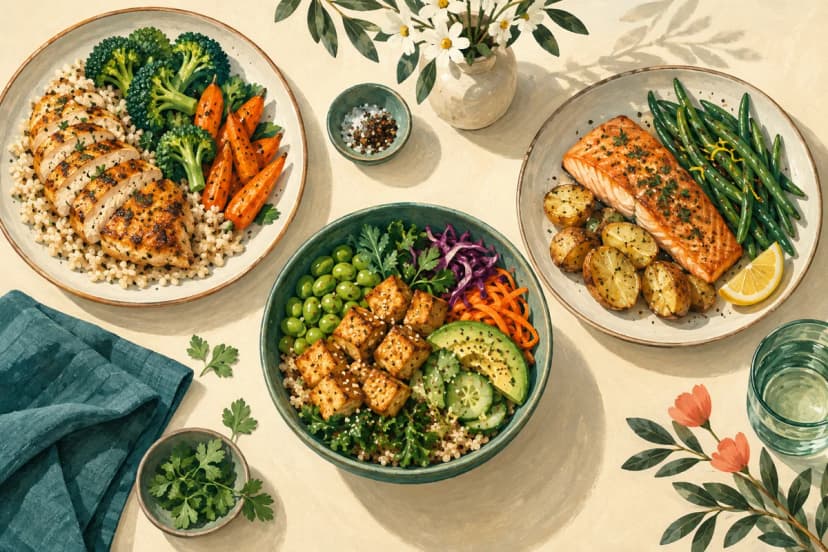
Example meal: 170g grilled chicken thigh (skinless), one cup roasted broccoli, half cup brown rice, and a tablespoon of teriyaki sauce. That is approximately 480 calories, 42g protein, and a plate that looks genuinely full. Compare that to a fast-food burger at 500+ calories that leaves you hungry an hour later because it lacks fiber and volume.
Understanding why some meals fill you up and others leave you reaching for snacks is all about satiety science. Our guide on why 500 calories can feel like 100 or 1,000 covers the research in depth.
What Are the Best Snacks for a Calorie Deficit?
Snacking in a deficit is not inherently bad, but it needs to be strategic. The worst deficit snacks are calorie-dense and easy to overeat (trail mix, granola bars, chips). The best ones are high in protein or fiber with built-in portion control.
- Greek yogurt with berries (120-150 cal) - 15-20g protein plus fiber. One of the most satisfying snacks per calorie.
- Apple with 1 tbsp peanut butter (195 cal) - The fiber from the apple and fat from the peanut butter create lasting satiety.
- Hard-boiled eggs, 2 large (140 cal) - Portable, pre-portioned, and 12g protein.
- Cottage cheese with cucumber (100-120 cal) - High protein, crunchy, and refreshing.
- Baby carrots with hummus, 2 tbsp (130 cal) - The volume of carrots plus the protein and fat in hummus.
- Protein shake with water (100-150 cal) - When you need something fast. 20-25g protein with minimal extras.
What Foods Should You Avoid in a Calorie Deficit?
You do not need to eliminate any food entirely, but some foods make a deficit dramatically harder to sustain because they pack a lot of calories into a small, unsatisfying volume. These are the foods to limit or portion carefully:
- Liquid calories - Juice, soda, specialty coffee drinks, and smoothies can add 200-500+ calories without triggering fullness signals. Your brain does not register liquid calories the same way it registers solid food.
- Fried foods - Frying roughly doubles the calorie content of most foods. A baked potato is 160 calories; french fries from the same potato are 365 calories.
- Granola and trail mix - Often marketed as healthy, but granola is 4-5 cal/g. A "small" bowl can easily hit 400-500 calories.
- Sauces and dressings - Ranch dressing adds 73 calories per tablespoon. Most people use 3-4 tablespoons on a salad, turning a 200-calorie salad into a 500-calorie meal.
- Ultra-processed snacks - Chips, cookies, and crackers are engineered to override your satiety signals. Research shows people eat 500+ more calories per day on ultra-processed diets compared to whole food diets.
Frequently Asked Questions
How many calories should I eat in a deficit to lose weight?
Most people lose weight sustainably on a deficit of 300-500 calories below their TDEE (total daily energy expenditure). For the average moderately active adult, that lands between 1,500 and 2,200 calories per day depending on body size and activity level. Going below your BMR (typically 1,200-1,500 calories) is counterproductive for most people, as it increases muscle loss and metabolic slowdown.
Will I lose muscle in a calorie deficit?
Some muscle loss is normal during any deficit, but you can minimize it significantly. Research shows that consuming 0.7-1g of protein per pound of bodyweight and doing resistance training 2-3 times per week preserves the vast majority of lean muscle mass during weight loss. The bigger your deficit and the lower your protein intake, the more muscle you will lose.
Can I eat junk food and still lose weight in a calorie deficit?
Technically yes, because weight loss depends on total calorie balance, not food quality. However, junk food is calorie-dense and low in satiety, meaning you will feel hungrier on fewer calories. Practically, this makes the deficit much harder to sustain. An 80/20 approach (80% whole foods, 20% whatever you enjoy) works well for most people long-term.
How long should I stay in a calorie deficit?
Most research supports deficit phases of 8-16 weeks followed by a 1-2 week maintenance break (eating at your TDEE). Extended deficits beyond 16 weeks increase the risk of metabolic adaptation, muscle loss, and psychological burnout. If you have significant weight to lose, cycling between deficit and maintenance phases produces better long-term results than one continuous cut.
What is the best time to eat when in a calorie deficit?
Meal timing matters far less than total daily intake and food quality. That said, research suggests that front-loading calories earlier in the day (larger breakfast and lunch, smaller dinner) may slightly improve fat loss and reduce late-night cravings. The best meal schedule is whatever you can follow consistently.
How Kalo Helps You Eat Better in a Calorie Deficit
The biggest challenge in a calorie deficit is not knowing what to eat. It is knowing how much you are actually eating. Studies show that people underestimate their calorie intake by 30-50% on average, which is often the difference between losing weight and staying stuck.
With Kalo's AI-powered photo tracking, you can snap a picture of your plate and get an instant calorie and macro breakdown for each component. When you photograph a chicken stir-fry, Kalo identifies the chicken, rice, vegetables, and sauce separately, so you can see exactly where your calories are coming from. Over time, this builds an intuitive sense for calorie density that helps you make better choices without having to track forever.
Stop guessing what your meals cost in calories. Download Kalo today to see exactly what is on your plate and stay on track with your deficit.
Sources
- Dietary energy density in the treatment of obesity - American Journal of Clinical Nutrition (2007)
- Ultra-Processed Diets Cause Excess Calorie Intake and Weight Gain - Cell Metabolism (2019)
- The role of protein in weight loss and maintenance - American Journal of Clinical Nutrition (2015)
- Weight loss: Feel full on fewer calories - Mayo Clinic
- Tips for Cutting Calories - Centers for Disease Control and Prevention
Related Articles

Why Don't Calories Match the Macros on a Food Label?
Rounding, fiber, and sugar alcohols can make calories differ from a 4-4-9 macro calculation. See two worked examples and...
What to Eat for Dinner Based on Your Remaining Calories and Protein
Compare three dinner combinations, check cooked portions, and use your remaining calories and protein as planning estima...

How Many Calories Does Walking 3,000 Steps Burn?
3,000 steps burn about 85-230 total calories depending on weight and cadence. See estimates, active calories, distance,...
Know what to eat next.
Kalo sets your daily calorie and macro targets and suggests meals that fit your goals, your diet, and what you have left today.