This article is for educational purposes only and is not medical advice. Talk with a qualified healthcare professional before making major nutrition, weight loss, or medication-related changes.
1700 calories a day is enough to lose weight for most women and some smaller or sedentary men, but it is too low for many active men and larger adults. If your TDEE is 2,000 to 2,400 calories, 1700 creates a 300 to 700 calorie deficit, which usually means about 0.5 to 1.4 pounds of fat loss per week.
The catch is that 1700 is not automatically "healthy," "safe," or "aggressive." It is just a calorie target. Whether it works depends on your maintenance calories, training, hunger, medical history, and how accurately you track the foods that are easiest to miss.
Key Takeaways
- 1700 calories is enough for weight loss when your maintenance calories are roughly 2,000 to 2,400 per day.
- Expected fat loss is usually 0.5 to 1.4 pounds per week, depending on the size of your daily deficit.
- 1700 is often reasonable for women with moderate activity, but it may be slow for petite sedentary women and too low for active women.
- 1700 is usually aggressive for men unless they are smaller, sedentary, or working with a clinician.
- Tracking accuracy matters because one large oil pour, dressing, or restaurant add-on can erase a 300 calorie deficit.
What Is a 1700-Calorie Diet?
A 1700-calorie diet is an eating plan where all meals, snacks, drinks, cooking oils, sauces, and extras add up to about 1700 calories per day. It is not a specific food list. It is a daily energy target, and it only causes weight loss when it is below your total daily energy expenditure, or TDEE.
In real life, 1700 calories might look like a 400-calorie breakfast, a 500-calorie lunch, a 200-calorie snack, and a 600-calorie dinner. That leaves more flexibility than 1200 or 1300 calories, but it still requires attention to calorie-dense foods like oils, nuts, cheese, dressings, alcohol, and restaurant portions.
Is 1700 Calories a Day a Calorie Deficit?
1700 calories is a calorie deficit if you burn more than 1700 calories per day. The useful question is how large the deficit is. The CDC notes that gradual, steady weight loss is more likely to stay off than faster loss, so the goal is usually a repeatable deficit, not the lowest number you can tolerate.
Use this table as a quick reality check:
| Estimated TDEE | Deficit at 1700 | Likely weekly loss | Verdict |
|---|---|---|---|
| 1,800 calories | 100 calories | ~0.2 lb/week | Very slow |
| 2,000 calories | 300 calories | ~0.6 lb/week | Moderate and realistic |
| 2,200 calories | 500 calories | ~1 lb/week | Strong target for many adults |
| 2,400 calories | 700 calories | ~1.4 lb/week | Aggressive but possible |
| 2,700+ calories | 1,000+ calories | 2+ lb/week | Usually too low |
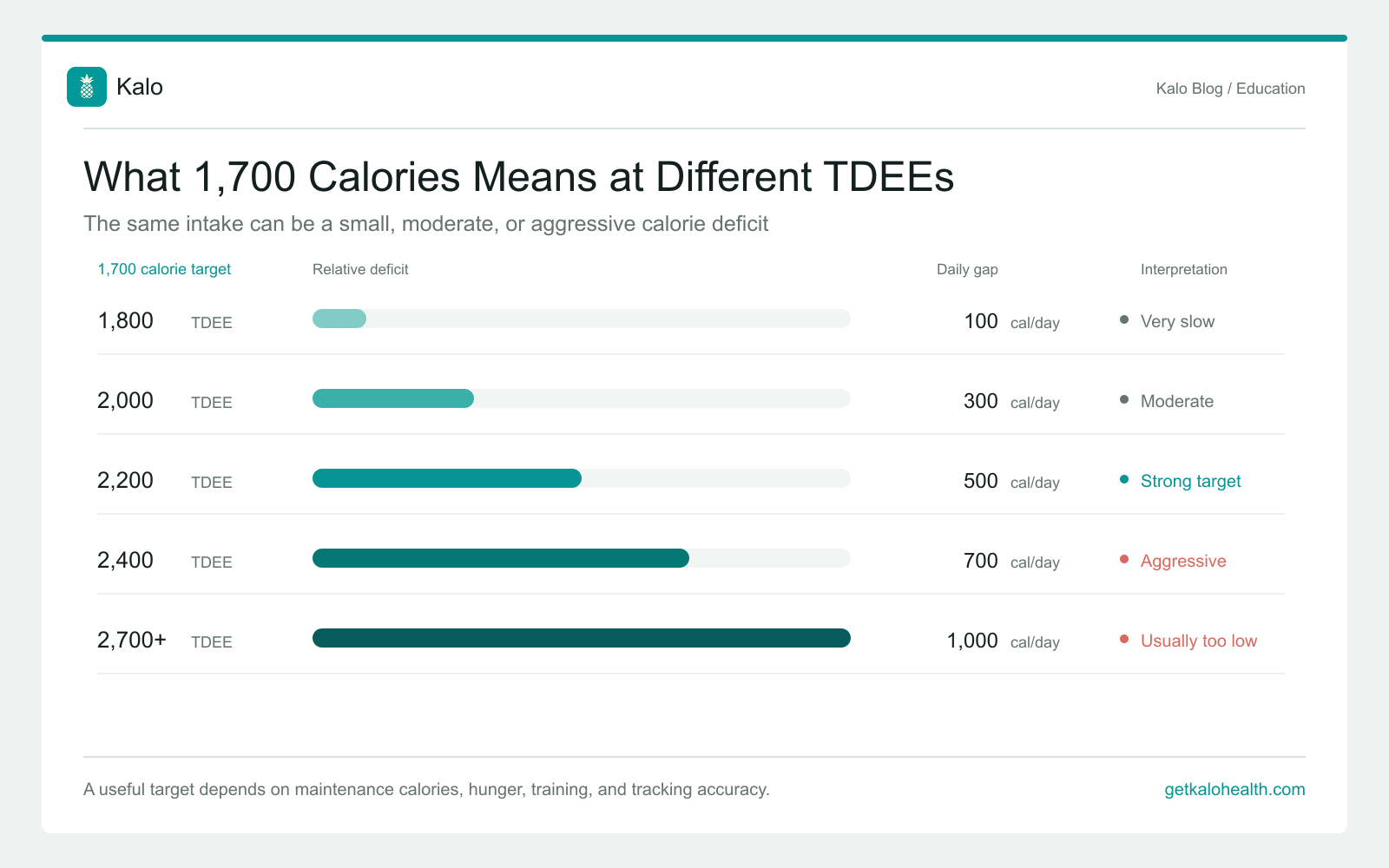
If you do not know your TDEE, start with the calorie deficit calculator. A calculator is only an estimate, but it gives you a better starting point than choosing 1700 because it sounds balanced.
Is 1700 Calories Enough for a Woman to Lose Weight?
1700 calories is enough for many women to lose weight, especially if maintenance is around 2,000 to 2,400 calories. In that range, 1700 creates a 300 to 700 calorie deficit, which is often enough to see trend-weight movement without making meals feel tiny.
For someone with lower estimated energy needs, 1,700 may be near maintenance. For someone who trains hard or has a physically demanding job, it may be unnecessarily low. Use the calculator methodology to understand the inputs and uncertainty before fine-tuning from observed trends.
Is 1700 Calories Enough for a Man to Lose Weight?
1700 calories will make many men lose weight, but it is often too aggressive to be the best starting target. MedlinePlus describes low-calorie diets as about 1,500 to 1,800 calories per day for men, and notes that these diets should still be supervised by a provider. For a man burning 2,600 to 3,000 calories per day, 1700 creates a 900 to 1,300 calorie deficit, which can raise hunger, fatigue, and rebound risk.
A smaller, sedentary man may do fine at 1700 for a short phase. A larger man, active man, or man trying to preserve training performance usually does better starting higher and adjusting based on trend weight. Losing slightly slower with better adherence usually beats losing quickly for two weeks and then regaining on weekends.
How Much Weight Will I Lose Eating 1700 Calories?
Your weight loss depends on your deficit, not on 1700 by itself. A 300 calorie daily deficit is about 2,100 calories per week, or roughly 0.6 pounds of fat. A 500 calorie daily deficit is about 1 pound per week. A 700 calorie daily deficit can approach 1.4 pounds per week before normal water-weight swings.
Example 1700-Calorie Outcomes
- 5'2", 145-lb sedentary woman: TDEE near 1,750 → about 0.1 lb/week
- 5'5", 165-lb lightly active woman: TDEE near 2,100 → about 0.8 lb/week
- 5'8", 185-lb active woman: TDEE near 2,500 → about 1.6 lb/week
- 5'10", 195-lb sedentary man: TDEE near 2,350 → about 1.3 lb/week
- 6'1", 220-lb active man: TDEE near 3,000 → usually too aggressive
The first week can be misleading. Lower carbs, less sodium, changed meal volume, soreness, constipation, and menstrual-cycle changes can all move scale weight faster or slower than fat loss. Judge 1700 by a 2 to 4 week trend, not a single weigh-in.
Should I Eat 1600, 1700, or 1800 Calories?
Choose a starting estimate that leaves room for adequate nutrition and normal daily activity. If 1,700 barely changes your weekly average after a reasonable observation window, recheck the inputs before automatically cutting lower. If it coincides with tiredness, feeling cold, preoccupation with food, or binge urges, consider a higher target and seek individualized guidance when needed.
A practical way to choose is to start with the highest target that still creates a clear deficit. You can always lower calories by 100 to 200 later, but it is harder to rebuild consistency after weeks of feeling underfed.
What Does a 1700-Calorie Day Look Like?
A good 1700-calorie day should not feel like random snacks plus a small dinner. Build it around protein first, then add high-volume plants, satisfying carbs, and measured fats.
Sample 1700-Calorie Day
- Breakfast (400 calories): Greek yogurt, berries, granola, and chia seeds
- Lunch (500 calories): chicken rice bowl with vegetables, salsa, and a measured avocado portion
- Snack (200 calories): protein shake or cottage cheese with fruit
- Dinner (600 calories): salmon or tofu, roasted vegetables, potatoes, and measured olive oil
Aim for a protein target that fits your body size, then use the rest of the calories for carbs and fats you actually enjoy. The more aggressive the deficit, the more important protein and fiber become.
How Do I Make 1700 Calories Work Without Feeling Hungry?
Treat 1700 as a repeatable structure, not a vague promise to "eat better." These steps make the target easier to follow:
- Estimate maintenance first - Use your TDEE, then confirm with 2 to 4 weeks of scale trends.
- Pick a realistic weekly rate - For many adults, 0.5 to 1.5 pounds per week is easier to sustain than chasing the fastest possible drop.
- Set a protein floor - Build each meal around a clear protein source before spending calories on extras.
- Pre-plan calorie-dense ingredients - Oils, dressings, nuts, cheese, nut butter, sauces, and alcohol need portions, not vibes.
- Keep one flexible snack - A planned 150 to 250 calories makes the day easier when lunch runs light or dinner is later than expected.
- Adjust from evidence - If weekly average weight is flat for 2 to 4 weeks and logging is accurate, lower by 100 to 200 calories or increase activity.
What Are the Common Mistakes on 1700 Calories?
The biggest mistake is assuming 1700 gives enough buffer to estimate loosely. It gives more room than 1300, but a few hidden extras can still turn the day into maintenance. Research comparing reported intake with measured intake has found that people can substantially underreport calories, especially when portions are estimated from memory.
A chicken bowl is the classic example. Rice, chicken, beans, vegetables, salsa, avocado, cheese, sour cream, and dressing can be a 600-calorie meal or a 950-calorie meal depending on portions. With Kalo, snapping the meal lets you review the rice, protein, toppings, dressing, and extras separately instead of logging one generic bowl and hoping it is close.
Who Should Not Eat 1700 Calories a Day?
1700 calories may be the wrong target without medical guidance for:
- Pregnant or breastfeeding people
- Teens and young adults who are still growing
- Highly active adults, endurance athletes, or people training hard several days per week
- Larger men or anyone with a high TDEE
- Older adults at risk of muscle loss, falls, or low appetite
- Anyone with diabetes, kidney disease, thyroid disease, or another condition that affects nutrition needs
- Anyone with a current or past eating disorder
If 1700 creates dizziness, persistent fatigue, missed periods, binge urges, poor sleep, cold intolerance, or training collapse, raise calories and talk with a qualified professional. A slower plan you can repeat is more useful than an impressive target that breaks adherence.
Frequently Asked Questions
Can you lose weight eating 1700 calories a day?
Yes, if 1700 calories is below your TDEE. For many women and some smaller men, it creates a moderate deficit. For petite sedentary people, it may be close to maintenance.
Is 1700 calories too low?
It depends on body size, sex, activity, and medical history. It is often reasonable for people burning 2,000 to 2,400 calories per day, but it is usually too low for active adults, larger men, pregnant people, breastfeeding people, and anyone with a history of disordered eating.
Why am I not losing weight on 1700 calories?
The common reasons are hidden calories, inaccurate portions, water retention, constipation, reduced daily movement, or a TDEE estimate that is too high. Track oils, sauces, restaurant meals, drinks, and snacks closely for two weeks before cutting lower.
Is 1700 calories enough with exercise?
It can be, but it depends on how much you train and whether exercise is already included in your TDEE estimate. If workouts feel worse, hunger spikes, or recovery suffers, 1700 may be too low for your activity level.
How much protein should I eat on 1700 calories?
Use a protein target based on body size and goal, then fit carbs and fats around it. Many dieters do better when each meal has a clear protein source instead of trying to hit the whole target at dinner.
Sources
- Steps for Losing Weight - CDC (2025)
- About the Body Weight Planner - NIH/NIDDK
- Eating and Physical Activity to Lose or Maintain Weight - NIH/NIDDK (2023)
- Diet for Rapid Weight Loss - MedlinePlus Medical Encyclopedia (2024)
- Discrepancy Between Self-Reported and Actual Caloric Intake - New England Journal of Medicine
How Kalo Helps You Hit 1700 Calories Accurately
At 1700 calories, the goal is not perfection. It is catching the details that quietly decide whether you are in a deficit. A few quick photo logs can show whether lunch is mostly lean protein and vegetables, or whether the dressing, oil, avocado, cheese, and rice are carrying more calories than expected.
Kalo turns meals into editable calorie and macro estimates in seconds, so you can stay consistent without searching a database for every ingredient. You still make the final call, but the app makes hidden calories easier to see before they become a plateau.
Trying to make 1700 calories accurate without weighing every bite? Download Kalo today to log meals with AI photo tracking and spot the hidden calories that change your deficit.
Related Articles

Why Don't Calories Match the Macros on a Food Label?
Rounding, fiber, and sugar alcohols can make calories differ from a 4-4-9 macro calculation. See two worked examples and...
What to Eat for Dinner Based on Your Remaining Calories and Protein
Compare three dinner combinations, check cooked portions, and use your remaining calories and protein as planning estima...

How Many Calories Does Walking 3,000 Steps Burn?
3,000 steps burn about 85-230 total calories depending on weight and cadence. See estimates, active calories, distance,...
Know what to eat next.
Kalo sets your daily calorie and macro targets and suggests meals that fit your goals, your diet, and what you have left today.