How to Calculate Your Macros for Weight Loss: A Step-by-Step Guide
This article is for educational purposes only and is not medical advice. Talk with a qualified healthcare professional before making major nutrition, weight loss, or medication-related changes.
To calculate your macros for weight loss, start with your Total Daily Energy Expenditure (TDEE), subtract 500 calories to create a deficit, then split those remaining calories into roughly 40% carbs, 30% protein, and 30% fat. For a person eating 1,800 calories per day, that works out to about 180g carbs, 135g protein, and 60g fat.
But here is the part most macro guides skip: the "best" ratio is the one you will actually follow for more than two weeks. Research from the New England Journal of Medicine found that any reduced-calorie diet produces meaningful weight loss regardless of macro composition, as long as people stick with it. The problem is that most people quit within a month because their macros feel impossible to hit. This guide will help you calculate macros that fit your body, your goals, and your actual life.
Key Takeaways
- Calculate your TDEE first -- your macros are a percentage of your total calorie target, so you need that number before anything else
- Protein is the only macro with a hard floor -- aim for 0.7-1g per pound of body weight to preserve muscle while losing fat
- A 40/30/30 (carb/protein/fat) split works for most people -- but active individuals may need more carbs and sedentary people may do better with fewer
- Macros matter more than most people think -- two people eating 1,800 calories can get very different body composition results depending on where those calories come from
- Tracking macros does not have to mean weighing every gram -- AI photo tracking and the plate method get you 80-90% of the way there
What Are Macros?
Macros (short for macronutrients) are the three main nutrients your body needs in large amounts: protein, carbohydrates, and fat. Every calorie you eat comes from one of these three sources. Protein and carbohydrates each contain 4 calories per gram, while fat contains 9 calories per gram. Alcohol is a fourth calorie source at 7 calories per gram, but it is not considered a macronutrient because your body does not need it to function.
When people talk about "counting macros" or "tracking macros," they mean monitoring how many grams of protein, carbs, and fat they eat each day rather than just counting total calories. This matters for weight loss because the composition of your diet affects whether you lose mostly fat or a mix of fat and muscle. A 2016 study in the American Journal of Clinical Nutrition found that people eating higher protein during a calorie deficit lost 27% more fat and gained muscle compared to those eating lower protein at the same calorie level.
How Do You Calculate Macros Step by Step?
Calculating your macros is a four-step process. Each step builds on the last, so follow them in order.
- Calculate your TDEE -- Your Total Daily Energy Expenditure is the number of calories your body burns in a full day, including exercise. Use the Mifflin-St Jeor equation (the most accurate formula for most people) and multiply by your activity level. If you are not sure how, check out our complete guide to calculating your TDEE. A typical result is 1,800-2,800 calories for most adults.
- Subtract calories for your deficit -- For steady fat loss of about 1 pound per week, subtract 500 calories from your TDEE. If your TDEE is 2,400, your target becomes 1,900 calories. Do not go below a 750-calorie deficit, as larger deficits increase muscle loss and are harder to sustain. For more on this, read our guide to how calorie deficits work.
- Set your protein target first -- Protein is the most important macro for weight loss. Aim for 0.7-1g per pound of body weight. For a 170-pound person, that is 119-170g of protein per day (476-680 calories from protein). Set this number first because it is non-negotiable for preserving muscle.
- Divide the remaining calories between carbs and fat -- After protein, you have flexibility. A balanced approach is to split the remaining calories roughly 50/50 between carbs and fat. If you exercise regularly, lean toward more carbs (55-60% of remaining). If you are more sedentary, you may prefer more fat (which is more satiating at rest).
What Is the Best Macro Ratio for Weight Loss?
A 40% carb, 30% protein, 30% fat split is the most commonly recommended starting point for weight loss. But "best" depends on your body, activity level, and food preferences. Here are three evidence-based ratios ranked by who they work best for:
Balanced (40C / 30P / 30F)
- Best for most people starting out
- Enough carbs for energy and workouts
- High protein to preserve muscle
- Easiest to sustain long-term
High Protein (30C / 40P / 30F)
- Best for people who lift weights
- Maximizes muscle retention in a deficit
- Very satiating (reduces hunger)
- Great for body recomposition
A third option is a lower-carb approach (25C / 30P / 45F), which works well for people who are sedentary, have insulin resistance, or simply feel more satisfied eating fewer carbs. Research shows all three ratios produce similar weight loss over 12 months, but adherence rates vary by individual. The ratio that feels least restrictive to you will produce the best long-term results.
Do Macros Actually Matter, or Is It Just About Calories?
Calories determine whether you lose weight. Macros determine what kind of weight you lose. This is the most important distinction in nutrition science that most people miss. Two people can eat exactly 1,800 calories per day and get completely different results.
A landmark 2012 study in JAMA compared three diets with identical calorie levels but different macro ratios. Participants on the high-protein diet burned 200+ more calories per day than those on the high-carb, low-protein diet, thanks to protein's higher thermic effect (your body uses 20-30% of protein calories just to digest it, compared to 5-10% for carbs and 0-3% for fat). They also lost more fat and less muscle.
So while you can technically lose weight eating nothing but crackers, your body composition, energy levels, and hunger will be dramatically worse than if you hit reasonable macro targets. Tracking macros is the difference between losing 10 pounds of fat and losing 7 pounds of fat plus 3 pounds of muscle.
How Much Protein Should I Eat to Lose Fat and Keep Muscle?
Aim for 0.7-1 gram of protein per pound of body weight per day. This range is supported by a meta-analysis of 49 studies published in the British Journal of Sports Medicine. If you weigh 160 pounds, that means 112-160g of protein daily. For a deeper breakdown based on your specific goals and activity level, see our complete guide to daily protein needs.
Here is a quick protein target table based on body weight:
If you are significantly overweight (BMI over 30), use your goal body weight instead of your current weight for this calculation. A 250-pound person aiming for 180 pounds should target 126-180g of protein, not 175-250g.
How Do You Convert Macro Percentages to Grams?
Once you have your calorie target and chosen a ratio, convert percentages to grams using these simple formulas:
- Protein grams = (Total calories x protein percentage) / 4. Example: (1,800 x 0.30) / 4 = 135g protein
- Carb grams = (Total calories x carb percentage) / 4. Example: (1,800 x 0.40) / 4 = 180g carbs
- Fat grams = (Total calories x fat percentage) / 9. Example: (1,800 x 0.30) / 9 = 60g fat
You do not need to hit these numbers exactly. Being within 5-10g of each target is plenty close. Obsessing over exact grams is one of the biggest reasons people burn out on macro tracking. Think of your macros as guardrails, not laser sights.
Should I Count Macros or Just Count Calories?
If you are just starting out, counting calories alone is enough to see results. Adding macro tracking is a level-up that makes sense once you have the calorie habit down. Think of it as progression: calories are the 101 course, macros are the 201.
That said, there are three situations where tracking macros from the start makes a real difference:
- You are losing weight but feeling weak or flat -- you are probably not eating enough protein, and tracking macros will fix that
- You have hit a plateau -- macro tracking often reveals that your calorie deficit has closed because carb and fat intake crept up while protein dropped
- You want to change body composition, not just scale weight -- if keeping muscle while losing fat matters to you, macros are essential
Common Macro Mistakes That Stall Weight Loss
These are common mistakes to watch for when setting and tracking macro targets:
- Setting protein too low -- Many popular calorie trackers default to 15-20% protein, which is far too low during a deficit. At 1,800 calories, 15% protein is only 67g. Most people need double that.
- Ignoring cooking fats -- A tablespoon of olive oil adds 14g of fat and 120 calories. Two tablespoons of butter in a pan adds 200 calories that never make it to your plate. When you snap a photo of your finished meal, you see the food but not the oil it was cooked in. This is where manual adjustments matter.
- Treating all carbs the same -- 50g of carbs from oatmeal and 50g of carbs from candy have wildly different effects on hunger, energy, and insulin. Prioritize complex carbs that come with fiber.
- Copying someone else's macros -- A 200-pound man who lifts 5 days a week and a 130-pound woman who walks for exercise need completely different macros, even if they both want to lose fat.
- Chasing perfect daily numbers -- Weekly averages matter more than daily perfection. If you eat 10g less protein on Monday and 10g more on Tuesday, you are fine.
Frequently Asked Questions
Can I eat whatever I want if it fits my macros?
Technically, yes. The "If It Fits Your Macros" (IIFYM) approach works for weight loss because your body responds to total calorie and macro intake, not food labels like "clean" or "dirty." However, food quality still affects hunger, energy, and long-term health. A practical approach is the 80/20 rule: get 80% of your macros from whole, minimally processed foods and use the remaining 20% for foods you enjoy.
How often should I recalculate my macros?
Recalculate every time you lose 10-15 pounds or every 8-12 weeks, whichever comes first. As you lose weight, your TDEE drops because your body requires fewer calories to maintain a smaller frame. A person who started at 200 pounds and lost 20 pounds may need to reduce their daily intake by 150-200 calories to keep losing at the same rate.
Do I need to track macros on rest days and workout days differently?
For most people, no. Keeping macros consistent daily is simpler and produces the same results. Advanced lifters sometimes cycle carbs higher on training days and lower on rest days, but this adds complexity with minimal benefit unless you are already very lean (under 15% body fat for men or under 22% for women).
What if I go over my fat macros but stay under calories?
If you are in a calorie deficit, you will still lose weight regardless of which macro is over or under. That said, consistently going over on fat usually means protein or carbs are too low, which can affect your energy and muscle retention. Treat it as a signal to adjust your food choices, not a reason to panic.
How Kalo Helps You Track Your Macros
The biggest barrier to macro tracking is the effort. Manually searching databases, estimating portions, and logging three separate numbers per food item is tedious. Most people quit within two weeks.
With Kalo's AI-powered photo tracking, you can log an entire meal's macros in seconds. Snap a photo of your dinner plate, and Kalo identifies each component separately -- the grilled chicken breast (38g protein, 0g carbs, 3g fat), the brown rice (3g protein, 36g carbs, 1g fat), and the roasted vegetables (2g protein, 12g carbs, 4g fat). You get a full macro breakdown without typing a single word or scrolling through a food database.
Stop guessing your macros and start seeing them. Download Kalo today to get instant macro breakdowns from a simple photo of your meal.
Sources
- Comparison of Weight-Loss Diets with Different Compositions of Fat, Protein, and Carbohydrates -- New England Journal of Medicine (2009)
- Higher compared with lower dietary protein during an energy deficit combined with intense exercise promotes greater lean mass gain -- American Journal of Clinical Nutrition (2016)
- Effects of Dietary Composition on Energy Expenditure During Weight-Loss Maintenance -- JAMA (2012)
- A systematic review, meta-analysis and meta-regression of the effect of protein supplementation on resistance training-induced gains -- British Journal of Sports Medicine (2018)
Related Articles

Why Don't Calories Match the Macros on a Food Label?
Rounding, fiber, and sugar alcohols can make calories differ from a 4-4-9 macro calculation. See two worked examples and...
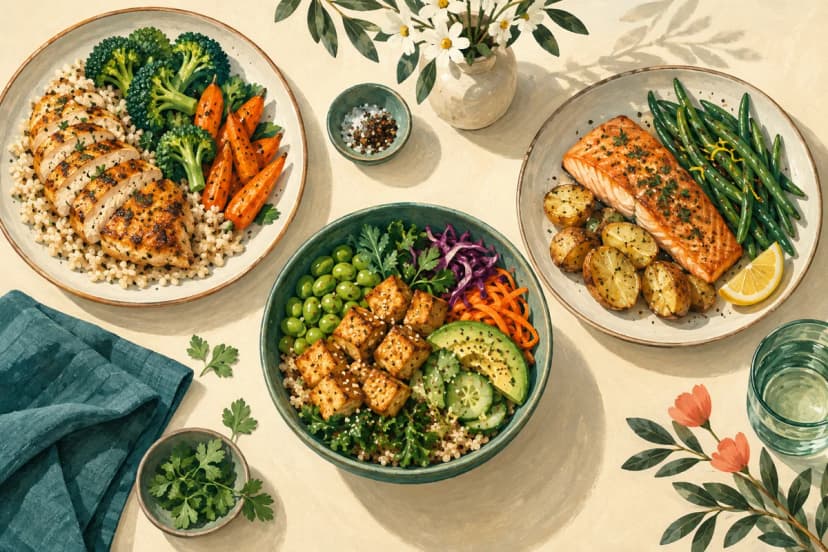
What to Eat for Dinner Based on Your Remaining Calories and Protein
Compare three dinner combinations, check cooked portions, and use your remaining calories and protein as planning estima...

How Many Calories Does Walking 3,000 Steps Burn?
3,000 steps burn about 85-230 total calories depending on weight and cadence. See estimates, active calories, distance,...
Ready to Start Your Health Journey?
Download Kalo to review meal estimates as you track.