How Many Calories Should a Woman Eat to Lose Weight?
This article is for educational purposes only and is not medical advice. Talk with a qualified healthcare professional before making major nutrition, weight loss, or medication-related changes.
Most women lose weight at 1,400 to 1,600 calories per day, which produces about 1 pound of fat loss per week for an average-sized adult. That target sits roughly 500 calories below the typical female TDEE of 1,900 to 2,100, so it builds a sustainable deficit without dropping below the 1,200-calorie safety floor that the NIH and CDC set for self-directed dieting. The exact number depends on your age, height, weight, and activity level, but for most women the answer lands inside the 1,400 to 1,700 calorie range.
The trouble is that "the average" doesn't describe anyone. A 5'2" 130-pound 50-year-old has a maintenance burn of about 1,650 calories. A 5'9" 200-pound 28-year-old who lifts three times a week burns closer to 2,400. Same gender, same goal, completely different number. Here's how to find your actual calorie target for weight loss, what to eat at that target, and the floor you should never go below.
Key Takeaways
- Most women lose weight at 1,400 to 1,600 calories, the equivalent of about a 500-calorie deficit below maintenance
- The minimum safe target is 1,200 calories, the NIH floor for self-directed dieting; lower than that requires medical supervision
- A 500-calorie daily deficit equals 1 pound of fat loss per week for the typical woman
- Age, height, and activity shift your number by 200 to 500 calories, which is why generic 1,200- or 1,500-calorie plans don't fit everyone
- Self-reported intake is off by 20 to 50 percent on average, meaning many "1,500-calorie" days are actually 1,800 to 2,000
- Hit 0.7 to 1g of protein per pound of goal body weight to preserve muscle and stay full at lower calories
What Is a Calorie Deficit for Women?
A calorie deficit happens when you eat fewer calories than your body burns. The body covers the gap by pulling from stored fat (and, if protein and training are inadequate, from muscle). For women, the average daily energy expenditure (TDEE) is about 1,900 to 2,100 calories, so a 500-calorie deficit lands you eating around 1,400 to 1,600 calories per day. Over a week, that adds up to a 3,500-calorie deficit, which is roughly the energy stored in 1 pound of body fat.
The math sounds simple, but two factors complicate it. First, female TDEE varies more than the popular "1,200 cal for women" rule suggests; a tall, muscular, active 30-year-old may need to eat 1,800 to lose at the same rate a smaller, sedentary 55-year-old loses at 1,300. Second, hormonal cycling and water retention can mask 1 to 2 weeks of fat loss on the scale, which is why a single bad weigh-in often does not mean the deficit isn't working.
How Many Calories Does a Woman Burn in a Day?
The average adult woman burns 1,800 to 2,200 calories per day, but the spread by body size and activity is wide. Daily burn (TDEE) is the sum of three numbers: basal metabolic rate (BMR), the calories needed for physical activity, and the small thermic effect of food. BMR alone accounts for 60 to 75 percent of the total and is the single biggest variable.
The Mifflin-St Jeor equation gives the most accurate female BMR estimate:
BMR (women) = 10 × weight (kg) + 6.25 × height (cm) − 5 × age (years) − 161
Then multiply BMR by your activity factor: 1.2 sedentary, 1.375 lightly active, 1.55 moderately active, 1.725 very active.
For a 5'5" (165 cm) 150 lb (68 kg) 35-year-old woman, the math gives a BMR of about 1,395 and a TDEE of around 1,920 at the lightly active level. Subtracting 500 lands a calorie target of 1,420 for a 1 lb/week loss rate. If you'd rather skip the hand math, our walkthrough on how to calculate your TDEE takes about three minutes.
How Many Calories Should a Woman Eat to Lose 1 Pound a Week?
Subtract 500 calories from your maintenance to lose about 1 pound of fat per week. For most women that lands a target between 1,300 and 1,700 calories per day, depending on size and activity. This is the rate the CDC recommends for sustainable, body-fat-focused weight loss without triggering muscle loss or rebound hunger.
Here are typical 500-calorie deficit targets for several common body types:
- 5'2", 140 lb, age 30, sedentary: TDEE ~1,750. Target 1,250 calories. (Approaches the 1,200 floor; track tightly.)
- 5'5", 160 lb, age 35, lightly active: TDEE ~1,950. Target 1,450 calories.
- 5'7", 180 lb, age 40, moderately active: TDEE ~2,250. Target 1,750 calories.
- 5'9", 200 lb, age 28, very active: TDEE ~2,500. Target 2,000 calories.
How Many Calories Should a Woman Eat to Lose 2 Pounds a Week?
Losing 2 pounds of pure fat per week requires a 1,000-calorie daily deficit, which is aggressive for most women and only appropriate for those with a higher starting body weight (BMI 30+). For an average woman with a TDEE of 2,000, a 1,000-calorie deficit means eating just 1,000 calories per day, which falls below the safe self-directed floor and triggers the side effects (muscle loss, gallstones, hair loss, hormonal disruption) that come with very-low-calorie dieting.
For most women under 200 lbs, 1 pound per week is the realistic target for fat loss that holds. If you want faster results, the better lever is increasing daily activity (an extra 6,000 to 8,000 steps adds about 250 to 350 calories of burn) rather than cutting food further.
What Is the Minimum Calories a Woman Should Eat Per Day?
The NIH and CDC recommend no less than 1,200 calories per day for women on a self-directed weight loss plan. Below that threshold, the body cannot reliably meet basic metabolic needs from food, micronutrient gaps appear within weeks, and adaptive thermogenesis kicks in to slow daily calorie burn by 200 to 500 calories. The result is a plan that produces the same fat loss as a moderate 1,400 to 1,500 target, but with worse side effects and a higher rebound rate.
Diets under 1,200 calories (medically classified as Very Low-Calorie Diets) are sometimes prescribed for adults with a BMI over 30 to support pre-bariatric weight loss, but only with physician supervision, protein-fortified meal replacements, and weekly bloodwork. They are not designed for at-home use.
How Do Calorie Needs Change With Age?
A woman's daily calorie burn drops by about 1 to 2 percent per decade until age 60, mostly due to muscle loss rather than a metabolic slowdown. That means the average maintenance number falls from roughly 2,000 calories at age 25 to 1,750 at age 55, a difference of 250 calories over 30 years. The fix is not eating less; it's protecting muscle. Strength training twice a week and hitting protein targets keeps maintenance closer to its 20-something baseline.
Approximate calorie targets for weight loss by age
- Women in their 20s: 1,500 to 1,800 calories
- Women in their 30s: 1,400 to 1,700 calories
- Women in their 40s: 1,400 to 1,600 calories
- Women in their 50s: 1,300 to 1,500 calories
- Women 60+: 1,200 to 1,500 calories
These are general ranges, not prescriptions. A 50-year-old who lifts and walks 10,000 steps daily will lose at the high end of the 30s range; a sedentary 28-year-old may need to start at the lower end of the 40s range.
How to Find Your Exact Calorie Target in 5 Steps
- Calculate your BMR with Mifflin-St Jeor using your current weight, height, and age. For most women, expect a BMR of 1,200 to 1,500 calories.
- Multiply BMR by your activity factor to get TDEE: 1.2 sedentary, 1.375 light, 1.55 moderate, 1.725 very active. Be honest; most women overestimate this step by one tier, which is why their target ends up too high.
- Subtract 500 calories from TDEE for a roughly 1 lb/week loss rate. Subtract 250 if you're already lean (under about 22% body fat) or want a slower, less hungry pace.
- Set a protein floor of 0.7 to 1g per pound of goal body weight. For a 145-lb target weight, that's 100 to 145g of protein per day. Protein preserves muscle and increases satiety.
- Track honestly for 14 to 21 days, then adjust by 100 to 150 calories at a time. If you've lost 0.5 to 1 lb per week, hold steady. If the scale hasn't moved after 3 honest weeks (and you've menstruated to clear water retention), drop 100 calories.
Why Most Women Eat More Than They Think
Here is the contrarian piece most calorie-target articles skip: the number on paper rarely matches the number on the plate. A landmark New England Journal of Medicine study put women who reported eating 1,028 calories a day in a metabolic ward and measured their actual intake. The real average was 2,081 calories, a 100% underestimate. Subsequent research using doubly labeled water has confirmed underestimation of 20 to 50 percent across the general population.
For weight loss, this changes the lever entirely. If your scale isn't moving at "1,500 calories," the answer is usually not "cut to 1,200." It's that your real intake is closer to 1,800 to 2,000 because of unmeasured oils, dressings, drink calories, "just a bite" tasting, and underestimated restaurant portions. This is the same pattern we cover in our breakdown of why people in self-reported calorie deficits don't lose weight: the deficit is real on the spreadsheet but imaginary on the plate.
What Should a Woman Eat at 1,400 to 1,600 Calories?
At a 1,400 to 1,600 calorie target, food choices matter more than they do at maintenance. The two priorities are hitting protein and choosing low-calorie-density foods (anything under 1.5 calories per gram) so portions stay big enough to fill the plate.
A typical 1,500-calorie day might look like this:
- Breakfast (~350 cal): Greek yogurt with berries and a tablespoon of almond butter, plus coffee with milk.
- Lunch (~450 cal): Big salad with 5 oz grilled chicken, mixed greens, chickpeas, vegetables, and 1 tablespoon olive oil dressing.
- Snack (~150 cal): An apple with 1 tablespoon peanut butter, or a string cheese.
- Dinner (~500 cal): 5 oz salmon, 1 cup roasted potatoes, and unlimited steamed broccoli.
- Hits roughly 100g protein, 20g fiber, and 45g fat for the day.
Frequently Asked Questions
Can a woman lose weight on 1,500 calories a day?
Yes. Most women lose 0.5 to 1 pound per week at 1,500 calories, since it sits about 400 to 500 calories below the average female TDEE of 1,900 to 2,000. Smaller or older women may find 1,500 closer to their maintenance, while taller or active women will lose faster at the same target.
How many calories should a woman eat to lose 2 pounds a week?
A 1,000-calorie daily deficit produces 2 pounds of fat loss per week, but for most women that means eating less than 1,200 calories, below the NIH safety floor. Two pounds per week is realistic only for women starting above a BMI of 30, and is best done with medical supervision. For most women, 1 pound per week (a 500-calorie deficit) is the sustainable target.
Is 1,200 calories a day enough for a woman?
1,200 calories is the lower bound of safe self-directed dieting for women and works for smaller, sedentary, or older women whose TDEE sits near 1,700. For taller, younger, or active women, 1,200 is too aggressive and triggers metabolic adaptation within 2 to 3 weeks. Our full guide on whether 1,200 calories is enough covers who it works for and who should eat more.
How many calories should a 5'4" woman eat to lose weight?
A 5'4" woman with a typical body weight of 130 to 150 lbs has a TDEE between 1,650 and 1,950 depending on age and activity. A 500-calorie deficit puts her target at 1,150 to 1,450 calories per day. If the math drops below 1,200, prioritize activity (adding 6,000 to 8,000 daily steps adds 250 to 350 burned calories) instead of cutting food further.
Why am I not losing weight at 1,400 calories a day?
The most common reason is intake underreporting. Research shows women underestimate calories by 20 to 50 percent on average, often missing oils, dressings, drinks, and bites between meals. The second most common reason is hormonal water retention, which can mask 1 to 2 weeks of fat loss on the scale, especially in the days before menstruation.
Keep a Food Record You Can Review
In Kalo, describe what you ate, including amounts, cooking oils, sauces, and drinks. Review the estimated calories and macros, correct the ingredients or portions, and save the meal to your food log.
Your log can help you compare meals with your daily targets and explore meal ideas based on what remains. These numbers are estimates, not a measurement of your intake or a promise of weight loss.
Kalo is free to download, with optional in-app purchases. Describe your next meal and review the estimate before saving it. Current purchase terms are shown before you confirm.
Sources
- Discrepancy Between Self-Reported and Actual Caloric Intake in Obese Subjects, New England Journal of Medicine (1992)
- Losing Weight: Healthy Weight Loss Recommendations, CDC
- Very Low-Calorie Diets, NIH/NIDDK
- A New Predictive Equation for Resting Energy Expenditure (Mifflin-St Jeor), American Journal of Clinical Nutrition (1990)
- Dietary Guidelines for Americans 2020-2025, U.S. Department of Health and Human Services
Related Articles
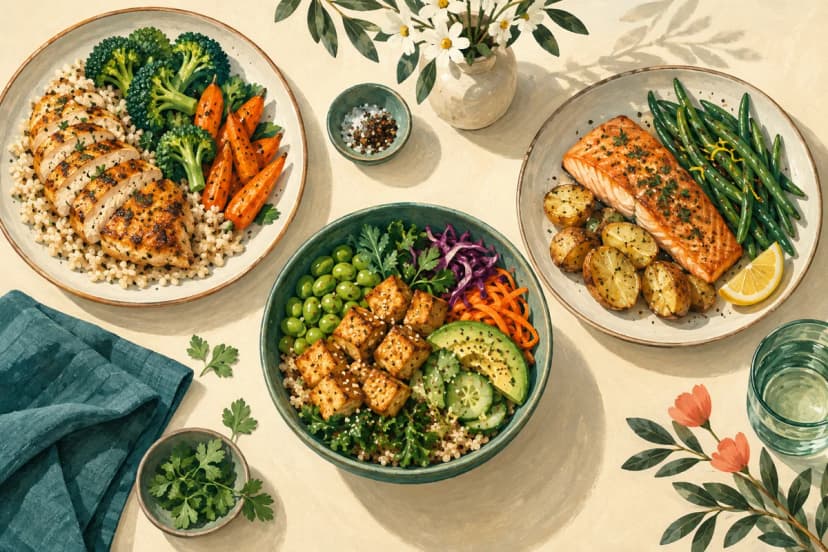
What to Eat for Dinner Based on Your Remaining Calories and Protein
Compare three dinner combinations, check cooked portions, and use your remaining calories and protein as planning estima...

How Many Calories Does Walking 3,000 Steps Burn?
3,000 steps burn about 85-230 total calories depending on weight and cadence. See estimates, active calories, distance,...

How Many Calories Does a 15-Minute Walk Burn?
A 15-minute walk burns about 40-140 total calories depending on your weight and pace. See estimates by weight, speed, st...
Ready to Start Your Health Journey?
Download Kalo to review meal estimates as you track.