
How Many Calories Does Incline Walking Burn? 12-3-30 Included
This article is for educational purposes only and is not medical advice. Talk with a qualified healthcare professional before making major nutrition, weight loss, or medication-related changes.
Incline walking burns about 135 to 490 calories in 30 minutes, depending on your body weight and how steep the grade is. A 155-pound (70 kg) person walking 3 mph burns roughly 197 calories at a 5 percent incline, 273 at 10 percent, and 304 at the 12 percent grade used in the viral 12-3-30 workout. The same walk on flat ground burns only about 121 calories, so a steep incline can more than double your burn without walking any faster.
That is why incline walking has become the favorite cardio of people who hate running. It delivers jog-level calorie burn at a pace you can hold a conversation at, with a fraction of the impact on your knees. But the numbers on the treadmill console, and the ones in most online calculators, are often wrong in ways that matter. Here are the real charts, the formula behind them, and the honest math on what incline walking does for weight loss.
Key Takeaways
- Incline walking burns 135 to 490 calories per 30 minutes, depending mostly on body weight and grade
- Each 1 percent of incline adds roughly 12 percent of your flat-ground burn at 3 mph, so a 12 percent grade more than doubles it
- The 12-3-30 workout burns about 250 to 425 calories on paper, but lab measurements came in at 180 to 210, largely because people hold the handrails
- Holding the rails takes weight off your legs and can cut your true burn by a third, so use fingertips for balance only
- A 5 percent grade adds about 60 percent more calories than flat walking at the same pace, the best ratio of extra burn to extra effort for beginners
- Incline walking only drives weight loss inside a calorie deficit, and one post-workout smoothie can erase a full session
What is incline walking?
Incline walking is walking uphill, either on a treadmill set to a grade or on real hills outside. The incline number is the grade percentage: a 10 percent incline means the surface rises 10 feet for every 100 feet you travel forward. Most treadmills adjust from 0 to 12 or 15 percent, and a typical highway hill is 4 to 6 percent for comparison.
Walking uphill burns more calories because your muscles must lift your body weight against gravity with every step, not just move it forward. That vertical work is expensive. It recruits more of your glutes, hamstrings, and calves than flat walking, raises your heart rate into the zone of a slow jog, and does it all at an impact level your joints barely notice.
How many calories does incline walking burn by weight and grade?
The table below shows estimated calories burned in 30 minutes of walking at 3.0 mph across common treadmill inclines and body weights. Most online calculators use flat-walking MET tables that ignore grade entirely. These numbers instead come from the ACSM walking equation, the standard exercise-science formula that includes a specific term for vertical work, so they account for exactly how steep your treadmill is set.
| Incline | 125 lb (57 kg) | 155 lb (70 kg) | 185 lb (84 kg) | 215 lb (98 kg) |
|---|---|---|---|---|
| 0% (flat) | 99 cal | 121 cal | 145 cal | 170 cal |
| 3% | 136 cal | 167 cal | 200 cal | 233 cal |
| 5% | 161 cal | 197 cal | 237 cal | 276 cal |
| 8% | 198 cal | 243 cal | 291 cal | 340 cal |
| 10% | 222 cal | 273 cal | 328 cal | 382 cal |
| 12% (12-3-30) | 247 cal | 304 cal | 364 cal | 425 cal |
| 15% | 284 cal | 349 cal | 419 cal | 489 cal |
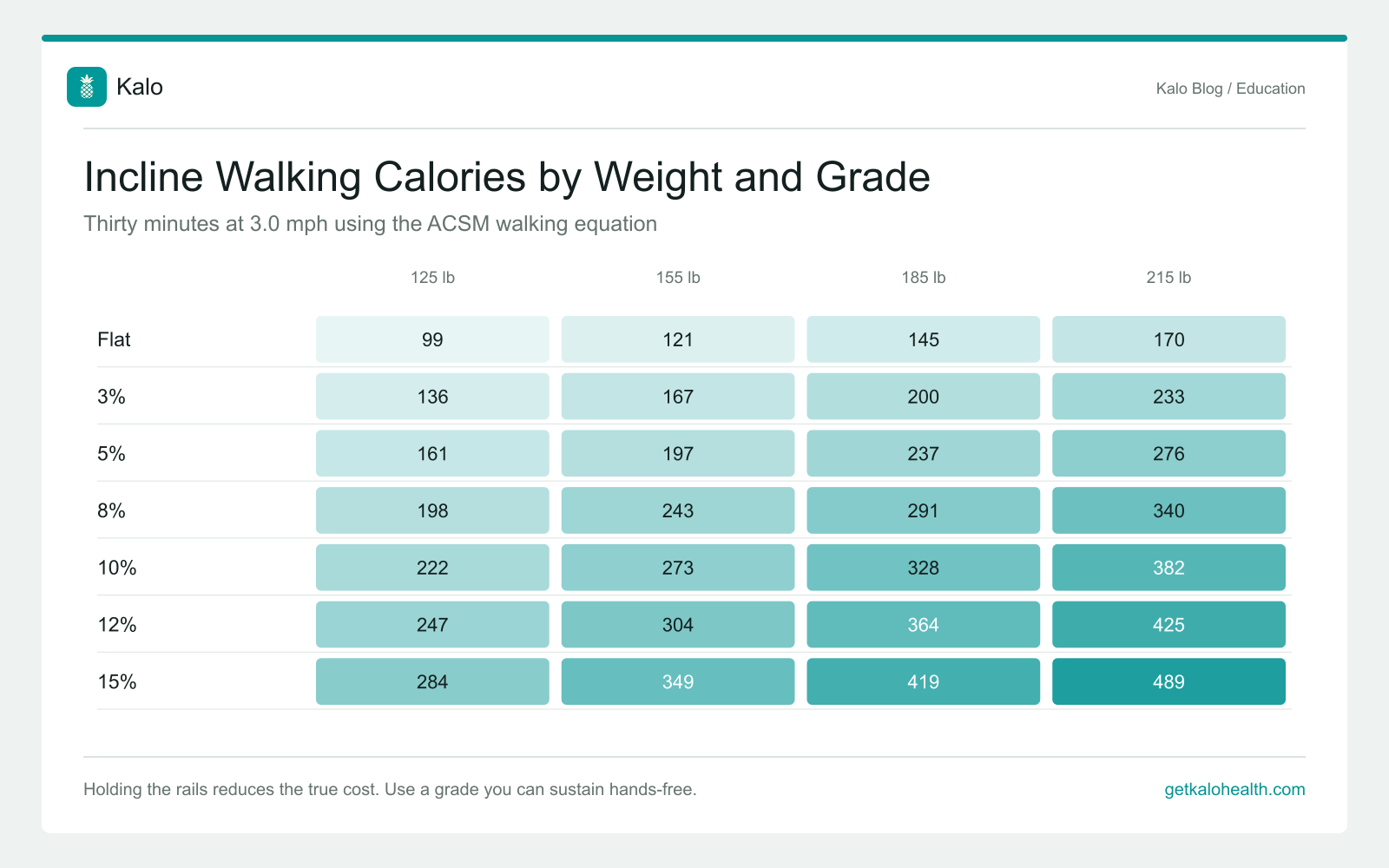
The pattern is remarkably consistent: each 1 percent of incline adds roughly 12 percent of your flat-ground burn at 3 mph. A modest 3 to 5 percent grade adds 40 to 60 percent more calories, and the 12 percent grade lifts the burn by about 150 percent. Walking faster multiplies everything further; bumping the pace from 3.0 to 3.5 mph at the same incline adds another 10 to 15 percent. For flat-ground numbers across every pace and duration, see our full guide to how many calories walking burns.
The formula behind the chart
If you want your exact number, the ACSM walking equation estimates oxygen cost as 0.1 × speed + 1.8 × speed × grade + 3.5, with speed in meters per minute and grade as a decimal. Multiply by your weight in kilograms, divide by 1,000, and multiply by 5 to get calories per minute. Worked example for a 155-pound (70 kg) person doing 12-3-30: speed is 80.4 m/min, so 8.04 + 17.37 + 3.5 = 28.9 ml/kg/min of oxygen, which works out to about 10.1 calories per minute, or 304 calories in 30 minutes. Notice the middle term, the vertical work, is twice the size of the forward-walking term. That is the entire magic of incline walking in one line of math.
How many calories does the 12-3-30 workout burn?
The 12-3-30 workout (12 percent incline, 3.0 mph, 30 minutes) burns about 250 to 425 calories per session depending on body weight, with a 155-pound person landing near 300. That is two and a half times the burn of the same walk on a flat belt, and it puts a brisk walker in the calorie-per-minute range of a 5 mph jog, the same territory covered in our comparison of walking vs running for weight loss.
Here is the catch most articles skip: when researchers actually measured the 12-3-30 workout in a lab, participants burned about 180 to 210 calories per session, well below what the math predicts. Part of the gap is participant body weight, but a bigger part is the handrails. Very few people can walk a 12 percent grade at 3 mph hands-free on their first try, and gripping the rails transfers a chunk of your body weight to your arms, which quietly deletes the vertical work you came for.
The same research found 12-3-30 drew about 41 percent of its calories from fat versus 33 percent for running at equal calorie burn. That sounds like a win, but burning more fat during a workout does not mean losing more fat over the week. Your body trades fat in and out of storage all day, and total calorie balance still decides what the scale does. Treat 12-3-30 as an efficient, joint-friendly way to burn 200 to 300 calories, not a fat-burning hack.
Is incline walking good for weight loss?
Yes, incline walking is one of the most sustainable calorie burners available, but only inside a calorie deficit. Four 30-minute incline sessions a week at a 10 percent grade burn roughly 1,100 calories for a 155-pound person, about a third of a pound of fat per week on their own. That is meaningful and repeatable, and unlike intense cardio, uphill walking barely spikes appetite for most people.
The honest math still applies, though. A 273-calorie incline session is undone by one 16-ounce fruit smoothie, and a week of sessions is undone by one generous restaurant meal. Incline walking widens a deficit; it cannot create one by itself if eating is untracked. Pair your sessions with a daily calorie target from the free calorie deficit calculator, and if 30 minutes is your window, see what a regular 30-minute walk burns for the flat-ground baseline you are improving on.
How do you start incline walking? A simple progression
Jumping straight to 12 percent is the most common mistake. It forces handrail gripping, trashes your calves, and makes the habit miserable. Build up instead:
- Start at 3 to 5 percent for two weeks - This adds 40 to 60 percent more burn than flat walking while your calves, Achilles tendons, and lower back adapt to the new angle.
- Keep your hands off the rails - Lightly touch for balance if needed, but never grip and lean back. If you cannot walk hands-free, the incline is too steep for you today. Lower it; your real burn will be higher.
- Raise the grade 1 to 2 percent per week - Each 1 percent adds about 12 percent more burn, so small weekly bumps compound fast. Most people reach a comfortable 10 to 12 percent in 4 to 6 weeks.
- Hold a pace you could talk at - Around 3.0 mph is the sweet spot for steep grades. If you are gasping, drop speed before dropping incline, since the grade is doing most of the calorie work.
- Walk it 3 to 5 times per week - Consistency beats intensity. Five 250-calorie sessions out-burn one heroic 500-calorie session every week of the year.
Frequently Asked Questions
How many calories does the 12-3-30 workout burn?
On paper, 12-3-30 burns about 250 to 425 calories depending on body weight, with a 155-pound person near 300. Lab measurements of real participants came in at 180 to 210 per session, largely because holding the handrails lowers the true cost. Walk hands-free to earn the full number.
Is incline walking better than running for weight loss?
At a steep grade, incline walking burns close to jogging: about 10 calories per minute for a 155-pound person at 12 percent versus 11 to 12 per minute jogging at 5 mph. Running still burns more per minute at typical paces, but incline walking is far easier on knees and hips. The better tool is whichever one you will repeat 4 or 5 times a week.
What incline should I walk at to burn fat?
There is no magic fat-burning grade; total calories burned and consistency matter most. Start at 3 to 5 percent, which adds 40 to 60 percent more burn than flat walking, and build toward 10 to 12 percent over a month or so. Pick the steepest grade you can walk hands-free while still able to talk.
Does holding the treadmill handrails reduce calories burned?
Yes, significantly. Gripping the rails transfers part of your body weight to your arms, removing some of the uphill work your legs would otherwise do. Measured 12-3-30 burns came in roughly 30 to 40 percent below predictions, partly for this reason. Use fingertips for balance only, or lower the incline until you can let go.
Is treadmill incline walking the same as walking uphill outside?
Nearly. A treadmill at the same grade and speed costs slightly less energy because the moving belt assists your stride and there is no wind resistance, a difference of a few percent. The bigger difference is that outdoor hills include downhill recovery stretches that burn far less, while a treadmill holds the grade for the entire session.
How Kalo Helps You Keep the Calories You Burn
An incline session that burns 273 calories only moves the scale if your food does not quietly claim it back. Most people underestimate what they eat by 30 to 40 percent, which is more than a 12-3-30 session every single day. The workout is the easy half of the equation; knowing what you actually ate is the half that decides the result.
With Kalo's AI photo tracking, you snap a picture of your plate and get an instant calorie and macro breakdown. Photograph a post-workout acai bowl and Kalo identifies the acai base, granola, banana, and honey separately, showing you in seconds that the 550-calorie bowl just out-ate your 300-calorie hill climb. Seeing both sides of the ledger is what turns incline walking from exercise into progress.
Putting in the incline work but the scale won't move? The answer is almost always on your plate. Download Kalo to snap photos of your meals, see your real calorie balance, and make every uphill minute count.
Sources
- Minetti et al. Energy Cost of Walking and Running at Extreme Uphill and Downhill Slopes - Journal of Applied Physiology (2002)
- Compendium of Physical Activities - MET values for walking and hill walking (2024)
- The 12-3-30 Workout: Does It Actually Work? Lab Research Review - Daily Burn (2025)
- Calories Burned in 30 Minutes of Activities - Harvard Health
- Physical Activity Guidelines for Adults - CDC
Related Articles

Are Calorie Counts on Food Labels Accurate? The 20% Rule
A U.S. food can hold up to 20% more calories than its label before it is misbranded. Tested snacks ran a median 4.3% ove...
Should You Weigh Food Raw or Cooked? How to Log Either Way
Either works if the entry matches. 150 g of roasted chicken is about 248 calories, but a raw entry logs 180. See USDA va...
Is Eating the Same Meals Every Day Good for Weight Loss?
In a 2026 study, people who mostly logged repeat foods lost 5.9% of body weight vs 4.3%. See the limits and how to build...
Know what to eat next.
Kalo sets your daily calorie and macro targets and suggests meals that fit your goals, your diet, and what you have left today.