How Many Calories Does Walking Burn? By Weight, Time & Miles
This article is for educational purposes only and is not medical advice. Talk with a qualified healthcare professional before making major nutrition, weight loss, or medication-related changes.
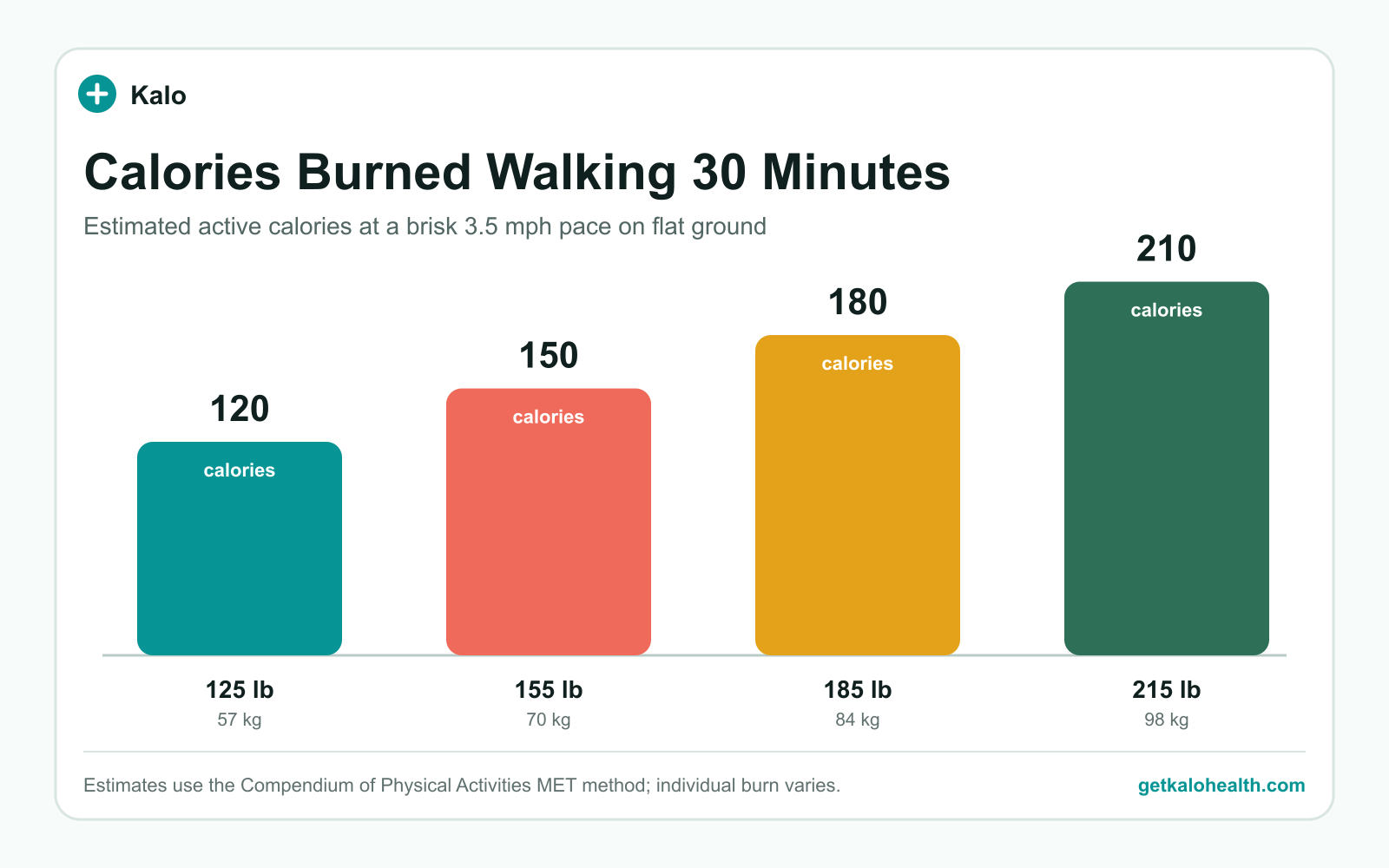
A 155-pound (70 kg) person burns about 50 calories in 10 minutes, 100 calories in 20 minutes, 150 calories in 30 minutes, and 300 calories in 1 hour of brisk walking at 3.5 mph. A 200-pound person burns closer to 190 calories in 30 minutes, while a 125-pound person burns about 120. Your exact calorie burn depends on your weight, speed, terrain, and walking intensity.
For a personalized estimate, use the free walking calorie calculator with your weight, time, distance, pace, steps, and incline. For quick comparisons, see the focused charts for 30 minutes, 1 mile, or 10,000 steps.
Key Takeaways
- Walking burns 3-6 calories per minute depending on your weight, speed, and terrain - about 80-200 calories per 30-minute walk
- Body weight is the biggest factor - a heavier person burns significantly more calories walking the same distance as a lighter person
- A 20-minute brisk walk burns roughly 80-140 calories for most adults; a 60-minute walk burns roughly 240-420 calories
- Walking 10,000 steps burns roughly 300-500 calories for most adults, equivalent to about 4-5 miles
- Distance searches need distance answers - 1 mile is usually 60-160 calories, 2 miles is usually 140-390, and 3 miles is usually 200-585
- Incline and speed matter - walking uphill or at a brisk pace (4+ mph) can increase calorie burn by 30-60%
Quick Walking Calorie Answers
Use this fast guide if you are on your phone and just need the likely range. These estimates assume a normal-to-brisk pace; heavier bodies, faster speeds, hills, and treadmill incline push the number higher.
| Walking question | Typical calories burned | More exact guide |
|---|---|---|
| How many calories does a 30-minute walk burn? | About 80-200 calories | 30-minute chart |
| How many calories does a 45-minute walk burn? | About 120-310 calories | Calculate your walk |
| How many calories does walking a mile burn? | About 60-160 calories | 1-mile chart |
| How many calories does walking 2 miles burn? | About 140-390 calories | 2-mile chart |
| How many calories does walking 3 miles burn? | About 200-585 calories | 3-mile chart |
| How many calories does walking 5 miles burn? | About 300-650 calories | Calculate by distance |
| How many calories does 10,000 steps burn? | About 300-500 calories | 10,000-step chart |
| How many calories does incline walking burn? | Often 1.5-2.5x flat walking | Incline chart |
Want a number based on your own walk? Use the free walking calorie calculator to adjust body weight, time, distance, steps, pace, and incline.
What Is a MET and How Does It Measure Walking Calories?
MET stands for Metabolic Equivalent of Task, and it's the standard unit researchers use to estimate the energy cost of physical activities. One MET equals the energy you burn at rest - roughly 1 calorie per kilogram of body weight per hour. Walking at a moderate pace of 3.0 mph has a MET value of about 3.5, meaning it burns 3.5 times more energy than sitting still.
A common MET-based estimate is calories = MET × body weight (kg) × duration (hours). It is useful for comparing walks consistently, but it still relies on population averages and cannot fully account for fitness, body composition, terrain, wind, or movement efficiency.
How Many Calories Does a 10-, 20-, 30-, 45-, or 60-Minute Walk Burn?
If you just want the quick number, use the chart below. These estimates assume a brisk 3.5 mph walk on flat ground. A slower stroll will be lower, a fast walk or hill will be higher, and a tracker may show a slightly different number because it uses your heart rate and stride data.
| Walk Duration | 125 lb | 155 lb | 185 lb | 215 lb |
|---|---|---|---|---|
| 10 minutes | 40 cal | 50 cal | 60 cal | 70 cal |
| 15 minutes | 60 cal | 75 cal | 90 cal | 105 cal |
| 20 minutes | 80 cal | 100 cal | 120 cal | 140 cal |
| 30 minutes | 120 cal | 150 cal | 180 cal | 210 cal |
| 45 minutes | 180 cal | 225 cal | 270 cal | 310 cal |
| 60 minutes / 1 hour | 240 cal | 300 cal | 360 cal | 415 cal |
The pattern is simple: double the time, double the calories. A 20-minute walk is about two-thirds of a 30-minute walk, and a 1-hour walk is about twice a 30-minute walk. That is why short daily walks can matter when they are consistent, but one walk still needs the food side of the deficit to cooperate.
How Many Calories Does Walking Burn by Weight and Speed?
The table below shows estimated calories burned during a 30-minute walk at different speeds and body weights, based on MET values from the Compendium of Physical Activities:
| Speed | 125 lb (57 kg) | 155 lb (70 kg) | 185 lb (84 kg) | 215 lb (98 kg) |
|---|---|---|---|---|
| 2.0 mph (slow) | 57 cal | 70 cal | 84 cal | 98 cal |
| 3.0 mph (moderate) | 100 cal | 123 cal | 147 cal | 171 cal |
| 3.5 mph (brisk) | 120 cal | 149 cal | 178 cal | 207 cal |
| 4.0 mph (fast) | 143 cal | 176 cal | 210 cal | 244 cal |
| 4.5 mph (very fast) | 171 cal | 211 cal | 252 cal | 293 cal |
As you can see, body weight makes a significant difference. A 215-pound person burns nearly double what a 125-pound person burns at the same speed. This is because moving a heavier body requires more energy, regardless of fitness level.
What Is the Walking Calories Formula?
A common planning formula is calories burned = MET × weight in kilograms × hours walked. A moderate 3.0 mph walk is about 3.5 METs, a brisk 3.5 mph walk is about 4.3 METs, and a fast 4.0 mph walk is about 5.0 METs. To convert pounds to kilograms, divide your weight by 2.2.
Example: 155 lb Person Walking 30 Minutes
- 155 lb / 2.2 = about 70 kg
- 30 minutes = 0.5 hours
- Brisk walking at 3.5 mph = about 4.3 METs
- 4.3 × 70 × 0.5 = about 150 calories
That formula is also why many Harvard Health-style walking calorie tables show similar numbers for 30 minutes: a 155-pound person lands around the low-to-mid 100s at a brisk pace and higher if they walk faster. If your own tracker shows a much bigger number, check whether it is including resting calories, active calories, heart-rate estimates, or an incline.
How Many Calories Does 10,000 Steps Burn?
The popular 10,000-step goal equates to roughly 4 to 5 miles of walking, depending on your stride length. For most adults, this burns between 300 and 500 calories. A 155-pound person walking 10,000 steps at a moderate pace burns approximately 370-400 calories. A 200-pound person doing the same burns closer to 475-500 calories.
It's worth noting that the 10,000-step target isn't a magic number backed by rigorous science - it originated from a 1960s Japanese marketing campaign for a pedometer. However, research from Harvard Medical School published in JAMA Internal Medicine found that even 4,400 steps per day significantly reduced mortality risk compared to 2,700 steps. More steps are better, but you don't need to hit exactly 10,000 to benefit.
Does Walking Uphill Burn More Calories?
Yes - walking on an incline significantly increases calorie burn. A 5% grade (a moderate hill) increases calorie expenditure by roughly 30-40% compared to flat terrain. A steep 10% grade can increase burn by 50-60%. For a 155-pound person, walking at 3.5 mph on flat ground burns about 150 calories in 30 minutes, but that same walk on a moderate incline burns closer to 200-210 calories.
This is why treadmill incline walking has become so popular. Setting the treadmill to a 10-12% incline at 3.0 mph (often called the "12-3-30" workout) can burn as many calories as a slow jog while being much easier on your joints. If you're looking to maximize your calorie deficit without high-impact exercise, understanding your calorie target alongside incline walking is a powerful combination.
Walking vs Running: How Do the Calories Compare?
Running burns roughly twice as many calories per minute as walking. A 155-pound person running at 6 mph burns about 372 calories in 30 minutes, compared to 149 calories walking at 3.5 mph. However, the comparison isn't quite that simple.
When you compare calories burned per mile rather than per minute, the gap narrows. Running usually uses more energy per mile, but the exact difference depends on body weight, pace, terrain, and running economy. Walking takes longer to cover the same distance and may be easier for some people to repeat consistently.
Walking (3.5 mph, 30 min)
- • ~150 calories burned (155 lb person)
- • Low injury risk
- • Sustainable daily
- • No recovery time needed
- Best for: consistency and long-term habits
Running (6 mph, 30 min)
- • ~370 calories burned (155 lb person)
- • Higher injury risk
- • Requires rest days
- • More cardiovascular benefit per minute
- Best for: time-efficient calorie burn
How to Burn More Calories While Walking
If you want to increase your calorie burn without breaking into a run, here are proven strategies ranked by effectiveness:
- Walk uphill or use an incline - Adding even a moderate 5% incline boosts calorie burn by 30-40%. Seek out hilly routes or use the treadmill incline setting.
- Pick up the pace - Increasing from 3.0 to 4.0 mph raises calorie burn by about 40%. A brisk walk where you can talk but not sing is the sweet spot.
- Add a weighted vest or backpack - Carrying extra weight forces your body to work harder. Start with 5-10% of your body weight. Avoid ankle or hand weights, which can alter your gait and cause injury.
- Walk on varied terrain - Sand, grass, gravel, or trails burn more calories than pavement because your muscles work harder to stabilize on uneven surfaces.
- Try interval walking - Alternate between 2 minutes of brisk walking (4.0+ mph) and 1 minute of easy walking. This raises your average heart rate and calorie burn without exhausting you.
- Walk longer, not just faster - Extending a 30-minute walk to 45 or 60 minutes adds 50-100% more calorie burn. Duration is often easier to increase than intensity.
Can You Lose Weight by Walking Alone?
Yes, but it depends on your diet. Walking creates a modest calorie deficit - typically 100-300 calories per session. To lose one pound of fat per week, you need a total deficit of about 3,500 calories, or 500 calories per day. Walking alone can contribute 20-60% of that daily deficit, but you'll likely need to manage your food intake for the rest.
A 30-minute walk might burn about 150 calories for a 155-pound person, while food portions and drinks can change daily intake by a similar amount. Walking can support a calorie deficit, but the scale trend still depends on the full balance between energy intake and expenditure.
Before deciding whether walking is "enough," calculate the bigger target: your total daily burn. A free TDEE calculator estimates how many calories you burn across the whole day, and the calorie deficit calculator turns that into a practical fat-loss target. If your goal is broader than walking calories, the weight loss guide hub connects the next steps.
How Much Should I Walk Per Day to Lose Weight?
For weight loss, most experts recommend 30-60 minutes of brisk walking most days of the week, which translates to roughly 7,000-10,000 steps. The CDC recommends at least 150 minutes of moderate-intensity aerobic activity per week, which breaks down to about 30 minutes of brisk walking five days a week.
However, the "best" amount of walking is the amount you can do consistently. Starting with 15-minute walks and gradually increasing is far more effective than committing to an hour a day and burning out after a week. Consistency trumps intensity - walking 20 minutes every day for a year burns roughly 36,000 more calories than walking 60 minutes a day for two months then stopping. As we discuss in our guide on breaking through weight loss plateaus, sustainable habits beat aggressive short-term pushes every time.
Frequently Asked Questions
How many calories does a 20-minute walk burn?
A 20-minute brisk walk burns about 80 calories for a 125-pound person, 100 calories for a 155-pound person, 120 calories for a 185-pound person, and 140 calories for a 215-pound person. A slower walk may be 20-30 percent lower, while a hill or treadmill incline can push the number higher.
How many calories does a 1-hour walk burn?
A 1-hour brisk walk burns roughly 240-415 calories for most adults, depending mainly on body weight. At 3.5 mph, a 155-pound person burns about 300 calories in an hour. A 215-pound person burns about 415, and a 125-pound person burns about 240.
How many calories does a 1-mile walk burn?
A 1-mile walk burns approximately 80-120 calories for most adults, depending on body weight. A 155-pound person burns about 90 calories per mile at a moderate pace. Heavier individuals burn more, and walking faster or uphill increases the burn slightly per mile.
Is it better to walk faster or walk longer?
For total calorie burn, walking longer is generally more effective because it's easier to sustain. Adding 15 minutes to your walk burns more additional calories than increasing speed by 0.5 mph for the same duration. However, if you're short on time, increasing speed or adding incline gives you more burn per minute.
Does walking after eating help burn more calories?
Walking after eating does not use a special calorie formula; weight, pace, and duration still drive the estimate. A short post-meal walk can be a practical way to add consistent movement, but it should not be treated as a way to erase a meal.
Do fitness trackers accurately measure walking calories?
Fitness trackers can estimate walking calories, but energy-expenditure accuracy varies by device and person. Use the number as a repeatable estimate rather than an exact measurement, and compare it with your longer-term activity and weight trends.
How many steps per day should I walk to lose weight?
Research suggests that 7,000-10,000 steps per day, combined with a modest calorie deficit, supports steady weight loss for most adults. A 2020 study in JAMA found that people who walked at least 8,000 steps daily had a 51% lower risk of all-cause mortality compared to those walking 4,000 steps.
How Kalo Helps You Track Walking and Nutrition Together
Walking calories are one part of the daily energy balance. Food portions, drinks, normal movement, and exercise estimates all contain uncertainty, so use a repeatable food and activity record alongside the longer-term weight trend.
Type what you ate in Kalo, review the estimated foods and portions, and add any missing ingredients such as oils or sauces. After saving a meal, check your remaining daily targets and explore meal ideas for what to eat next.
Use the walking calculator for an activity estimate, and Kalo for a meal record you can review. Download Kalo to log your next meal and explore ideas that fit your remaining targets.
Sources
- Compendium of Physical Activities - MET values for walking
- Calories Burned in 30 Minutes of Activities - Harvard Health
- Association of Step Volume and Intensity With All-Cause Mortality - JAMA Internal Medicine (2019)
- Steps per Day and All-Cause Mortality - JAMA (2020)
- Physical Activity Guidelines for Americans - CDC
- Accuracy of Wearable Devices for Estimating Energy Expenditure - Stanford University (2017)
Related Articles

Do You Count Cooking Oil Calories? How to Log Oil and Spray
Yes. A tablespoon of olive oil has about 119 calories, and a spray labeled 0 calories is not zero. See how to measure an...
Can ChatGPT Count Calories? What the Research Shows
ChatGPT put calories within 10% of a nutritionist reference for under half of 222 foods. See when a chat estimate works...
Why Don't Calories Match the Macros on a Food Label?
Rounding, fiber, and sugar alcohols can make calories differ from a 4-4-9 macro calculation. See two worked examples and...
Know what to eat next.
Kalo sets your daily calorie and macro targets and suggests meals that fit your goals, your diet, and what you have left today.