How Many Calories Does a 30-Minute Walk Burn?
This article is for educational purposes only and is not medical advice. Talk with a qualified healthcare professional before making major nutrition, weight loss, or medication-related changes.
A 30-minute walk burns roughly 100 to 200 calories for most adults at a moderate to brisk pace. A 155-pound (70 kg) person burns about 150 calories walking 30 minutes at a brisk 3.5 mph, while a 125-pound person burns around 120 calories and a 215-pound person burns closer to 210. Your exact number depends mostly on your body weight, then your speed and whether you walk uphill.
Thirty minutes is the walk most people can actually fit into a real day: a lunch loop, a dog walk, a post-dinner stroll. The question is whether that half hour is doing anything for your waistline. The honest answer is that it helps, but it burns less than the average snack, and the gap between what you walk off and what you eat back is where the scale gets stuck.
Key Takeaways
- A 30-minute walk burns about 100 to 200 calories for most adults, depending mostly on body weight
- At a brisk 3.5 mph pace, that is roughly 120 calories at 125 lb, 150 at 155 lb, 180 at 185 lb, and 210 at 215 lb
- A 30-minute walk covers about 1.5 to 2 miles and 3,000 to 4,000 steps at a normal pace
- Walking uphill or on a treadmill incline can add 30 to 60 percent more calories to the same 30 minutes
- Five 30-minute walks a week burn around 750 calories, which is real but smaller than one restaurant meal
- A daily 30-minute walk only drives weight loss inside a calorie deficit, so what you eat matters more than the walk itself
What is the average calorie burn for a 30-minute walk?
The average calorie burn for a 30-minute walk is about 100 to 200 calories, and it is calculated from your body weight, your pace, and the time you spend moving. Exercise scientists estimate it using MET values (Metabolic Equivalent of Task), the standard unit for the energy cost of an activity. One MET is the energy you burn sitting still, and walking at a moderate 3 mph is about 3.5 METs, meaning it burns 3.5 times more energy than rest.
The formula is calories = MET × body weight (kg) × time (hours). For a 155-pound (70 kg) person walking 30 minutes (0.5 hours) at 3.5 METs, that works out to about 122 calories at an easy pace and roughly 150 at a brisk one. This is the same method fitness trackers and online calculators use, so the numbers below line up with what your watch shows, give or take its usual margin of error.
How many calories does a 30-minute walk burn by weight and speed?
Body weight is the single biggest factor, and pace is second. The table below shows estimated calories burned during a 30-minute walk at different speeds and body weights, based on MET values from the Compendium of Physical Activities.
| Pace | 125 lb (57 kg) | 155 lb (70 kg) | 185 lb (84 kg) | 215 lb (98 kg) |
|---|---|---|---|---|
| 2.0 mph (slow stroll) | 57 cal | 70 cal | 84 cal | 98 cal |
| 3.0 mph (moderate) | 100 cal | 123 cal | 147 cal | 171 cal |
| 3.5 mph (brisk) | 120 cal | 149 cal | 178 cal | 207 cal |
| 4.0 mph (fast) | 143 cal | 176 cal | 210 cal | 244 cal |
| 4.5 mph (power walk) | 171 cal | 211 cal | 252 cal | 293 cal |
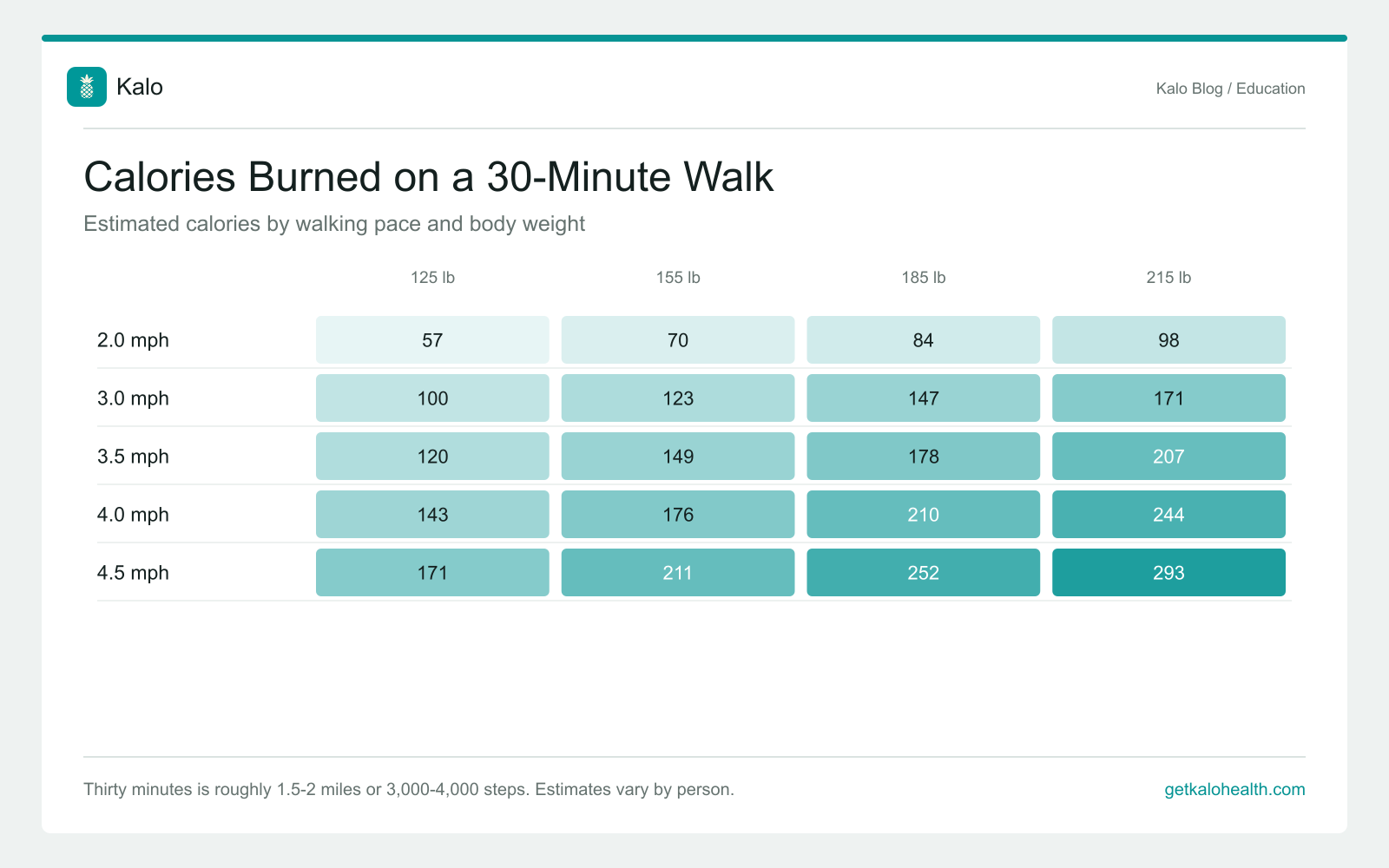
Two patterns stand out. First, a 215-pound person burns nearly double what a 125-pound person burns at the same pace, because moving a heavier body costs more energy. Second, picking up the pace from a moderate 3.0 mph to a fast 4.0 mph raises the burn by about 40 percent for the same 30 minutes. For the full breakdown across every pace and distance, see our complete guide to how many calories walking burns by weight and pace.
Does a 30-minute walk on an incline or treadmill burn more?
Yes. Walking uphill is the single fastest way to raise the burn of a 30-minute walk without speeding up. A moderate 5 percent grade adds roughly 30 to 40 percent, and a steep 10 percent grade can add 50 to 60 percent. For a 155-pound person, a flat brisk walk burns about 150 calories in 30 minutes, but the same time on a moderate hill burns closer to 200 to 210.
This is why the treadmill 12-3-30 workout (12 percent incline, 3 mph, 30 minutes) became so popular. For most people it burns 250 to 350 calories in half an hour, on par with a light jog, while staying low impact on the knees and hips. If you want more burn from the same 30 minutes, incline beats speed for most people because it is easier to sustain.
How far is a 30-minute walk, and how many steps?
A 30-minute walk covers about 1.5 miles at a moderate 3 mph pace and 1.75 miles at a brisk 3.5 mph. In steps, that is roughly 3,000 to 4,000 steps for most adults, since a brisk walker takes around 100 to 130 steps per minute. Taller people with longer strides cover more ground and log slightly fewer steps for the same distance.
That makes a daily 30-minute walk a solid chunk of the popular step goals: about a third of 10,000 steps. If you are building toward a target, our guides on how many steps a day you need to lose weight and the calorie math behind those steps will help you connect the walk to a real plan.
Can you lose weight by walking 30 minutes a day?
Yes, but only if your diet does not cancel out the burn. A daily 30-minute brisk walk burns roughly 150 calories, which adds up to about 1,050 calories a week. On its own, that is around 0.3 pounds of fat per week, since one pound of fat is about 3,500 calories. Paired with a modest calorie deficit from food, most people lose 0.5 to 1 pound per week.
Here is the part most articles skip: a 30-minute walk burns less than a single common snack. That 150-calorie walk is erased by one chocolate-chip cookie, a flavored latte, or a tablespoon and a half of peanut butter. Even five brisk walks a week, around 750 calories, add up to less than the calories in one fast-food cheeseburger. The walk is worth doing, but you cannot out-walk a fork, which is the same trap behind comparing walking vs running for weight loss and assuming more exercise alone fixes the scale.
The takeaway is not to skip the walk. Walking barely spikes hunger and is easy to repeat daily, which makes it one of the most sustainable ways to widen a deficit. The winning formula is a 30-minute walk plus a calorie target you actually hit. The free calorie deficit calculator turns your goal weight into a daily intake number so the walk has something to build on.
How to burn more calories on a 30-minute walk
If you only have 30 minutes, here are the highest-impact ways to get more out of it, ranked by effectiveness:
- Add incline - A 5 percent grade adds 30 to 40 percent more burn. Find a hilly route or raise the treadmill incline. This is the biggest lever.
- Walk briskly enough to feel slightly breathless - Moving from 3.0 to 4.0 mph raises the burn by about 40 percent. Aim for a pace where you can talk but not sing.
- Wear a weighted vest or loaded backpack - Carrying 5 to 10 percent of your body weight increases the work. Avoid ankle or hand weights, which can strain your joints.
- Use intervals - Alternate 2 minutes brisk with 1 minute easy. This lifts your average heart rate and burn without exhausting you in half an hour.
- Choose softer or uneven terrain - Grass, sand, gravel, or trails make stabilizing muscles work harder than flat pavement does.
Frequently Asked Questions
How many calories does a 30-minute walk burn for a woman?
A 140-pound woman burns about 135 calories on a 30-minute brisk walk, while a 120-pound woman burns closer to 115. Because calorie burn scales with body weight, smaller women burn less than the often-quoted 200-calorie figure. Walking faster or uphill raises the number by 30 to 60 percent.
Is a 30-minute walk a day enough exercise?
For general health, yes. Thirty minutes of brisk walking most days meets the CDC guideline of 150 minutes of moderate activity per week, which lowers the risk of heart disease, diabetes, and early death. For weight loss specifically, it helps but works best combined with a calorie deficit from food.
Is it better to walk 30 minutes once or two 15-minute walks?
For calorie burn, they are nearly identical, because total time and pace are what matter. Two 15-minute walks can even be more practical, and a short walk after meals helps blunt blood sugar spikes. Choose whichever format you will actually do every day.
Does walking 30 minutes after dinner burn more fat?
It does not burn meaningfully more calories, but a post-meal walk does lower blood sugar spikes by up to 30 percent, according to research in Diabetes Care. Steadier blood sugar can reduce later cravings, which indirectly supports staying in a deficit.
Why does my watch say my 30-minute walk burned more than 200 calories?
In a Stanford University study of seven wrist-worn devices, none estimated energy burned with less than 20% error. Treat your watch's number as a rough estimate, especially since many apps already include daily activity in your calorie target, so adding it again double-counts. Our guide to active calories vs total calories shows which number to use.
How Kalo Helps You Make Every Walk Count
Knowing your 30-minute walk burned 150 calories is only useful if you also know what you ate. Most people underestimate their daily intake by 30 to 40 percent, which is more than enough to erase a daily walk without noticing. The walk is the easy half; honest food tracking is the half that actually moves the scale.
With Kalo's AI photo tracking, you snap a picture of your plate and get an instant calorie and macro breakdown. Photograph the post-walk smoothie and Kalo identifies the banana, peanut butter, and protein powder separately, so you can see in seconds whether the recovery snack just undid your walk. Pair that with your step count and you finally see both sides of the equation in one place.
Walking every day but the scale won't budge? The gap is almost always on your plate. Download Kalo to snap photos of your meals, see your real calorie balance, and make every 30-minute walk count.
Sources
- Compendium of Physical Activities - MET values for walking (2024)
- Calories Burned in 30 Minutes of Activities - Harvard Health
- Physical Activity Guidelines for Adults - CDC
- Walking: Is It Enough for Weight Loss? - Mayo Clinic
- Shcherbina et al. Accuracy in Wrist-Worn, Sensor-Based Measurements of Heart Rate and Energy Expenditure in a Diverse Cohort - Stanford University (2017)
Related Articles

Is Eating the Same Meals Every Day Good for Weight Loss?
In a 2026 study, people who mostly logged repeat foods lost 5.9% of body weight vs 4.3%. See the limits and how to build...
Active Calories vs Total Calories: Which Should You Use?
Active calories leave out resting energy and total calories include it. See which number to add to a calorie target, wit...
Do You Count Cooking Oil Calories? How to Log Oil and Spray
Yes. A tablespoon of olive oil has about 119 calories, and a spray labeled 0 calories is not zero. See how to measure an...
Know what to eat next.
Kalo sets your daily calorie and macro targets and suggests meals that fit your goals, your diet, and what you have left today.