How Many Calories Does Walking 10,000 Steps Burn?
This article is for educational purposes only and is not medical advice. Talk with a qualified healthcare professional before making major nutrition, weight loss, or medication-related changes.
Walking 10,000 steps burns roughly 330 to 570 calories for most adults, or about 40 calories per 1,000 steps. The exact number depends mostly on your body weight: a 125-pound person burns around 330 calories, a 155-pound person about 410, and a 215-pound person closer to 570. Pace and incline shift the total by 10 to 50 percent on top of that.
If you wear an Apple Watch, a Fitbit, or just carry your phone, you have probably watched the step counter tick toward 10,000 and wondered what that actually means for your waistline. The honest answer is smaller than most people hope, and the gap between "steps burned" and "weight lost" is where almost everyone gets stuck.
Key Takeaways
- 10,000 steps burns about 330 to 570 calories for most adults, depending almost entirely on body weight
- The rule of thumb is ~40 calories per 1,000 steps for a 150-pound adult, or about your weight in pounds × 0.27 per 1,000 steps
- 10,000 steps is about 4 to 5 miles and takes 75 to 100 minutes at a normal pace
- A single latte and muffin (~700 calories) can erase the entire calorie burn of a 10,000-step day
- Fitness tracker calorie estimates can be far off - in a Stanford study of seven wrist-worn devices, none estimated energy burned with less than 20% error
- Steps only drive weight loss inside a calorie deficit — what you eat matters more than what you walk off
What is the steps-to-calories conversion?
The steps-to-calories conversion is an estimate of how much energy you burn per step, scaled to your body weight. Heavier bodies require more energy to move, so calorie burn rises almost linearly with weight. A widely used rule is that an average 150-pound adult burns about 0.04 calories per step — roughly 40 calories per 1,000 steps, or 400 calories per 10,000 steps.
That per-step number isn't fixed. It scales with your weight (the biggest factor), your walking speed, the incline, and even the terrain. Researchers calculate it using MET values (Metabolic Equivalent of Task) from the Compendium of Physical Activities: walking at a moderate 3 mph has a MET of about 3.5, and the formula is calories = MET × body weight (kg) × time (hours). The step charts below are built from that same method, so they line up with what your tracker and most calculators use.
How many calories does 10,000 steps burn by weight?
Body weight is the single biggest variable. The table below shows estimated calorie burn for 10,000 steps (about 4.5 miles at a moderate pace) across common body weights, plus the per-1,000-step rate you can use to estimate any step count.
| Body Weight | Calories (10,000 steps) | Per 1,000 Steps |
|---|---|---|
| 125 lb (57 kg) | 330 cal | 33 cal |
| 155 lb (70 kg) | 410 cal | 41 cal |
| 185 lb (84 kg) | 490 cal | 49 cal |
| 215 lb (98 kg) | 570 cal | 57 cal |
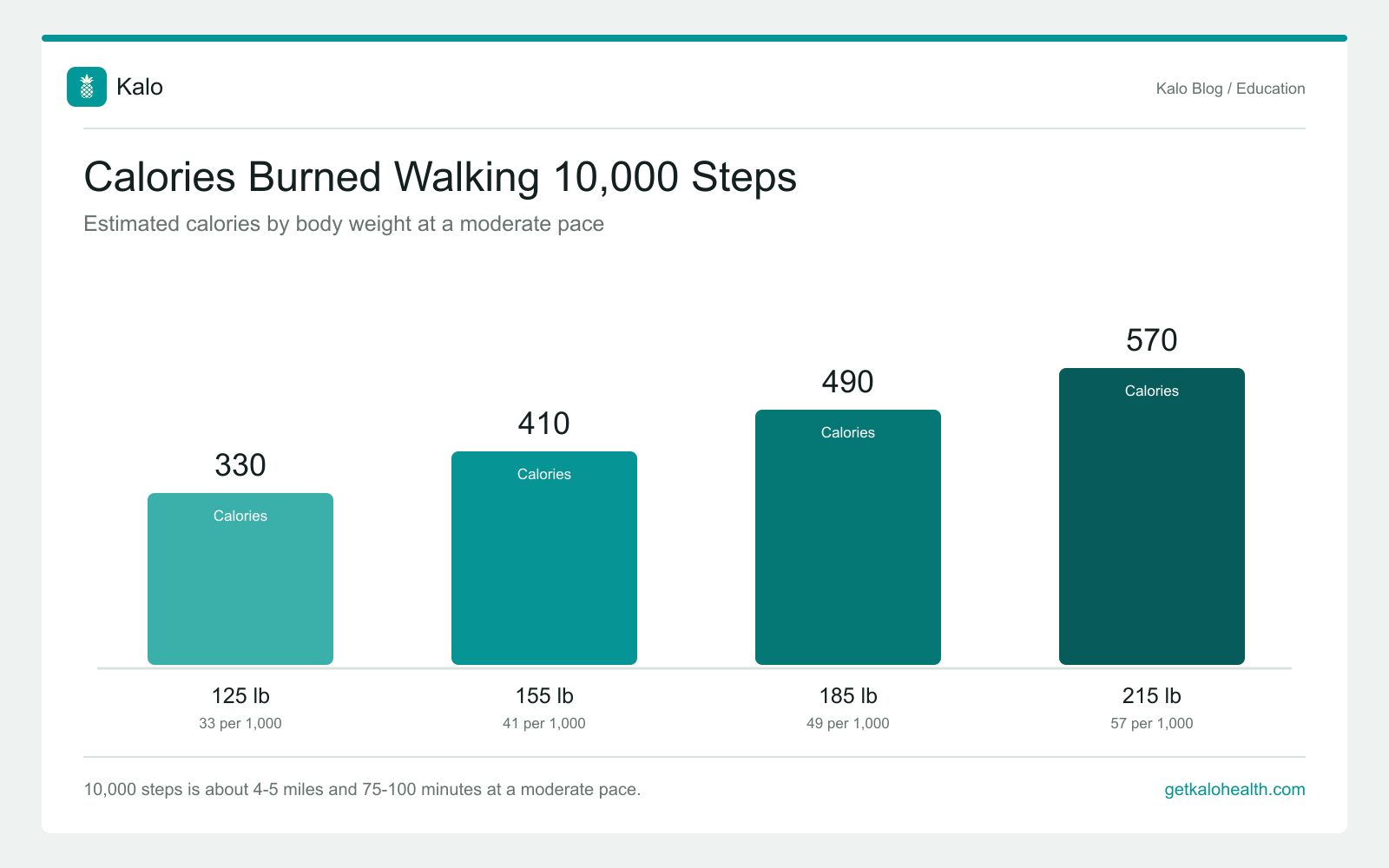
Notice that a 215-pound person burns nearly 70 percent more than a 125-pound person for the exact same 10,000 steps. That is why generic "10,000 steps = 500 calories" claims are misleading: the right number for you depends on what you weigh. For a full breakdown by walking speed, see our guide on how many calories walking burns by weight and pace.
How many calories do 5,000, 15,000, or 20,000 steps burn?
You can estimate any step count from the per-1,000-step rate above. The table below maps the most-searched step totals to calorie burn across body weights, so you can find the number that matches what your tracker actually logged today.
| Steps | 125 lb | 155 lb | 185 lb | 215 lb |
|---|---|---|---|---|
| 2,000 | 65 cal | 80 cal | 100 cal | 115 cal |
| 5,000 | 165 cal | 205 cal | 245 cal | 285 cal |
| 7,500 | 250 cal | 310 cal | 370 cal | 430 cal |
| 10,000 | 330 cal | 410 cal | 490 cal | 570 cal |
| 15,000 | 495 cal | 615 cal | 735 cal | 855 cal |
| 20,000 | 660 cal | 820 cal | 980 cal | 1,140 cal |
These figures assume flat ground at a moderate pace. Walking uphill, on sand, or carrying a weighted pack can add 20 to 50 percent. Want a more personal estimate? The simplest mental shortcut: your weight in pounds, times 0.27, equals roughly the calories per 1,000 steps. A 160-pound person burns about 43 calories per 1,000 steps, so 12,000 steps is around 515 calories.
How long does it take to walk 10,000 steps?
At a moderate pace of 3 mph, 10,000 steps takes about 75 to 100 minutes and covers 4 to 5 miles. At a brisk 4 mph, the same step count takes closer to 60 minutes. One mile is roughly 2,000 to 2,500 steps depending on your height, so taller people with longer strides hit 10,000 steps in fewer minutes.
Most people don't walk 10,000 steps in one block. They accumulate them across the day — the commute, errands, pacing on calls, and a post-dinner stroll. That is good news for calorie burn, because spreading movement throughout the day keeps you out of the "sedentary" bucket more hours than a single workout does.
How many steps does it take to burn 500 calories or 1 pound?
To burn 500 calories from walking, most adults need somewhere between 9,000 and 15,000 steps, depending on body weight. A 215-pound person gets there in about 8,800 steps; a 125-pound person needs closer to 15,000. The average adult lands around 12,000 steps to burn 500 calories.
Burning one pound of fat takes roughly 3,500 calories, which works out to about 85,000 to 90,000 steps for a 150-pound person — the equivalent of hitting 10,000 steps every day for over a week. That math is exactly why walking alone is a slow lever for weight loss, and why pairing steps with a calorie target matters so much.
Is 10,000 steps a day enough to lose weight?
Only if you are also in a calorie deficit. Steps burn calories, but weight loss is governed by the gap between calories in and calories out. Walking 10,000 steps a day adds a meaningful 300 to 570 calories to the "out" side, but it is easy to cancel on the "in" side without noticing.
Here is the uncomfortable math: a large flavored latte (~250 calories) and a bakery blueberry muffin (~450 calories) come to roughly 700 calories — more than the entire burn from 10,000 steps for most people. You cannot out-walk a fork. This is the same trap behind eating back your exercise calories: the burn feels earned, so the snack feels free, and the deficit quietly disappears.
That doesn't make steps useless — far from it. Walking is one of the most sustainable ways to enlarge a deficit because it barely spikes hunger and is easy to repeat daily. The winning formula is steps plus a calorie target, not steps alone. If you want the exact number to aim for, our guide on how many steps a day you need to lose weight breaks it down, and the calorie deficit calculator turns your goal into a daily intake number.
Why is the calorie number on my watch probably too high?
If your Apple Watch or Fitbit says 10,000 steps burned 600 calories, treat that as an optimistic ceiling. A Stanford University study found that wrist-worn trackers overestimate energy expenditure by 15 to 40 percent on average, with error rates varying widely between devices and individuals. They are far better at counting steps than at converting those steps into calories.
There are two reasons this matters. First, many calorie trackers and weight-loss apps already bake your daily activity into your target, so adding your watch's "exercise calories" on top can double-count and stall your deficit. Second, an inflated burn number tempts you to eat back calories you never actually spent. The safer approach is to treat walking as a bonus, anchor your plan to food intake, and let the steps quietly enlarge the deficit.
Frequently Asked Questions
How many calories does 10,000 steps burn for a woman?
A 140-pound woman burns about 370 calories walking 10,000 steps, while a 120-pound woman burns closer to 320. Because calorie burn scales with body weight, smaller women burn less than the often-quoted 500-calorie figure. Use roughly 27 calories per 1,000 steps per 100 pounds of body weight to estimate your own number.
How many steps does it take to burn 1,000 calories?
Most adults need roughly 22,000 to 30,000 steps to burn 1,000 calories from walking, depending on body weight. For an average 155-pound person, that is about 24,000 steps, or close to 12 miles. Walking faster or on an incline lowers the step count needed.
Does walking 10,000 steps a day burn belly fat?
You cannot spot-reduce fat from any one area, but a calorie deficit that includes daily walking does burn visceral (belly) fat, because it is the most metabolically active fat and the body draws on it early. Studies on regular walking in overweight adults show measurable reductions in waist circumference and visceral fat over 12 weeks. The fat loss comes from the deficit, not the location of the movement.
How many miles is 10,000 steps?
10,000 steps is approximately 4 to 5 miles for most adults, based on an average of 2,000 to 2,500 steps per mile. Your exact distance depends on stride length: taller people cover more ground per step, so they walk closer to 5 miles, while shorter people land nearer 4.
Will I lose weight walking 10,000 steps a day without changing my diet?
Sometimes, but slowly and unreliably. If 10,000 steps adds a true 300 to 500 calorie deficit and you don't eat more to compensate, you could lose about half a pound per week. In practice, most people unconsciously eat back the burn, which is why combining steps with calorie tracking produces far more consistent results.
How Kalo Helps You Close the Gap Between Steps and Results
Counting steps is the easy half of weight loss — your phone does it automatically. The hard half is knowing what you ate, and that is exactly where the 10,000-step burn gets erased. The average person underestimates their daily intake by 30 to 40 percent, which is more than enough to wipe out a full day of walking.
With Kalo's AI photo tracking, you snap a picture of your plate and get an instant calorie and macro breakdown. Photograph that latte and muffin and Kalo identifies each item and its calories separately, so you can see in seconds whether your snack just undid your walk. Pair that with your daily step count and you finally see both sides of the equation in one place — which is the only place weight loss actually happens.
Sources
- Compendium of Physical Activities — MET values for walking (2024)
- How Many Calories Do You Burn Walking 10,000 Steps? — Healthline
- Lee et al. "Association of Step Volume and Intensity With All-Cause Mortality in Older Women" — JAMA Internal Medicine (2019)
- Saint-Maurice et al. "Association of Daily Step Count and Step Intensity With Mortality Among US Adults" — JAMA (2020)
- Shcherbina et al. Accuracy in Wrist-Worn, Sensor-Based Measurements of Heart Rate and Energy Expenditure in a Diverse Cohort
Hitting 10,000 steps but not seeing the scale move? The gap is almost always on your plate. Download Kalo to snap photos of your meals, see your real calorie balance, and make every step count.
Related Articles

Active Calories vs Total Calories: Which Should You Use?
Active calories leave out resting energy and total calories include it. See which number to add to a calorie target, wit...
Do You Count Cooking Oil Calories? How to Log Oil and Spray
Yes. A tablespoon of olive oil has about 119 calories, and a spray labeled 0 calories is not zero. See how to measure an...
Can ChatGPT Count Calories? What the Research Shows
ChatGPT put calories within 10% of a nutritionist reference for under half of 222 foods. See when a chat estimate works...
Know what to eat next.
Kalo sets your daily calorie and macro targets and suggests meals that fit your goals, your diet, and what you have left today.